



- AI software integration adds AI to your existing CRM, ERP, or support tools without replacing them
- Most businesses can integrate AI in 8 to 21 weeks; an accurate timeline depends on system complexity and data readiness.
- Integration costs range from $20,000 for a focused startup module to $115,000+ for enterprise multi-system rollouts.
- 60% of AI projects fail due to poor data preparation. Fix your data pipeline before you build anything.
- Starting with one high-ROI use case and validating it before scaling is the single biggest predictor of success.
- Compliance (GDPR, HIPAA, SOC 2, EU AI Act) must be scoped in Phase 1, not added after launch.
Many founders believe that adding AI to their business means replacing the software they already rely on. The reality is different. AI software integration means connecting AI capabilities to your existing systems so your CRM, ERP, or support tools produce AI-enhanced outputs.
But how do you integrate AI into existing software without disrupting operations? The short answer: through AI development services, specifically APIs, middleware, or embedded models that connect to your current stack and layer AI outputs on top of what you already run.
This guide walks you through integration methods, system-specific approaches, and compliance requirements. Whether you run a startup, a mid-sized company, or an enterprise, you’ll finish with a clear picture of what AI software integration actually involves and what it costs.
What Is AI Software Integration?
AI software integration is the process of adding AI capabilities: predictive analytics, natural language processing, and computer vision to your existing business software without rebuilding it. Instead of starting from scratch, you layer AI through APIs, middleware connectors, embedded machine learning models, or plugins.
As a custom software development company, TekRevol builds this integration as a layered architecture. It preserves your infrastructure while adding AI where it creates measurable value.
Want to Know the Best AI Integration for Your Software Stack?
Our experts will review your existing technology stack, workflows, and business goals to identify the highest-ROI AI integration opportunities with a practical implementation plan.
Book a Free Scoping CallWhy AI Software Integration Matters For Business in 2026
The businesses gaining ground with AI right now are not the ones running the most sophisticated models. They are the ones who embedded AI into existing workflows early and built a data foundation to support it. The numbers confirm it, and they are not close.
Key Benefits of Integrating AI into Business Processes
Integrating AI into your stack delivers value across four dimensions:
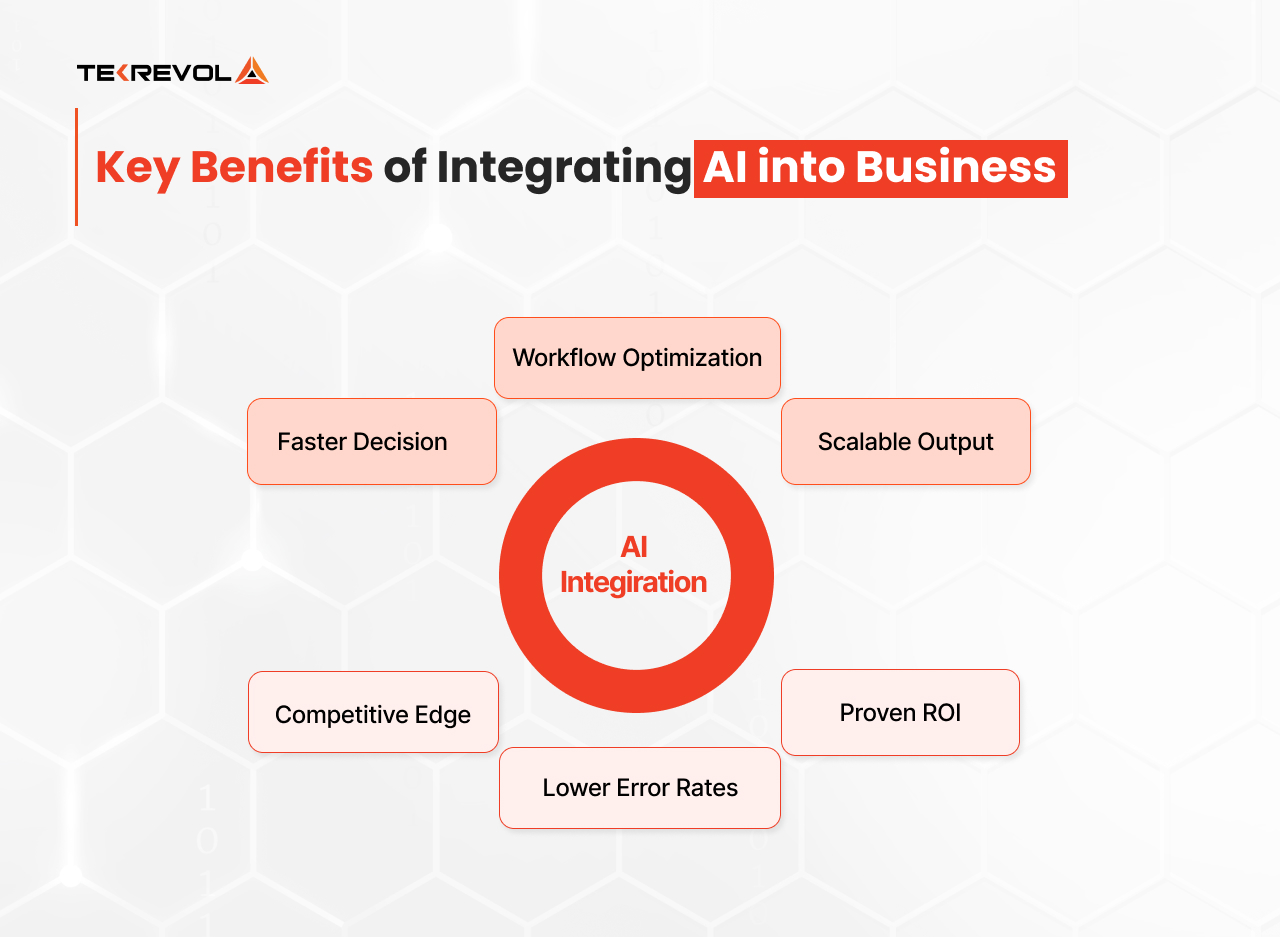
- Workflow efficiency: AI handles repetitive tasks like data entry, ticket classification, invoice matching—so your team focuses on decisions that require judgment.
- Faster decisions: Demand forecasting, lead scoring, and fraud detection all improve when AI runs on clean operational data in real time.
- Scalable output: One model can handle millions of classification decisions per day without adding headcount.
- Competitive position: 78% of companies are already deployed. Each quarter of delay is a measurable ground ced.
As a digital transformation company, TekRevol’s approach to business software modernization preserves your infrastructure while adding AI where it creates the most measurable value.
Is Your Business Ready? The AI Integration Readiness Assessment
Before writing a technical brief or signing a contract, run this five-part Integration Readiness Score (IRS). It tells you whether you can move to integration now or whether a foundation issue needs attention first.
| Technical Area | Score 1–2
(Needs Work) |
Score 3–4
(Deployment-Ready) |
Score 5
(Optimized) |
| Data Quality & Schema | Unstructured docs, duplicate entries | Structured DB with minor manual sorting | Cleaned and validated data arrays ready for the pipeline |
| API Availability | Legacy code, no documented endpoints | Active REST APIs, limited documentation | Secure, well-documented webhooks ready for streaming |
| Team AI Literacy | Manual record entry only | Operators use basic automation tools daily | Engineering leads understand request/response loops |
| Compliance Exposure | Missing privacy logs or access controls | Basic authentication, no external encryption | Full compliance with industry oversight protocols |
| Budget Certainty | Vague funding, no infrastructure cost tracking | Capital allocated for initial development | Defined funding for development & ongoing operations |
Interpreting Your Score
- 5–12: Fix your data infrastructure before integrating. Focus on cleaning database structures and documenting API endpoints.
- 13–20: Ready for a focused pilot. Target one measurable bottleneck to prove value without a high upfront cost.
- 21–25: Cleared for advanced multi-system automation across departments.
How to Integrate AI into Existing Software: The 4-Phase Approach
A standard AI integration follows a four-phase roadmap spanning 12 to 20 weeks. At TekRevol, we use the following sequence to implement AI to keep your operations stable and reduce rework.
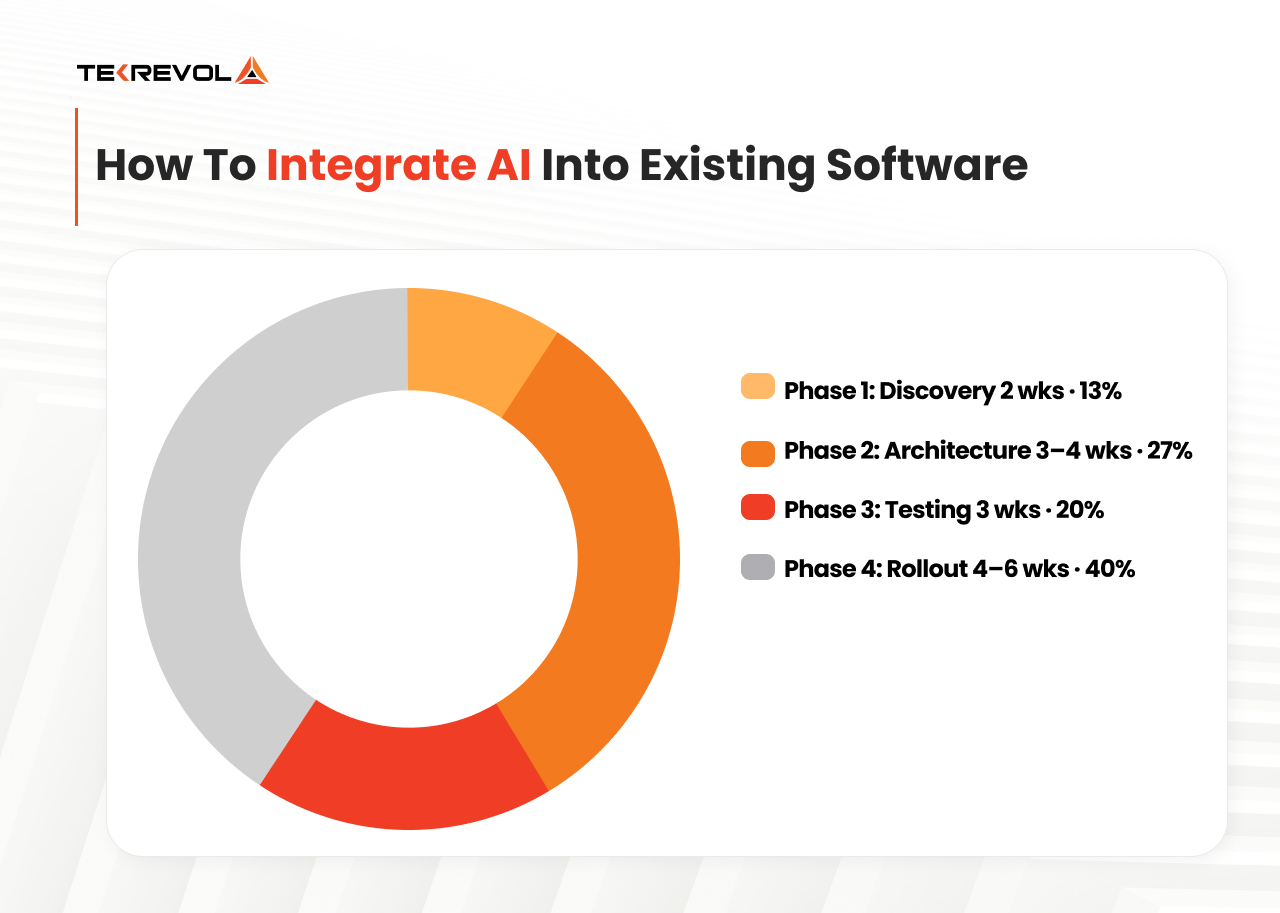
Phase 1: Discovery Sprint
The discovery sprint identifies one business process with the clearest ROI potential and the cleanest available data.
- Output: A technical scope document mapping current data flows, flags integration risks, defines the AI feature to build in Phase 2, and sets the success metrics for evaluation
Phase 2: API and Architecture Design
This phase designs the connection between your existing system and the AI layer. The team selects integration methods, designs data pipelines, and builds an environment that mirrors your production setup.
- Output: Documented API connections, data flow map, and compliance review for regulated data
Phase 3: Testing and Validation
Run the AI feature in parallel with your existing process. This is the AI proof of concept stage. Compare outputs against your baseline, identify edge cases, and refine the model on real operational data.
- Output: a validated model with accuracy benchmarks and a go or hold checklist for rollout.
Phase 4: Phased Rollout
The AI feature goes live in stages, one department or workflow. Staged rollout limits risk and gives you time to adapt before full deployment.
- Output: a live AI integration with monitoring dashboards, fallback protocols, and a documented retraining schedule for the first six months post-launch.
AI Integration Timeline Expectations by Business Scale
| Implementation Phase | Startup (1 to 2 systems) | SMB (3 to 6 systems) | Enterprise (10+ systems) |
| Discovery | 1 Week | 2 Weeks | 2-3 Weeks |
| Architecture | 2-3 Weeks | 3-4 Weeks | 4-6 Weeks |
| Validation | 2-3 Weeks | 3 Weeks | 4 Weeks |
| Rollout | 3-4 Weeks | 4-6 Weeks | 6-8 Weeks |
| Total | 8 to 12 weeks | 12 to 15 weeks | 16 to 21 weeks |
4 Common AI Software Integration Methods
AI software integration uses four primary technical approaches: APIs, middleware, microservices, and custom model deployment.
Each approach connects AI to your existing workflows. The difference is in architecture, cost, and data privacy requirements. Some use cases suit no-code AI tools; others require full custom infrastructure.
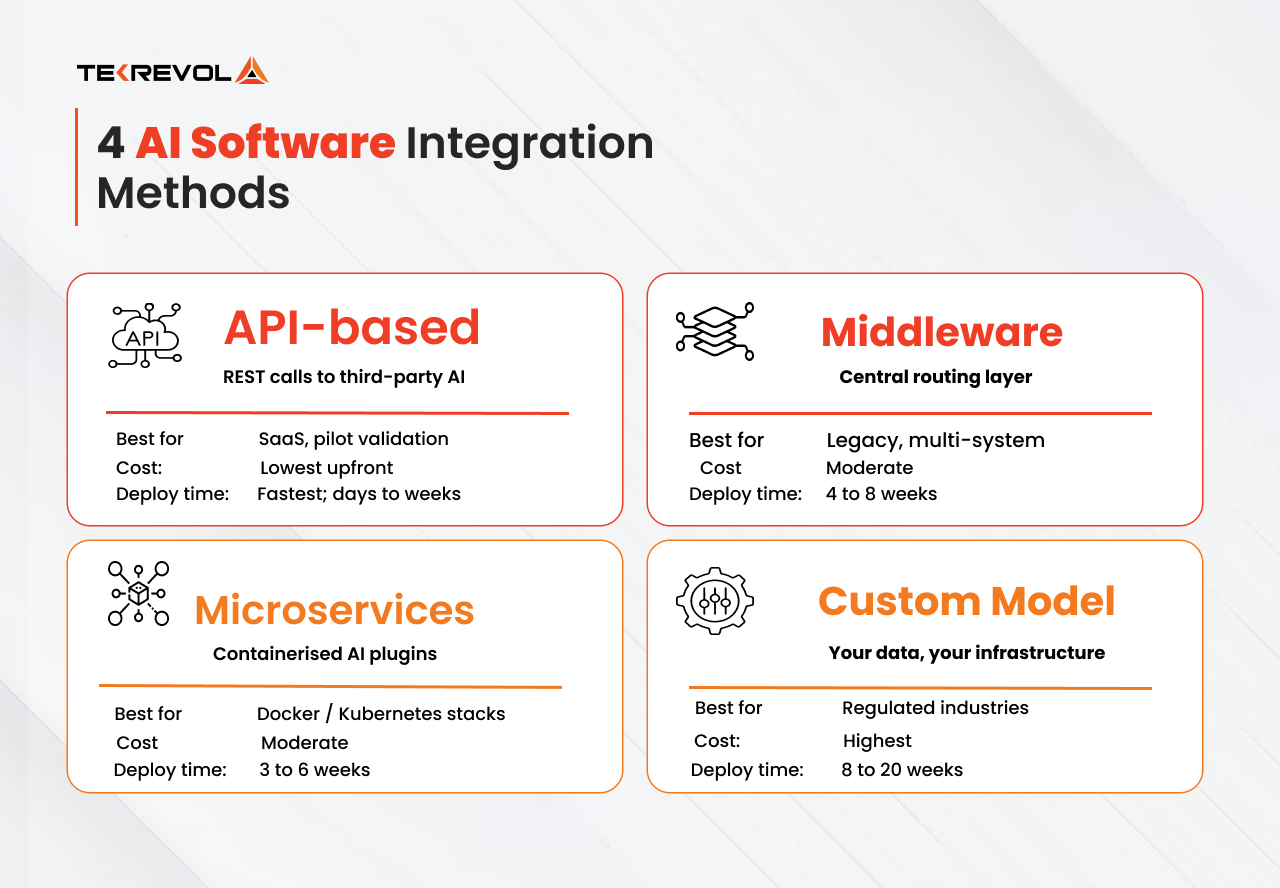
1: API-Based Integration
API-based integration connects your software to a third-party AI service through REST API calls. Services like OpenAI, Google Cloud AI, and AWS AI receive your data, run a prediction or generation task, and return the result to your system.
- Best for SaaS products, AI proof of concept validation, and testing AI value
- Main tradeoff: Vendor dependency and API rate limits at high volume
2: Middleware and ESB Patterns
Middleware integration routes data between your existing legacy systems and AI services through a central integration layer. It allows you to log requests and transform data formats before external model processing
- Best for disconnected legacy stacks, multi-system environments, and centralized governance requirements
- Tradeoff: Longer setup time and ongoing monitoring requirements
3: Microservices Plugins
Packages AI features as independent containerized services and connect them to your existing architecture without touching your core business logic.
- Best for teams already running Kubernetes or Docker, who need AI features to scale independently
- Tradeoff: Requires existing DevOps infrastructure to justify the approach
Method 4: Custom Model Deployment
It trains, fine-tunes, and hosts open-source AI models on your private cloud infrastructure. This gives you absolute control over data privacy and keeps information within your secure network.
- Best for healthcare, finance, high-volume use cases where API costs exceed hosting costs; proprietary training data
- Tradeoff: highest upfront investment and ongoing ML engineering
How Much Does AI Software Integration Cost by Business Types
AI software integration costs between $20,000 to $115,000 for most business operators. The range reflects system complexity and the number of workflows being modified. Here is how those numbers break down by business type.
| Business Type | Typical Range | What Drives the Cost |
| Startup / Small Business | $20,000 to $45,000 | Single AI module, 1 to 2 system connections, minimal compliance requirements |
| SMB | $30,000 to $70,000 | Multi-system integration, data pipeline build, moderate compliance layer |
| Enterprise | $60,000 to $115,000+ | Multi-department rollout, legacy system connectors, full compliance, and security architecture |
The Hidden Cost Stack
The number most vendors quote in a proposal covers the build phase. The full cost of AI software integration includes 4 additional categories that often go unmentioned until billing begins.
| Cost Category | What It Covers | Share of Total Cost |
| Integration Engineering | API connections, middleware setup, data pipeline design | 40–60% |
| Data Preparation | Cleaning, labeling, and structuring existing data before model training | 10–25% |
| QA and Testing | Parallel testing, edge case identification, accuracy benchmarking | 10–15% |
| Compliance Layer | GDPR, HIPAA, SOC 2 review, RBAC, encryption for regulated data | 5–15% (higher for regulated industries) |
| Ongoing Model Retraining | Model updates every 3–6 months as business data changes | $2,000–$10,000 per cycle |
Industries Where AI Software Integration Delivers the Fastest ROI
AI software integration works across most business categories. The following three verticals consistently see the fastest return because each one has a specific, measurable bottleneck that AI removes without requiring changes to the core system.
1. Logistics and Supply Chain
Supply chains struggle with manual data entry and late tracking updates. AI integration analyzes historical order patterns, seasonal trends, supplier lead times, and external signals like market shifts.
The AI layer sits between your ERP and procurement workflows, generating purchase recommendations and reorder triggers. Result: reduced stockouts, lower carrying costs, and fewer emergency orders at premium prices.
2. Digital Health and Patient Record Management
Healthcare networks handle poorly structured clinical notes and insurance validation documents. These manual workflows slow down care delivery and increase administrative overhead expenses.
Natural language processing (NLP) services extract, summarize, and flag critical information. Forrester case studies document a 30–50% reduction in chart review time and an 18–25% improvement in coding accuracy when AI layers into existing EMR systems.
3. B2B SaaS and Small Business Marketing
Software applications lose subscribers when system notifications fail to match actual user behavior trends. Standard bulk messaging scripts increase in churn rates.
Connecting local product analytics databases with specialized text models allows your system to personalize customer outreach automatically. This is one of the fastest ROI categories in AI software integration for small businesses.
Want to see how AI drives a company’s success?
Watch this discussion hosted by Asim Rais Siddiqui to bring together leading experts in AI and enterprise transformation
Integrating AI with Specific Business Systems
System-specific integration is where abstract plans meet real technical decisions. Here is what AI software integration looks like inside the four systems where most businesses concentrate their software budget.
CRM Integration (Salesforce, HubSpot)
Connecting predictive tools to customer databases automates lead qualification and tracks sales sequences based on contact behavior and deal stage.
- Cost: $15,000 to $40,000 for a focused AI CRM integration module
- Timeline: 6 to 10 weeks
ERP Integration (SAP, Oracle, NetSuite)
AI improves demand forecasting, inventory optimization, and anomaly detection. Most ERP systems require middleware connectors like MuleSoft to bridge the AI layer with the data schema.
- Cost: $40,000 to $1M+, depending on module count and system age.
- Timeline: Standalone modules deploy in 12 to 16 weeks; full enterprise ERP integrations run 9 to 14 months
Marketing Stack Integration (HubSpot, Marketo, Klaviyo)
Connecting automated content tools to your marketing stack allows for content generation, audience segmentation, and real-time performance optimization via API connections.
- Cost: $15,000 to $35,000 for a focused AI marketing module
- Timeline: 6 to 12 weeks
Customer Support Integration (Zendesk, Freshdesk, Intercom)
Linking text processing models to help desk tools automates ticket classification and powers smart chat tools.
- Cost: $10,000 to $30,000 for an entry-level. A full AI support layer with custom training data runs $40,000 to $80,000
- Timeline: 6 to 10 weeks for standard helpdesk integrations
If your integration touches customer-facing digital surfaces, our guide to integrating AI in web development applies directly to your frontend architecture decisions.
Compliance and Governance in AI Software Integration
Enterprise AI integration introduces specific compliance requirements depending on your industry and data environment.
| Framework | Who It Applies To | Key AI Integration Requirement |
| GDPR | Any business handling EU resident data | AI models may process only data necessary for the stated purpose. Automated decisions require a human review |
| HIPAA | US healthcare and health-adjacent businesses | AI systems processing PHI must run in HIPAA-compliant environments with signed BAAs for all AI vendors. |
| SOC 2 Type II | SaaS companies and data processors | AI pipelines must pass an annual audit for security, availability, and confidentiality controls |
| EU AI Act (2026) | High-risk categories: credit, hiring, healthcare | Conformity assessments, human oversight, and full documentation are required before deployment. |
Five Governance Controls Every AI Integration Requires
- Role-Based Access Control (RBAC): Define which users and systems can read, write, and trigger your AI layer. Access rules should be documented before the integration goes live.
- Data Residency Rules: Know where your data travels when it reaches a third-party AI API. Many enterprise contracts require data to stay within specific geographic regions.
- Audit Logging: Every AI decision that affects a customer record, patient file, or financial transaction should generate a traceable log entry.
- Vendor Risk Assessment: Before signing with an AI vendor, review their SOC 2 report, data processing agreement, and breach notification policy.
- Model Transparency Documentation: Document what data the model was trained on, what it is designed to predict, and what its known limitations are.
7 AI Integration Mistakes That Derail Projects
These seven patterns account for the majority of AI integration projects that fail to produce ROI. Each one is preventable with AI software integration best practices.
1. Starting with the wrong use case
Start with the process that has a clear, existing baseline metric. If you cannot measure the current state, you cannot measure the improvement.
2. Treating data readiness as an afterthought
Gartner’s 2025 AI research attributes 60% of initiative failures to inadequate data preparation. Build data prep into Phase 1, with a dedicated timeline and budget line.
3. Underestimating the hidden cost
Integration engineering, data preparation, QA, compliance, and ongoing retraining can add 40 to 80% to a vendor’s initial quote. Budget for the full stack from the start.
4. Choosing a vendor that requires a full system replacement
AI software integration runs on top of existing systems. A vendor whose first recommendation involves replacing your CRM or ERP is presenting a preference, not a technical requirement.
5. Skipping compliance in regulated industries
Adding compliance controls after deployment costs more and creates legal exposure. Compliance belongs in Phase 2 of the architecture design.
6. Defining success after deployment
A success metric should exist before the model is built. ‘Ticket routing accuracy above 85% within 90 days’ is a success metric. ‘Better AI performance’ is not.
7. Scaling before validating the pilot
Run one AI module in one workflow. Measure it against the baseline, then expand. Businesses that skip the pilot phase encounter scaling problems.
For a full breakdown of what separates successful deployments from failed ones, see our analysis of AI adoption challenges and how to navigate them.
How to Choose an AI Integration Partner
Selecting an integration partner requires vetting their engineering experience rather than believing marketing promises. Ask every vendor these five questions before discussing a proposal:
- Can you show a comparable project? Ask for specifics: which system, which integration method, and what the measurable outcome was.
- What is explicitly in scope and out of scope? Get it in writing before signing. Scope gaps are where cost overruns originate.
- How do you handle data preparation? A vendor who skips this in the first conversation plans to bill for it separately.
- What happens if the model underperforms post-launch? Confirm who covers retraining costs and on what schedule.
- Is compliance included or a separate service? In regulated industries, it must be part of the integration scope.
Ranked as the #1 AI development company in 2024, TekRevol optimizes your workflows via phased delivery, written scope documentation, and integrations that run alongside your existing systems. We prioritize open connections that grow alongside your software infrastructure.
Conclusion
The gap between AI-active businesses and those still evaluating is real and measurable. Successful AI software integration allows you to modernize your workflows without throwing away your current investments.
To integrate AI in business strategy: identify the highest-ROI use case, validate it as an AI proof of concept, and scale AI value once the baseline confirms the return. This phased approach is the reason clients choose TekRevol for AI automation.
Automation and AI compound together. Each validated workflow creates the data foundation for the next integration. The readiness assessment and vendor questions in this guide give you everything to start that process today.
Your Next AI Integration Is Already Overdue
We assess your current systems, map the ideal AI integration path, evaluate implementation readiness, and deliver a phased roadmap with realistic timelines and cost estimates.
Get Your AI Integration Strategy →


