



- AI in healthcare automates diagnosis, documentation, drug discovery, patient monitoring, and administrative workflows simultaneously.
- Hospitals using AI report $3.20 ROI per dollar invested, with returns realized in under 14 months.
- Administrative AI saves up to $360 billion annually in US healthcare, with no FDA clearance required.
- Patients in rural clinics now access specialist-level diagnostics in minutes — AI closed a gap decades of policy couldn’t.
- Basic healthcare AI tools start at $50K — enterprise-grade clinical platforms can exceed $5 million depending on scope.
Healthcare operations generate more data than almost any other sector on earth. Yet, the vast majority of it remains siloed, locked away in legacy systems, fragmented EHRs, and manual workflows that drain institutional productivity.
That’s the gap AI is closing. And it’s closing fast.
When we talk about AI, we aren’t talking about replacing clinical judgment. We are talking about intelligent co-pilots that accelerate diagnostic workflows, flag deteriorating patients hours before escalation, and automate the administrative burdens driving physician burnout.
The market reflects this urgency: the healthcare AI market is projected to reach $45.2 billion in 2026. A global Microsoft–IDC study found that organizations see an average return of $3.20 for every $1 invested.
Capturing that ROI requires more than off-the-shelf software; it demands secure, compliant architecture. In a heavily regulated sector, a health system’s primary barrier isn’t algorithm capability; it is choosing a healthcare app development company that understands how to engineer rigid data governance, HIPAA compliance, and AI firewalls from day one.
We’ve built across enough healthcare AI projects to know what real outcomes look like, and we’ll show you exactly that.
But first, understand the fundamentals.
What Is AI in Healthcare?
AI in healthcare refers to the use of machine learning, natural language processing, computer vision, and intelligent agents to automate or support clinical and administrative tasks across health systems.
It is not one technology. It is an entire category of innovation, spanning disease diagnosis, patient engagement, predictive analytics, administrative automation, drug discovery, and remote monitoring.
It is also not the same as health IT or digital health, and enterprise buyers who conflate these three categories end up scoping the wrong project.
- Health IT is the infrastructure that stores and transfers health data, EHR systems, billing tools, and databases. It enables operations but does not learn or adapt.
- Digital healthcare solutions are the tools patients and clinicians use, telehealth platforms, apps, and wearables- that track and connect but rarely analyze.
- AI in healthcare is the intelligence layer built on top of both, learning from data to find patterns, make predictions, and improve outcomes over time.
The category you are building in determines your regulatory exposure, your compliance requirements, your integration complexity, and your realistic timeline to value. Getting this wrong at the scoping stage is expensive.
AI vs. Algorithms: Why the Distinction Matters for Enterprise Buyers
Most procurement conversations use these two terms interchangeably. They are not the same, and the difference has real consequences for liability, auditability, and long-term value.
- An algorithm follows fixed rules written by a human. It does not learn. It cannot adapt. It only acts on what someone already knew when they wrote it. Algorithmic decisions are fully auditable because the logic is explicit.
- AI learns from data. It analyzes thousands of patient records, detects patterns humans may miss, and improves over time. It is not just faster automation; it is a system that discovers insights beyond predefined rules.
The tradeoff is transparency. AI decisions are often not fully auditable in the way algorithmic decisions are. That gap creates real questions around accountability, compliance, and clinical trust. For enterprise buyers, this is not a technical footnote. It is a procurement and governance question that needs an answer before you sign a contract.
Navigating this architectural divide requires more than a software vendor; it requires an experienced AI development company that knows how to balance AI capability with enterprise-grade risk mitigation and data governance.
Consult With Our Enterprise Healthcare AI Experts
We help you choose the right AI models as per your compliance, architecture, and workflow requirements.
Book A FREE Consultation Now!The 5 Main Types of AI Used in Healthcare
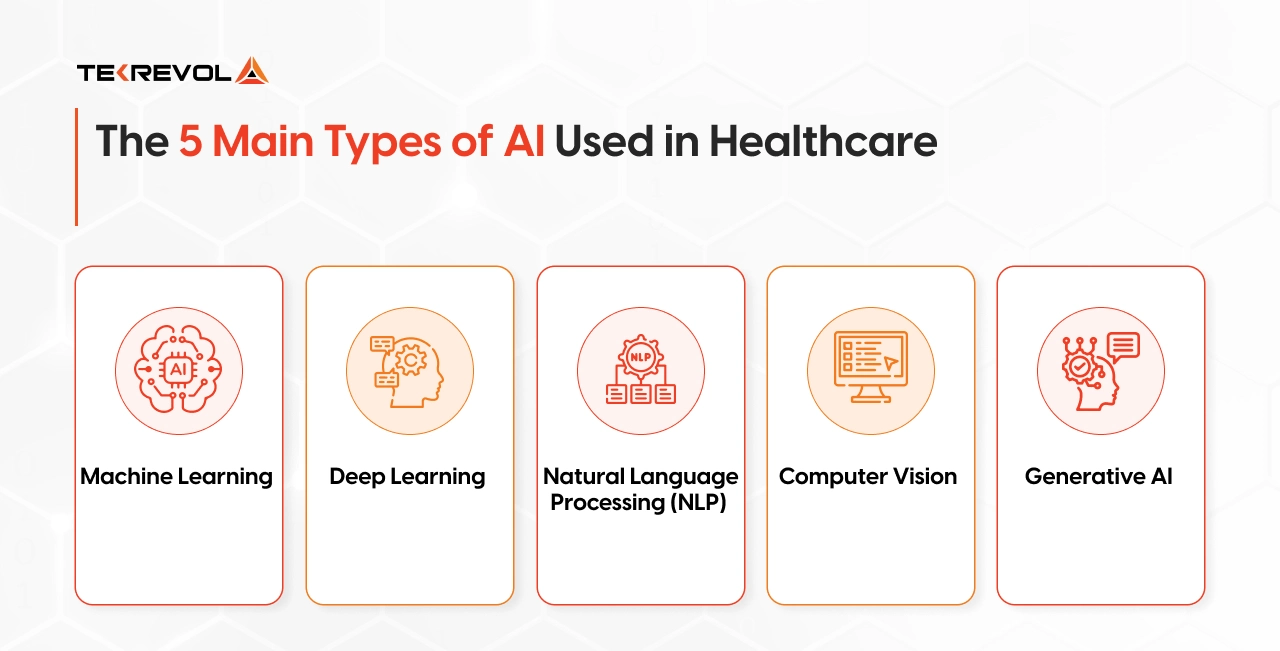
The five main types of AI used in healthcare are machine learning, deep learning, natural language processing (NLP), computer vision, and generative AI. Each serves a distinct function, from predicting patient risk to reading medical images to automating clinical documentation.
Machine Learning
The most widely deployed AI type in health systems today. By leveraging machine learning development services in healthcare, organizations can easily find patterns in historical data and use them to predict outcomes effectively.
It is the most mature in terms of regulatory precedent and the most straightforward to integrate into existing EHR workflows. If your organization is beginning its AI deployment, this is the right starting point.
Deep Learning
A subset of machine learning built for complex data like medical images and audio. It’s behind diagnostic tools that detect cancer and retinopathy from scans, and ambient documentation tools that convert patient-physician conversations into structured notes automatically.
Natural Language Processing (NLP)
Enables systems to read, interpret, and generate human language. In healthcare, it extracts diagnoses from unstructured clinical notes, automates prior authorization submissions, and handles patient-facing communication.
Prior authorization automation using natural language processing requires no FDA clearance and produces measurable ROI within 12 months. However, it carries meaningful interpretive risk—clinical language is dense, context-dependent, and ambiguous, requiring specialized NLP services to ensure the system is architected to prevent consequential errors.
Computer Vision
This technology processes complex visual data, including diagnostic scans, clinical images, and video feeds. It is primarily utilized in diagnostic imaging to flag anomalies such as melanoma, pneumonia, and diabetic retinopathy.
Generative AI
This technology produces new content rather than just analyzing existing data. In healthcare settings, it drafts discharge notes, synthesizes research, and automates care plan documentation. However, deploying Generative AI solutions requires the most rigorous validation of any AI type because these models can occasionally produce incorrect outputs with high confidence, necessitating strict human-in-the-loop verification.
Why AI in Healthcare Matters Right Now
The global health system is under pressure; it cannot solve with people alone.
The world faces a shortage of up to 11 million health workers by 2030. U.S. physicians already spend nearly two hours on documentation for every one hour of patient care. Chronic disease burden is rising faster than the capacity to treat it.
Healthcare is data-heavy and insight-light. An enormous amount of patient information exists: EHRs, genomics, imaging, wearables, and most of it goes underutilized. AI converts that raw data into actionable insights. Faster decisions, earlier interventions, fewer errors.
- AI in healthcare is projected to grow to $45.2B by 2026, up from $4.9B in 2020, at a 44.9% CAGR.
- In U.S. healthcare, generative AI could generate $60–110B in annual value (McKinsey).
- AI could reduce U.S. healthcare costs by up to $150B annually by shifting care toward proactive models.
This isn’t a future bet. The ROI is documented, and the physicians seeing it firsthand are the clearest proof. TekRevol’s CMO Abeer Raza spoke directly with Dr. Harvey Castro, a practicing physician and healthcare executive, about what AI adoption actually looks like on the ground. It’s worth 30 minutes of your time
How AI in Healthcare Actually Evolved — And Why It Took 50 Years
AI in healthcare didn’t start with ChatGPT. It started in a Stanford lab in the 1970s, and the reason it took 50 years to go mainstream tells you everything about what it actually takes to make AI work in healthcare.
Early Healthcare AI Systems Never Made It to Practice
In 1972, Stanford’s MYCIN system showed that AI could match infectious disease experts in diagnosing bacterial blood infections, achieving strong performance in controlled evaluations. Yet despite its accuracy, it was never used in clinical practice.
The problem wasn’t the technology; it was the environment around it. There were no electronic health records, no legal framework for AI-assisted diagnosis, and no clinical culture ready to trust machine recommendations.
In the 1980s, similar rule-based expert systems followed the same path. They performed well in testing but failed in real-world settings because medicine is too complex and contextual to be fully captured in fixed rules.
The lesson remains relevant today: the biggest barriers to healthcare AI are not algorithmic, but regulatory, organizational, and human.
The 1990s and 2000s: the quiet foundation
Clinical decision support tools arrived, basic, rule-based, but actually deployable in real hospital settings. Then EHR adoption spread across US health systems and created something more important than any single tool: the data infrastructure that machine learning needs to train on.
Nobody called it an AI revolution at the time. In retrospect, it made everything that followed possible.
2012: the moment most people missed
A deep neural network called AlexNet entered the ImageNet visual recognition challenge and didn’t just win, it halved the error rate of every competing system.
Healthcare researchers noticed immediately. AI trained on medical images started matching, then exceeding, human specialists on specific diagnostic tasks. Google’s DeepMind detected over 50 eye diseases from retinal scans with accuracy comparable to world-leading ophthalmologists. The FDA began building regulatory architecture for AI-enabled medical devices. An era had quietly begun.
COVID-19: 18 months that did what a decade couldn’t
Telehealth scaled overnight. Remote monitoring went from pilot to standard practice. AI for vaccine development and disease tracking became mission-critical, not because organizations were ready, but because they had no choice.
They deployed out of necessity. And discovered it worked.
Large language models changed the equation again. Suddenly, AI could hold a conversation, summarize a patient history, and explain a diagnosis in plain language, at scale, at any hour. By mid-2025, the FDA had cleared over 1,250 AI-enabled medical devices.
The results are no longer theoretical. The Permanente Medical Group used AI scribes to save 15,791 physician hours in one year across 2.5 million patient visits, and nearly half of patients noticed their doctors spent less time looking at screens during consultations.
The proof-of-concept era is over. What’s left is deploying AI correctly, safely, and accountably in the full complexity of real clinical environments.
TekRevol has engineered healthcare AI through every phase of this shift — from HIPAA-compliant patient platforms to production-grade clinical AI systems. The lesson across every deployment: the technology is rarely what fails. The EHR integration that wasn’t scoped, the compliance layer bolted on at the end, that’s where projects stall. We build against that pattern from day one.
How Is AI Used in Healthcare? 6 Key Applications
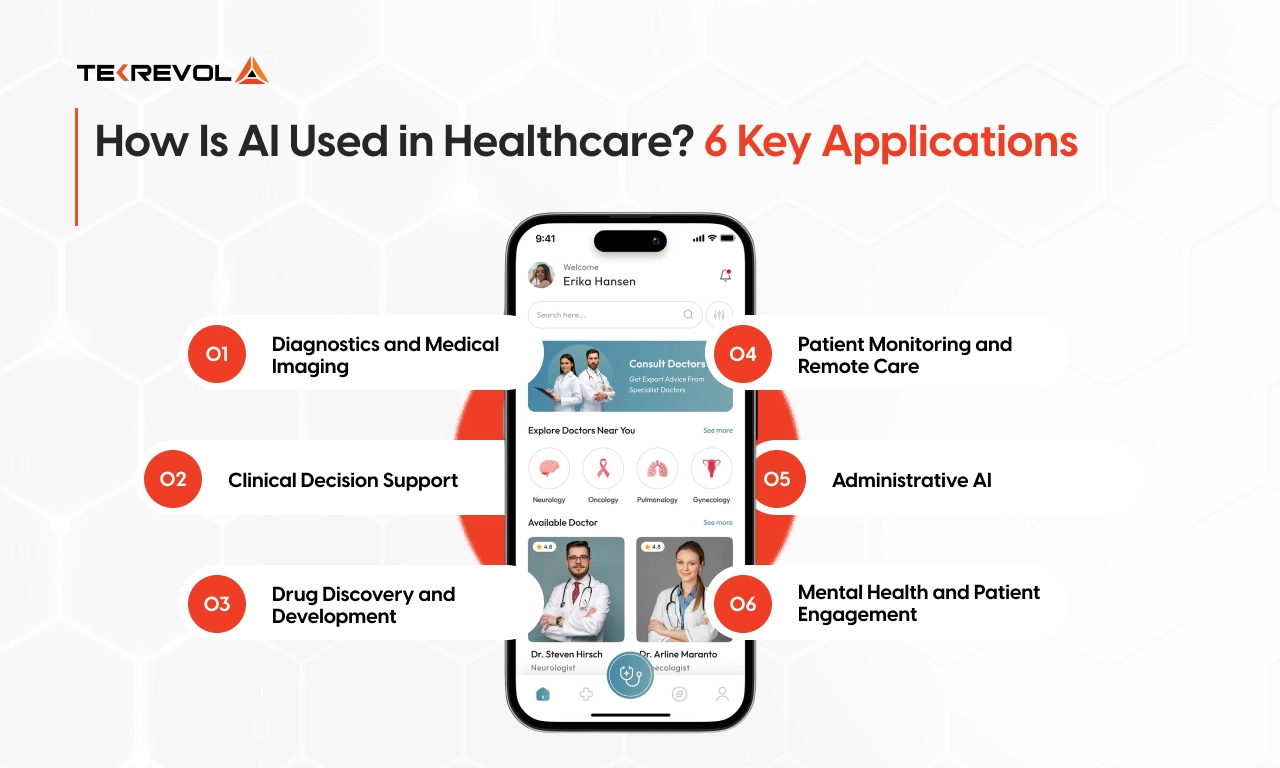
AI is used across six core areas in healthcare today. Each uses a different form of AI to reduce errors, save time, and improve patient outcomes.
1. Diagnostics and Medical Imaging
A radiologist reviewing 200 scans in a single shift is statistically more likely to miss something by the end. That’s not a criticism. That’s biology. And it’s exactly the gap AI was built to close.
Imaging AI is live across radiology, pathology, and dermatology, analyzing 200–400 CT images in under 20 seconds, detecting over 50 eye diseases from retinal scans with specialist-level accuracy, and flagging malignancies in mammograms that human reviewers miss under volume pressure.
Radiologists using AI don’t get replaced. They get better. In medicine, that difference is measured in lives.
2. Clinical Decision Support
Physicians make hundreds of decisions every day, often under time pressure and with limited information. Clinical AI does not replace their judgment; it helps by bringing the right information to the right decision at the right time.
In real-world healthcare settings, AI can identify sepsis risks earlier, flag potentially dangerous drug interactions before medications are prescribed, and detect signs of patient deterioration by continuously analyzing vital signs.
The systems that work don’t replace physicians; they help them make better decisions with better information.
3. Drug Discovery and Development
Developing a new drug usually takes 10–15 years and costs over $2.6 billion, with much of the delay coming from process, not science. AI helps speed this up by reducing trial and error in research and improving how drugs are tested.
For example, AlphaFold solved the long-standing protein folding problem, helping scientists understand how proteins behave and speeding up drug target discovery. AI is also improving clinical trials by selecting better patient groups and detecting risks earlier.
4. Patient Monitoring and Remote Care
For patients with chronic conditions, what happens between hospital visits often matters more than the visits themselves. Remote monitoring AI helps close that gap.
Wearables continuously track vital signs and alert care teams before symptoms become serious. In hospitals, AI models can detect patient deterioration hours earlier than clinical observation. This helps reduce unnecessary hospital visits while ensuring critical cases are not missed.
5. Administrative AI
Ask any physician where their day actually goes. The answer is never “treating patients.”
US physicians spend nearly two hours on documentation for every one hour of patient care. Prior authorization alone costs 16 hours per physician per week. Administrative AI fixes this, and it is where the fastest ROI in healthcare lives. Unlike clinical AI, most administrative use cases require no FDA clearance. Deployment starts in weeks, not years.
For enterprise buyers, this is the right place to start. The compliance requirements are lower, the integration timelines are shorter, and the ROI math is defensible from day one.
When we built the Nurse Practitioners app, the goal was exactly this: transforming in-home nursing care into an on-demand experience where patients find licensed practitioners nearby, book instantly, and communicate securely through one platform. The administrative layer that used to take phone calls and manual scheduling now happens in seconds.
6. Mental Health and Patient Engagement
Mental healthcare often struggles with the gap between when help is needed and when care is actually available. AI doesn’t replace clinicians, but it helps reduce that gap.
AI tools can support patients between therapy sessions by tracking mood changes and identifying early warning signs. Virtual assistants manage check-ins and reminders, allowing clinicians to focus on more complex cases. AI-powered support also makes it easier for people to take the first step toward care when they might otherwise avoid seeking help.
When we built Complete Focus, a mental performance platform combining meditation, breathwork, and brain training into one daily practice, recognized with a MarCom Gold Award in 2025 — the design challenge was exactly this: build something that meets users wherever they are in their wellness journey, not just when they’re already in a clinician’s office. The platform was recognized because the outcomes were real. Not because the interface was polished.
Planning a mental health app? See our complete guide to mental health app development, costs, and monetization.
Seen enough to know where AI fits in your operations?
Our team maps your highest-ROI workflow, EHR integrations, and compliance requirements before a single tool is selected.
Book Your Free Technical Audit →Benefits of AI in Healthcare
AI in healthcare reduces diagnostic errors, cuts administrative burden, personalizes treatment, and is saving health systems tens to hundreds of millions of dollars annually, with returns now documented across real deployments, not just projections.
Faster, More Accurate Diagnosis
One of the key benefits of AI in healthcare is that speed and accuracy in diagnosis are not just operational improvements. They can make the difference between detecting cancer at stage one versus stage three.
AI can detect certain diseases with up to 94% accuracy, often outperforming radiologists.
In cardiac monitoring alone, DeepRhythmAI reduced the false-negative rate to 0.3% across 14,606 patients, compared to 4.4% with standard analysis. That gap is not a statistic. It is patients who get the right diagnosis instead of the wrong one.
The model flags. The clinician decides. But they decide with better information than before.
Reducing Clinician Burnout
Physician burnout in the U.S. has reached crisis levels. The leading driver isn’t patient volume. It’s paperwork.
Two studies published in JAMA Network Open (October 2025), using data from UChicago Medicine, Emory Healthcare, and Mass General Brigham, found that ambient AI scribes reduced documentation time, lowered clinician burnout, and reduced cognitive load for doctors.
A present, rested clinician makes fewer errors than a burned-out one. That’s not a wellness argument. It’s a patient safety argument.
Personalized Treatment and Precision Medicine
Every patient is different. AI makes it possible to actually treat them that way, analyzing genetic profiles, biomarkers, and treatment histories to recommend the right intervention for a specific individual, not the statistically average one.
Standard protocols treat all patients with the same condition in the same way, which often doesn’t work for rare cancers or complex chronic diseases. In oncology, precision AI is helping create more personalized treatment approaches.
Cost Savings That Compound
The ROI on healthcare AI is no longer theoretical. In 2025, health systems reported saving between $20 million and $100 million annually from generative AI, ambient listening, and predictive models combined.
20%: Reduction in readmission rates at hospitals using AI-based risk scoring, saving an estimated $800,000 per facility annually (American Hospital Association, 2023)
Improving Access in Underserved Settings
This is the benefit nobody leads with, and arguably the most important one.
A remote clinic without a specialist can upload an image and get a diagnostic interpretation in minutes. A patient with no nearby mental health provider can access support at 2 a.m. Google’s diabetic retinopathy model, deployed across India and Southeast Asia, proved what’s possible: specialist-level care at population scale in places specialists were never coming.
When AI works the way it should, it doesn’t just make the best health systems more efficient. It makes the best care available to everyone, not just the people who can afford to be near it.
What Does It Cost to Implement AI in Healthcare?
Healthcare AI implementation costs range from $50,000 for a focused administrative tool to over $5 million for enterprise-wide clinical deployment, with most mid-sized health systems spending $250,000 to $1.5 million in year one. The model is rarely the expensive part. Integration, compliance, and data readiness are.
Implementation Cost by Use Case
| Use case | Cost Range | Time to ROI |
| Administrative AI (prior auth, scheduling) | $50K – $150K | 3–6 months |
| Ambient documentation / AI scribe | $100K – $300K | 6–12 months |
| Clinical decision support | $200K – $500K | 12–18 months |
| Diagnostic imaging AI | $300K – $800K | 12–24 months |
| Patient monitoring / remote care | $150K – $400K | 6–12 months |
| Enterprise-wide AI platform | $1M – $5M+ | 18–36 months |
What the Budget Conversation Needs to Include
Most healthcare AI budgets underestimate total cost of ownership by 40–60%. The hidden costs that derail deployments after launch:
- EHR integration — $10K–$50K depending on system complexity
- HIPAA and compliance architecture — 15–25% added to build cost
- Cloud infrastructure — $2,500–$9,000 per month
- Annual model maintenance — 15–20% of initial build cost
- Clinical change management — the most underbudgeted line item every time
Not sure where to start or what it will cost?
Use our Healthcare AI Cost Calculator to get a scoped estimate based on your use case and requirements.
Calculate Your Cost Now→Ethical Considerations in Healthcare AI
In healthcare AI, issues such as consent, transparency, accountability, and human dignity are not theoretical; they directly affect clinical practice. They are design decisions that engineers, product teams, and healthcare leaders need to make before they write a line of code.
Informed consent
Do patients know when AI is part of their care? In many current deployments, the answer is: not clearly. That’s a problem. Patients have a right to know when a machine is involved in their diagnosis or treatment recommendations.
Transparency and explainability
A black-box AI that gives a recommendation is only useful if clinicians can understand it. “The model said so” is not enough for clinical decisions. Explainable AI, which shows how it reaches a result, is a clinical necessity, not just a technical feature.
Accountability
When an AI recommendation contributes to a harmful outcome, who is responsible? The developer? The hospital? The physician who relied on it? These accountability frameworks are still being written. Organizations deploying AI need clear internal policies before regulators write them for everyone.
Hard limits
There are certain decisions AI should never make alone, including end-of-life care, mental health crisis response, and complex emergency diagnoses. These situations require human judgment, presence, and accountability.
At TekRevol, these are not abstract principles. They guide every architectural decision we make, even when it means reducing complexity to ensure safety, trust, and real-world reliability.
Challenges and Risks of AI in Healthcare
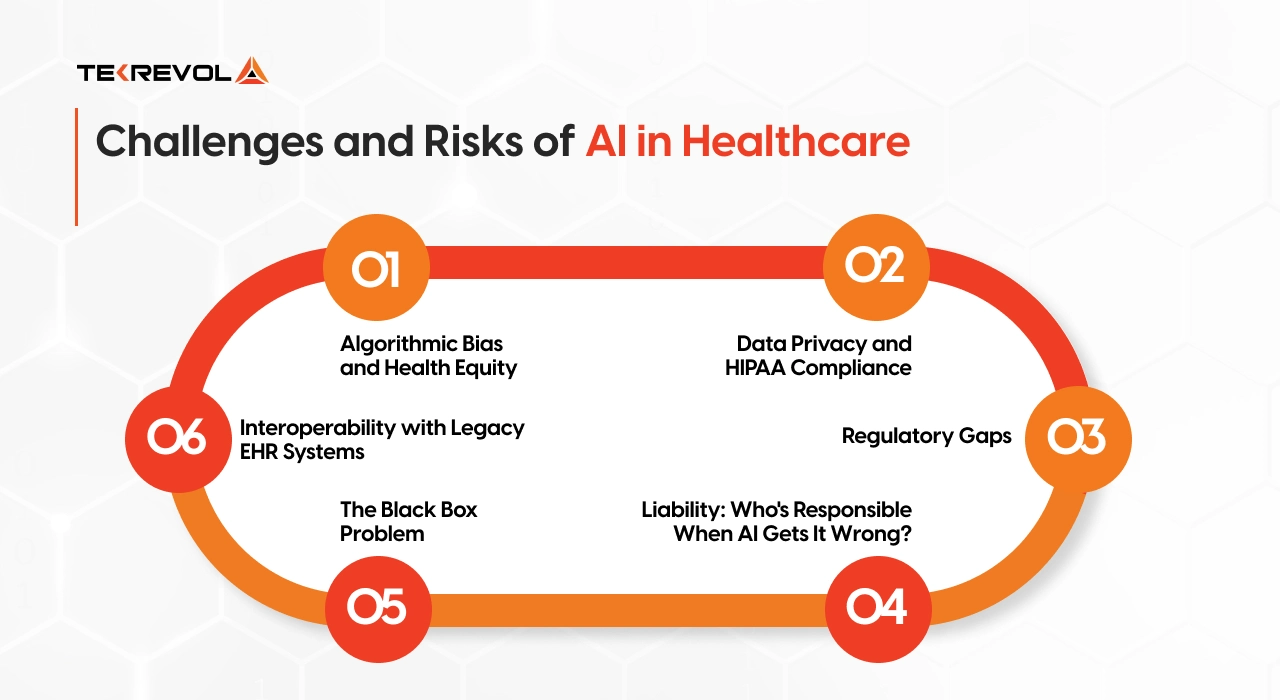
AI in healthcare carries real risks alongside real promise. Ignoring them doesn’t make them go away; it just means they surface later, at a higher cost. Here’s what the industry is still working through, and how the best teams are addressing it.
Algorithmic Bias and Health Equity
AI is trained on historical healthcare data, which often reflects inequality. Because of this, models built mainly on white patient data can perform worse for patients of color. In consumer apps, this is a flaw. In clinical AI, it is a health equity concern.
The fix isn’t simple, but it’s clear: diverse training data, rigorous subgroup testing across patient populations, and continuous post-deployment monitoring. Bias audits need to be a standing process, not a one-time pre-launch check.
Data Privacy and HIPAA Compliance
Healthcare data breaches cost an average of $7.42 million per incident, the highest of any industry. Around 40% of hospitals report “shadow AI,” where staff use unauthorized tools with patient data.
The solution is architectural, not procedural. Privacy has to be designed into the system before the first line of code, not reviewed by legal after the product is built. Every healthcare platform we’ve shipped at TekRevol starts with a compliance architecture review before anything else.
Regulatory Gaps
The FDA has cleared over 1,250 AI-enabled medical devices. Clearance only covers approved use cases, but in practice, many systems are used beyond those boundaries, creating legal gray areas.
The frameworks are maturing, but they’re still catching up to the technology. The organizations navigating this well aren’t waiting for regulators to catch up; they’re scoping compliance requirements before they start building, not after.
Liability: Who’s Responsible When AI Gets It Wrong?
When an AI system contributes to a diagnostic error, who is responsible? The physician? The hospital? The developer? U.S. law hasn’t resolved this, and that ambiguity is slowing enterprise adoption more than any technical limitation.
The practical answer today is auditability. Organizations that can clearly show how a recommendation was made, what data was used, what logic was applied, and what output was produced are in a much stronger position when something goes wrong. That’s why traceability is being built into healthcare AI systems by design, not added later.
The Black Box Problem
Many deep learning systems can’t explain how they concluded. They’re accurate, but “the model said so” is not a clinical justification. In healthcare, explainability isn’t optional. It’s how clinicians decide whether to trust a recommendation and how regulators decide whether to approve one.
In healthcare, explainable AI is no longer a preference, it is a requirement. Enterprise teams are prioritizing transparency from the beginning.
Interoperability with Legacy EHR Systems
Many U.S. hospitals run on legacy EHR systems that don’t easily connect with modern AI. For healthcare app development companies, reliable real-time data access remains a key barrier, leading to failed deployments.
MiloCare+ is a direct example of what solving this looks like in practice: an AI-powered health records platform TekRevol built to give patients and providers seamless, secure access to consultations, prescriptions, and medical records in one place. The lesson: interoperability has to be scoped in the planning phase, not discovered in deployment.
Generative AI in Healthcare: The Biggest Leap, and the Biggest Risk
Every AI application covered so far follows a predictable pattern: input data, trained model, structured output. Generative AI breaks that pattern entirely.
Large language models don’t just analyze — they create. A 40-page patient record summarized in seconds. A clinical note written from a spoken conversation. A patient question answered in plain English at 2am. That capability didn’t exist in healthcare three years ago. Now it’s in production across major health systems.
$60–110B — Annual value generative AI could unlock in US healthcare alone. (McKinsey)
Where it’s already deployed: Ambient documentation tools like Nuance DAX show a 15–30% reduction in documentation time per encounter. Clinical summarization delivers structured patient histories before the physician enters the room. Patient Q&A handles routine health questions 24/7 without adding staff.
The risk enterprise buyers can’t ignore: Generative AI hallucinates. LLMs produce confident, fluent text that is sometimes factually wrong. In a consumer app, that’s a bad experience. In a clinical setting, it’s a patient safety event. Most vendors address this in product copy. It needs to be addressed in the codebase.
AI in Medicine vs. AI in Healthcare: What’s the Difference?
These two terms get used as if they mean the same thing. They don’t, and the distinction shapes every technical, regulatory, and compliance decision you’ll make.
Think of it this way. Healthcare AI is the whole building. Medical AI is one critical floor inside it.
| AI in healthcare | AI in medicine | |
| What it covers | Everything — clinical, admin, operations, population health | Clinical only — diagnosis, treatment, direct patient care |
| Who uses it | Clinicians, administrators, insurers, payers | Clinicians and researchers |
| Examples | Scheduling bots, billing automation, ambient documentation, EHR optimization | Radiology AI, surgical assistance, drug discovery, clinical decision support |
| Regulated as | Varies — some functions need no clearance | Typically regulated as an FDA medical device |
| Time to ROI | Fast — admin layer delivers immediate returns | Longer — requires clinical validation and regulatory approval |
| Risk level | Lower in operational functions | Higher — directly impacts patient outcomes |
A scheduling bot and a diagnostic AI are both ‘healthcare AI’ on a vendor’s website. They are not the same procurement decision, the same compliance requirement, or the same timeline to value. Knowing what you’re building determines everything that follows.
AI in Healthcare Is Already Working: Here’s the Proof
Real-world AI deployments in healthcare are reducing diagnostic errors, cutting sepsis mortality, and saving thousands of physician hours annually. These aren’t projections; they’re documented outcomes from live deployments across major health systems in the US and globally.
Google DeepMind x NHS: AI Predicts Kidney Failure 48 Hours Early
DeepMind partnered with the Royal Free Hospital in London to build Streams, a real-time alert system for acute kidney injury. Missed AKI cases dropped from 12.4% to 3.3%, clinicians saved up to two hours a day, and DeepMind’s Nature-published research showed AI could predict AKI risk 48 hours before clinical detection.
But the deployment came with a significant caveat. The agreement gave DeepMind access to 1.6 million patient records without explicit patient consent — triggering a regulatory investigation and becoming one of healthcare AI’s most cited privacy cautionary tales.
The clinical outcomes were real. So was the privacy failure. The industry’s standards today are higher precisely because of cases like this.
Mayo Clinic: AI That Learns Across Institutions
Since 2019, Mayo Clinic has built a platform providing scalable, multi-institutional, de-identified data and analytical tools across its entire care network. It now powers AI research predicting drug efficacy, Alzheimer’s progression, and cardiovascular risk at a scale no single institution could achieve alone.
Rology: Expanding Radiology Across Africa and the Middle East
Radiologists are scarce across much of Africa and the Middle East. Rology’s AI-powered radiology tools give hospitals diagnostic capability without requiring an on-site specialist. The platform has partnered with 300+ hospitals across 13 countries and has contributed to saving over 1.2 million lives, according to figures reported consistently across its December 2025 funding coverage.
The biggest impact of healthcare AI may not be in the most advanced systems, but in the ones that need it the most.
The Future of AI in Healthcare: 2026 and Beyond
The next frontier of healthcare AI isn’t smarter models; it’s systems that act, coordinate, and govern themselves across entire care pathways. Here’s what’s already being built.
Agentic AI — moving from assistant to actor
Current AI assists. Agentic AI acts. It receives an objective, follows up on all patients discharged in the last 48 hours with a readmission risk score above 0.7, and completes every step: scheduling calls, updating records, routing complex cases to care coordinators, and logging outcomes. This is where the efficiency gains stop being incremental and start being transformational.
Multi-agent systems and cloud-native health infrastructure
A single AI agent is powerful. A network of agents working in coordination across specialties, departments, and systems is a different order of capability. Oracle Health is already deploying AI agents across the revenue cycle, nursing workflows, and clinical operations simultaneously. This is multi-agent coordination happening in production healthcare environments today.
AI governance as a competitive advantage
This is the counterintuitive insight organizations are starting to understand: governance isn’t a constraint on AI capability. It’s a competitive advantage.
Health systems with formal AI governance, clear policies, audit trails, accountability frameworks, and bias monitoring are winning enterprise contracts, passing regulatory review faster, and building patient trust that translates into retention. Organizations running shadow AI face the opposite: liability exposure, inconsistent outcomes, and no ability to audit what went wrong when something does.
How TekRevol Builds AI for Healthcare
Most healthcare AI projects don’t fail because the model was wrong. They fail because the infrastructure around it wasn’t ready, the EHR integration wasn’t scoped, and the compliance layer was bolted on at the end. We’ve seen this pattern enough times to build against it deliberately.
Every engagement starts with a technical audit before a single line of code. We map EHR integrations, data pipelines, and compliance requirements first, then implement in phases, starting with one workflow with defined ROI targets before scaling. That’s what separates a healthcare AI product that compounds in value from one that stalls six months after launch.
As a mobile app development company with deep healthcare AI expertise, TekRevol has delivered 60+ healthcare products with a 100% HIPAA compliance record. Across every engagement, one pattern holds: the teams that reach ROI fastest are the ones that scope compliance and EHR integration before they define a single feature.
Ready to See ROI From Healthcare AI in Under 12 Months?
Our team identifies your highest-value workflow, scopes the integration, and builds in phases aligned to your budget cycle.
Book Your Free Technical Audit →


