



Dramatic changes in healthcare delivery over the last decade mainly come from digital tools, which have made remote medical services so accessible that patients don’t even have to travel and wait weeks for an appointment when healthcare services become available online. Telehealth solutions have turned out to be a convenient mode of patient care and, at the same time, reduce the operational costs of healthcare providers.
Among many virtual care models available in the market, the debate of synchronous vs asynchronous telehealth has become a hot topic. Both models are capable of providing remote healthcare, but they work in very different ways. Knowing these differences can assist healthcare app development companies in selecting the right model and designing effective digital health solutions.
This article outlines the working of synchronous and asynchronous telehealth, the most suitable areas for each model, and that way of combining both to achieve optimum patient care efficiency.
How Telehealth Works & Its Importance in Today’s Healthcare
Telehealth is now a key part of the entire healthcare system. Hospitals, healthcare centers, and even startups are putting money into virtual care options for better access and less patient waiting time. However, before diving into the differences between synchronous and asynchronous telehealth, one should first grasp the role of telehealth in the entire healthcare ecosystem, first.
Telehealth platforms provide different channels, such as smartphone apps, encrypted patient portals, and live video communication,s through which healthcare practitioners and patients can interact. These internet-based solutions handle a variety of telemedicine app development services, including consultation, home care monitoring, and medication administration.
Some of the most recent and relevant statistics from the healthcare sector further detail the velocity of telehealth growth:
- The telehealth market worldwide is anticipated to surpass $455 billion by 2030, and this number indicates the fast uptake of virtual care technologies.
- Over 1.4 billion digital health users globally are projected to be using the services on a daily basis by the year 2026, as per the Statista forecast.
- Globally, more than two-thirds of healthcare provider offices now feature the possibility of virtual consultation, and it has been fully integrated into their routine care, according to the report of healthcare consulting companies.
Defining Telehealth
Telehealth is a term used to denote health services that are provided through the use of telecommunication technologies. Hence, these services are what patients want most in medical applications.
Telehealth software solutions usually encompass:
- Video consultations
- Messaging systems
- Digital prescriptions
- Remote monitoring tools
- Health education platforms
These healthcare solutions create a connected healthcare environment where patients and providers can communicate efficiently.
Types of Telehealth Services
Telehealth services can be delivered in multiple ways depending on the clinical need and communication model.
Common telehealth examples include:
- Virtual doctor visits
- Remote therapy sessions
- Digital prescription services
- Patient portal communication
- Chronic disease monitoring
These offerings are usually divided into synchronous and asynchronous models.
Transform Your Healthcare Services with Smarter Technology
TekRevol creates advanced telehealth platforms designed to enhance patient engagement, streamline operations, and deliver secure, seamless digital care experiences.
Book Your Free ConsultationWhat is Synchronous Telehealth?
One needs to be familiar with the concept of synchronous telehealth to make a difference between synchronous and asynchronous telehealth usage because it is the virtual healthcare form most people are accustomed to. This type of healthcare is based on live communication between medical professionals and patients.
By using digital means, the parties are in direct communication. Therefore, the experience of synchronous telehealth is very similar to that of a conventional office visit. The patients contact the doctors and make an appointment for a video or audio call.
How Does Synchronous Telehealth Work
Synchronous telemedicine does not allow for any delay in the exchange of words between the two participants. By and large, it is the patient who needs a doctor visit, and thus the flow of the session resembles the traditional one very much.
A typical synchronous visit includes:
- Patient schedules an appointment
- Provider reviews patient history
- Live video or phone consultation
- Diagnosis discussion
- Treatment planning
This approach makes synchronous telemedicine ideal for situations where immediate interaction is required in an on-demand healthcare application.
Technologies Used in Synchronous Telemedicine
Modern synchronous telehealth platforms rely on secure communication technologies to ensure privacy and reliability.
Common technologies include:
- Secure video conferencing tools
- VoIP calling systems
- Live chat platforms
- Telehealth mobile apps
- Electronic health record integrations
Reliable video and audio quality are essential for effective patient evaluations.
Synchronous Telehealth Examples
Several healthcare scenarios demonstrate how synchronous telehealth works in practice. These synchronous telehealth examples highlight situations where real-time communication is essential.
Examples include:
- Live video consultation with a physician
- Virtual urgent care visits
- Online mental health therapy sessions
- Real-time specialist consultations
- Physical therapy video sessions
Such interactions in the present allow healthcare providers to evaluate symptoms promptly and correctly.
Advantages of Synchronous Telehealth
If you compare synchronous and asynchronous telehealth, you’ll find that synchronous care has several benefits that make it necessary for a lot of medical conditions. Talking to each other in real-time not only helps the doctor get a more accurate diagnosis but at the same time, the patient relationship gets strengthened.
For difficult and complicated cases, healthcare professionals mainly use synchronous services because direct interaction is necessary.
Instant Medical Diagnosis
Healthcare providers during the session can raise questions to patients and visually observe the physical condition of the patient. That is why the diagnosis is more accurate, and there is less uncertainty.
Increased Patient Trust
Real-time conversations are more humanized than communication through multiple messages. Some patients are more willing to bring up issues related to their health in an interactive session. Developers make sure that while creating a telemedicine app that higher level of engagement typically results in better cooperation with treatment.
Quicker Finalization of Treatment Plans
In one consultation, the physician or the clinician can both come to a diagnosis and provide the patient with a treatment plan.
Therefore, the waiting time is reduced, and the health of the patient is improved. Getting a prescription or even a referral to another specialist can be done right away, too.
Limitations of Synchronous Telehealth
Although synchronous telehealth is highly effective, it also presents challenges. Understanding these limitations helps organizations evaluate synchronous vs asynchronous telehealth more realistically.
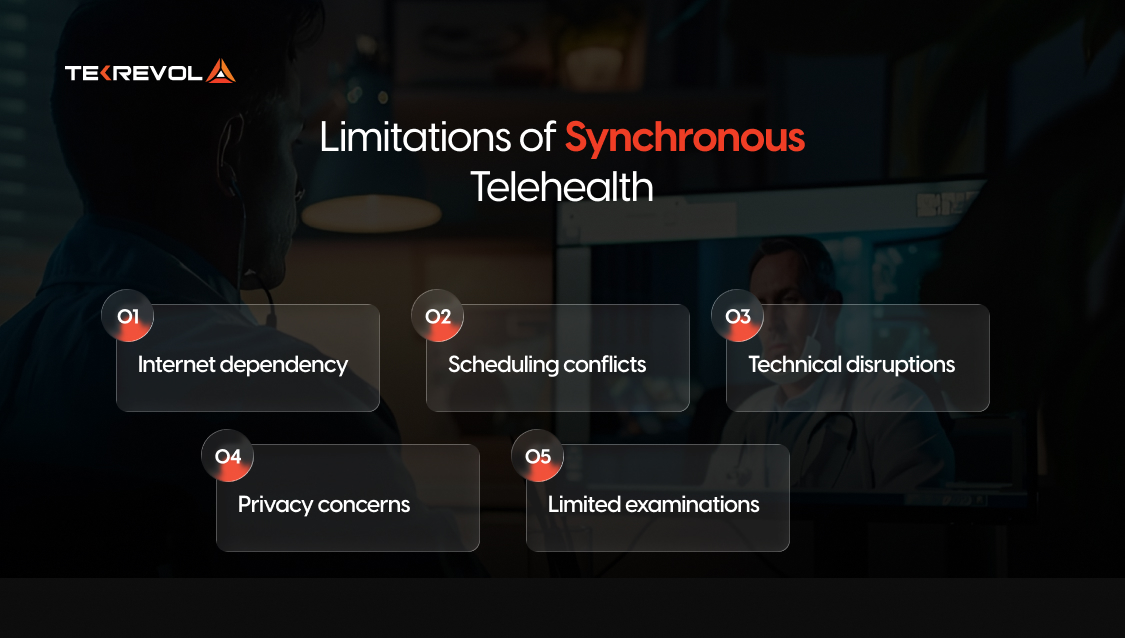
Healthcare software developers must consider operational and technical constraints before implementing synchronous systems.
Scheduling Requirements
Synchronous appointments require both patient and provider to be available at the same time. This can create scheduling difficulties for busy clinics.
Missed appointments can reduce efficiency.
Higher Operational Costs
Real-time consultations require dedicated staff and infrastructure. Providers must allocate time for each session.
This limits the number of patients that can be treated daily.
Technical Challenges
Video consultations depend heavily on internet connectivity and device compatibility. Poor connections can disrupt medical sessions.
Technical issues may reduce patient satisfaction.
What is Asynchronous Telehealth?
For a better grasp of synchronous vs asynchronous telehealth, one should first understand asynchronous telehealth and how it is different from live doctor-patient interactions. It is a way of communication where there is a time lapse between the messages of patients and healthcare providers.
A lot of people are wondering what asynchronous telehealth is, as it is not the same as a conventional doctor visit. Later, healthcare providers will review the patient information that has been submitted instead of coming into contact at the same time.
How Asynchronous Telehealth Works
Asynchronous communication follows a store-and-forward process where medical information is shared digitally and reviewed later.
Typical workflow includes:
- Patient submits symptoms or reports
- Medical data is uploaded
- Provider reviews information later
- Provider sends recommendations
This flexible model allows providers to manage multiple patients efficiently.
Technologies Used in Asynchronous Telehealth
Asynchronous systems rely on secure data storage and messaging tools rather than live communication.
Common technologies include:
- Patient portals
- Secure messaging apps
- Cloud storage systems
- Mobile health apps
- Remote monitoring devices
These tools allow providers to access patient data anytime.
Asynchronous Telehealth Examples
Many healthcare services work effectively without real-time interaction. These asynchronous telehealth examples demonstrate the flexibility of this model.
Examples include:
- Uploading skin condition photos
- Messaging doctors through portals
- Completing intake forms online
- Sending lab results digitally
- Remote patient monitoring reports
These services improve convenience and efficiency.
Benefits of Asynchronous Telehealth
When comparing synchronous vs asynchronous telehealth, asynchronous care offers significant efficiency advantages. Providers can review cases at convenient times without scheduling live appointments.
This model improves scalability for growing healthcare businesses.
Flexible Communication
Patients can submit health information at any time. Providers respond when available. This flexibility benefits both parties.
Increased Provider Productivity
Doctors can review multiple cases quickly without conducting full consultations. This increases patient capacity.
Better Documentation
Digital records are automatically stored and organized. Providers can easily track patient history. Better documentation improves care quality.
Limitations of Asynchronous Telehealth
One of the drawbacks of asynchronous telehealth is that it cannot be universally applied across all clinical situations. Knowing about these problems is really helpful when deciding between synchronous and asynchronous telehealth.
There are cases of health conditions that require real-time interaction and cannot be solved otherwise.
Delayed Responses
Patients may have to wait a few hours or even days before they get a response. Such a delay may be inappropriate for emergency situations.
Limited Clinical Observation
Providers cannot observe patients directly. Visual and behavioral cues may be missed. This can affect diagnosis accuracy.
Communication Gaps
Written communication may lead to misunderstandings. Patients may not describe symptoms accurately.
This can require additional follow-ups.
Synchronous vs Asynchronous Telehealth: Key Differences
What separates synchronous from asynchronous telehealth the most is when the communication happens and how the work is done. Each of the two models is capable of supporting virtual healthcare, but in fact, they have been designed to serve different needs.
Healthcare providers usually combine the two methods in their practice to offer more complete patient care.
Instant VS Scheduled Communication
Synchronous telehealth allows an instant patient-provider interaction.
Asynchronous telehealth allows communication at different times.
Patient Experience Comparison
Live consultations provide reassurance and personal interaction.
Asynchronous care offers convenience and flexibility.
Clinical Use Case Differences
Synchronous care works best for:
- Urgent consultations
- Mental health therapy
- New diagnoses
Asynchronous care works best for:
- Follow-ups
- Minor conditions
- Prescription renewals
Don’t Let Outdated Healthcare Systems Slow Your Growth
TekRevol builds modern telehealth platforms designed to deliver seamless patient experiences, improve operational efficiency, and help healthcare providers scale with confidence.
Get Your Free ConsultationWhen to Use Synchronous Telehealth
Understanding when to use synchronous telehealth helps app development in solving healthcare challenges like patient care. Not all medical situations require real-time interaction, but some depend heavily on it.
Providers should consider synchronous visits when an accurate assessment is essential.
Urgent Medical Consultations
Immediate symptoms often require quick evaluation.
Providers can determine severity quickly.
Visual Assessments
Conditions that require visual examination benefit from video consultations.
Examples include rashes and injuries.
Therapy and Counseling
Mental health sessions require real-time communication for effective treatment.
Live interaction improves patient trust.
When to Use Asynchronous Telehealth
Asynchronous care works best for routine healthcare needs. This approach reduces provider workload while maintaining care quality.
Healthcare organizations can scale services efficiently using asynchronous tools.
Chronic Disease Monitoring
Patients with long-term conditions can submit regular health data. Providers review trends over time.
Routine Follow-Ups
Follow-up visits often do not require live consultations. Providers can review patient progress remotely.
Patient Intake and Screening
Digital intake forms reduce administrative work. Providers can review information before consultations.
How TekRevol Helps Develop Cutting-edge Telehealth Solutions
Developing a dependable telehealth platform involves not only the technical know-how but also an understanding of the healthcare sector. TekRevol assists various organizations in developing scalable digital healthcare systems that can accommodate both synchronous and asynchronous models.
Startups and healthcare enterprises require platforms that are not only secure but also flexible and user-friendly. TekRevol engineers solutions that are geared towards sustained growth and meet the standards of healthcare regulations.
Custom Telehealth App Development
TekRevol develops telehealth platforms that support:
- Video consultations
- Secure messaging
- Remote monitoring
- Appointment scheduling
- Patient portals
These platforms support both synchronous and asynchronous workflows within one system.
Secure and Scalable Healthcare Platforms
Healthcare applications must protect patient data while maintaining performance.
TekRevol builds platforms with:
- Secure data encryption
- Cloud-based infrastructure
- HIPAA-ready architecture
- High scalability
These features ensure reliable performance even as patient numbers grow.
TekRevol focuses on building telehealth solutions that balance usability with advanced functionality. Healthcare organizations can deliver better patient experiences while improving operational efficiency.
By implementing both synchronous and asynchronous care models, TekRevol helps healthcare providers create flexible digital ecosystems that meet modern patient expectations.
Deliver Better Patient Care Through Technology
TekRevol creates scalable telehealth solutions built to support growth, enhance patient engagement, and modernize healthcare delivery for long-term success.
Get Your Free Strategy Session


