



It is no mere luck that a product idea is eventually taken through to market. Rather, it’s the oversight of all these processes: planning, organising, validating and continuously improving that will determine your success.
Whether you are creating a digital platform, a creative app or a SaaS product, your success will mainly depend upon how you manage the product development life cycle. Skipping this means you will have to struggle with costs, products and meeting deadlines later.
Before we get to the important part, let’s answer a question that is fundamental: What is product development? Product development is a planned method of changing an idea into a working and market-ready product. It covers the whole process, starting from idea generation, validation, planning, design, development, testing, launch to post-launch optimisation. If aimed at strategic goals, it consequently limits the risk and gives the chance for rapid business growth.
The custom software development life cycle guarantees that each step of the innovation process is done meticulously and appropriately. It connects the company’s objectives with the customers’ requirements and the technology that can be implemented. Both startups and established companies can benefit from gaining a deep insight into and applying the appropriate development framework, which can be a key to their product’s success/failure in the market.
Why Product Development Life Cycle Matters
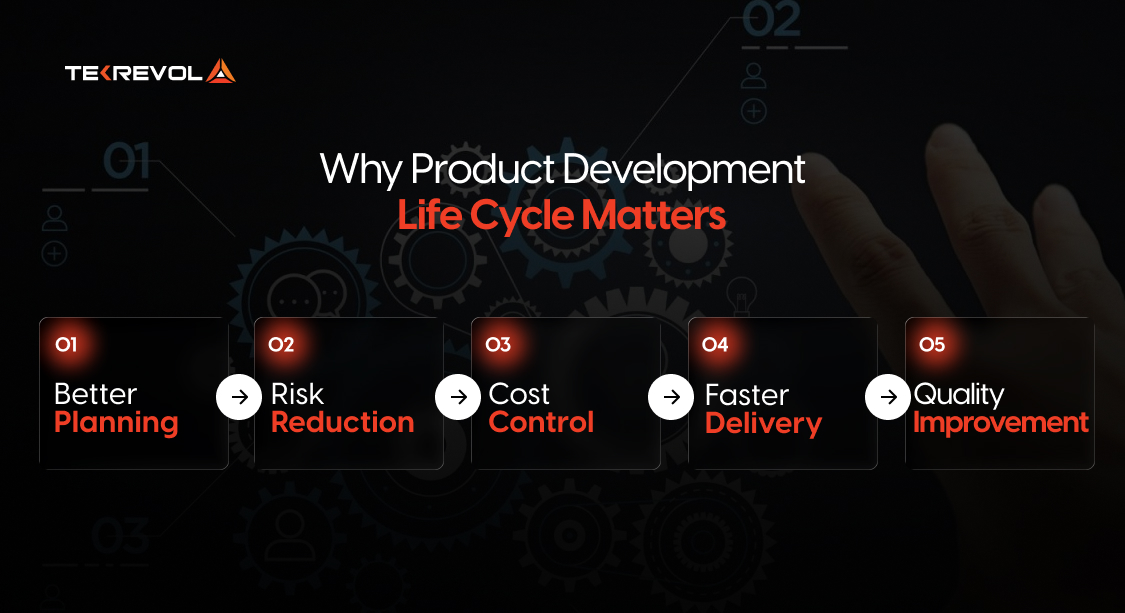
The product development life cycle is more than just a set of steps. It is a high-level plan that helps reduce risks and increase effects. Companies that revolutionise product development are more capable of handling market fluctuations, controlling financial resources, and bringing highly usable products to the customer.
- According to Gartner forecast reports it is noted that the digital technology is spending around $6.15 trillion towards AI integration.
- The McKinsey report shows that 50% product launches fail to meet business vision due to poor strategy.
- Also, McKinsey’s analysis indicates that enterprises with a clearly defined product strategy post revenue growth rates up to 30% higher than those of their competitors who lack formal processes.
The figures, therefore, strongly imply that it is no longer a matter of choice whether or not to thoroughly oversee the product development process.
A product development lifecycle management (PDLCM) strategy, properly delineated, can be a great asset to the SaaS development company in:
- Speeding up the delivery of production to the market
- Enhancing cooperation between different departments
- Control development costs
- Deliver consistent user value
- Adapt quickly to feedback
Companies that view product development as a perpetually running machine rather than a stop-and-go initiative eventually reset the bar of competition at a higher level themselves.
Don't let outdated product strategies slow your growth
TekRevol helps you streamline the product development life cycle for faster launches.
Start Your Product Journey TodayStage 1 – Idea Generation and Opportunity Identification
The essence of each great product lies in the value offered by the problem that it solves. The first step in the product development life cycle is determining the foundation that the entire journey will be built on. Before building, you need a custom software development tailored to businesses that need to look around for opportunities, understand customer pain points, and analyze market gaps.
This is the creative and research-driven phase where innovation begins. A strong start here reduces risk in later product development life cycle stages.
Recognizing Customer Pain Points and Market Void
True innovation mainly relies on the founding of user dissatisfaction. Get feedback through consumer surveys and personal interviews, and study your competitors’ performance to discover the steps of the development process that are only partially met or even totally unmet. Identify the areas where the customers have to put up with the inconvenience of the existing solutions, and find the ones that are looking for a higher performance or better usability.
Assessing Industry Trends and Competitive Landscape
Market trends determine the product features. Investigate the technologies that are being developed, changes in customer behaviour, and changes in law enforcement. Study your competitor’s products to get ideas for your product’s unique selling points.
Matching Ideas with Corporations’ Objectives
There is no point in investing in a new idea just because it sounds good. It has to fit the company’s strategic goals, be financially viable, and the company must have the capacity to carry it out. By doing so, the company can be sure that its resources are not going to be wasted.
Stage 2 – Idea Screening and Feasibility Analysis
They should narrow down the list to a practical few if a number of ideas have been created. This phase prevents companies from investing heavily in unrealistic concepts. It is a crucial step in the product development cycle.
A sound evaluation confirms that the concept is technically feasible, financially viable, and has a market.
Technical and Operational Feasibility
Consider if the company has the knowledge, facilities, and equipment needed. In the context of the software product development life cycle, it is tech stacks, integrations, and scalability potential that need to be looked at.
Financial Viability and Cost Estimation
Make a rough calculation of the cost of development, the subsequent operational costs, and the return on investment (ROI) that would be expected. Revenue forecasting and the determination of the break-even point should be part of the plan.
Market Validation and Demand Testing
Use pilot projects, landing pages, or the production and early release of prototypes to test assumptions. Demand confirmation should happen before the big-budget implementation is done.
Stage 3 – Product Concept Development and Planning
Once a product is deemed feasible, the next step in the product development life cycle stages is formalized planning. This phase is all about crystallizing the idea from vague to concrete.
Mapping out the steps in a project will give everyone a clear picture of what’s to be done, and clear planning will help to prevent scope creep and confusion during execution.
Setting Product Vision and Value Proposition
Product vision describes the desired outcome for the product. A strong value proposition will highlight the benefits that the product has over competitors
Drafting the Product Roadmap
The roadmap is a rough sketch of the phases, milestones, and timeline. It is a tool that helps stakeholders to visualize the priorities and the allocation of resources.
Feature Prioritization and Scope Finalization
Some features may be more valuable than others. Applying feature prioritisation techniques such as MoSCoW or RICE will help in identifying the functionalities that have the highest impact. This methodical step ensures that the product development life cycle remains focused and that the product development life cycle gets a boost.
Stage 4 – Design and Prototyping
Design bridges the gap between strategy and execution. This stage in the product development life cycle transforms ideas into visual and interactive representations.
User experience plays a major role in product success. A poorly designed product fails regardless of functionality.
UX Research and Wireframing
UX research sets us up for defining user journeys and uncovering behaviour patterns. Wireframes are like the skeleton of the page, without showing more than necessary, making UX design more linient.
UI Design and Interactive Prototypes
High-fidelity mockups are the stepping stone of the product concept to a physical one. On the other hand, interactive prototypes are great for simulating real-world scenarios and allowing initial testing.
Developing and Evaluating the Minimum Viable Product
An MVP is an abbreviation for minimum viable product and is basically a version of a product that only has sufficient features to be used by early customers who can then provide feedback for future product development. This way, teams can rapidly test the market’s needs by creating a Minimum Viable Product
Stage 5 – Product Development and Engineering
This is the phase of the software product development life cycle when most of the work exerted on the product creation belongs to the ‘production’ phase. Developers are the ones who finally realize the design by transforming the drawings into fully functioning systems.
This step usually requires the designer, engineer, and project manager to work closely together.
Picking the Right Technology Stack
To ensure long-term sustainability, the choice of technology has to be both scalable and secure. The decision rests, among other things, on the factors of performance, budget, and future integrations.
Agile Development and Sprint Execution
Almost without exception, companies opt for the agile product development life cycle due to the adaptability it offers. The work is split up into sprints, and there are always feedback loops running.
Backend, Frontend, and Integrations
The backend is where data is processed, and the business development software logic, which is abstracted from the user, is handled. The frontend ensures the user interaction. APIs are glueing external services together for a harmonious functionality.
Stage 6 – Testing and Quality Assurance
Testing is not optional. It safeguards the integrity of the product development life cycle.
Quality assurance is the process of verifying that a product has good performance, is easy and secure to use, before it is released.
Functional and Performance Testing
Make sure all the features work properly. Check how much load the system can handle and its speed in different scenarios.
Security and Compliance Validation
Today, the number of cybersecurity threats is going up globally. Carry out penetration testing and follow the standards of your industry.
User Acceptance Testing
The final product is tested by the real users before it is launched. Their feedback at this point helps to fine-tune the product.
Stage 7 – Product Launch and Go-To-Market Strategy
There is no point in creating a product if no one will know about it. This stage of the product development lifecycle aims at the commercialisation of the product.
To launch a product is to bring it to market. A smart and well-planned product launch will lead to a greater market impact and a larger market share.
Market Positioning and Branding
Develop a strong brand message. Point out the main features that distinguish your product from others in the market.
Marketing Campaign Execution
Make use of digital advertisements, social media services, public relations, and email marketing. Generate excitement prior to the launch.
Early Performance Tracking and Optimisation
Keep an eye on the KPIs such as the cost of acquiring a customer, customer turnover rate, and customer engagement. Modify the strategies based on the changes.
Stage 8 – Post-Launch Optimization and Lifecycle Management
The journey does not end at launch. The journey of a product doesn’t finish when the product is launched, hence the mature product development lifecycle management strategies always upgrade a product. New features and scalability are fueled by post-launch insights.
Getting Customer Feedback
To get customer feedback, collect the reviews, support tickets, and analytics data. After that, find the common issues and enhancement requests.
Constant Product Improvements and New Feature Introduction
Publish patch releases guided by user behaviour patterns. Repetition is the key to the product’s success of the future.
Growth and Maturity Management by Scaling
The infrastructure needs to scale as more and more users are getting the product. Keep track of market saturation and design your innovation strategies so that the product life span is extended.
Your next successful product starts with the right process
TekRevol helps businesses navigate every stage of product development.
Get Your Custom RoadmapCommon Challenges in the Product Development Life Cycle
Even if the product development life cycle is well organised, there will be challenges. Product development is a process that involves diverse stakeholders, has to be completed under pressure of tight deadlines, possesses a degree of technical complexity, and, at the same time, the customer expectations are always changing. If these factors are not handled properly, they can not only hinder progress but also affect the product quality.
A serious problem for businesses is the imbalance between speed and strategy. In order to quickly enter the market, companies are often tempted to hurry through the first product development life cycle stages. However, skipping thorough validation or planning inevitably leads to redoing the work later, thus the costs go up, and the long-term success is delayed.
Some of the typical difficulties are:
- Scope Creep: Uninterrupted addition of features without proper prioritisation not only disrupts timelines but also inflates budgets. Besides, it makes testing and quality assurance more complex.
- Insufficient Market Validation: Making assumptions about customer demand might cause a product to be poorly adopted. Even a technically sound product, if not properly validated, may fail.
- Team Disconnection: Ineffective communication between product, design, development, and marketing teams results in confusion and delays.
- Limited Budget and Time: Often, when the development time is underestimated, it results in missing the deadline and financial difficulties.
- Post-Launch Disregard: A lot of businesses put the main focus on the launch of the product and then neglect investing in continuous improvement and lifecycle optimization.
When we deal with these issues in advance, we significantly improve the probability of successful product development and launch.
Best Practices for a Successful Product Development Process
It is more than just ticking the boxes; a product development lifecycle can be a great success. Besides requiring discipline, collaboration, and continuous improvement, it is also a necessity. When organisations treat development as a strategic function instead of a one-time project, they are more likely to create sustainable and scalable products.
A solid product development lifecycle can mainly be achieved by keeping the customer focus strong at every phase of the process. Gaining users’ insights and data should always be the basis of decisions, be it idea validation, the launch, or updates after the product launch. This way, teams are prevented from creating features based on assumptions.
Some best practices that are historically effective in delivering positive results are as follows:
- Leverage Agile Methodologies: The agile product development life cycle allows for iterative releases, frequent feedback, and quicker adjustments to changes. The framework permits teams to stay structured while being nimble.
- Ensure Clear Communication: A seamless partnership between different roles, such as product managers, designers, developers, and marketers, leads to fewer disagreements and faster work.
- Conduct Thorough Data-Driven Decision-Making: Product refinements should be influenced by data, such as analytics, user behaviour tracking, and performance metrics, not just be guesswork.
- Testing Your Ideas Frequently and Early: Doing market fit checks, MVPs, and prototyping is a great way to reduce risks and save money before making a big commitment.
- Make a Post-Launch Growth Plan: Long-term product development lifecycle management includes constant tracking, updating, and upgrading with new features.
By following these practices, organizations can improve efficiency, reduce risk, and maximize the value delivered throughout the entire product development life cycle.
How Tekrevol Helps You Navigate the Product Development Life Cycle
Navigating the product development life cycle requires more than technical expertise. It demands strategic thinking, market awareness, and seamless collaboration across teams. Tekrevol supports businesses by turning raw ideas into structured, scalable digital solutions through a well-defined and results-driven approach.
From early discovery workshops to post-launch optimization, Tekrevol ensures every stage of the software product development life cycle is handled with precision. Their team combines innovation with practical execution, helping businesses reduce risk while accelerating time to market.
Tekrevol adds value through:
- Strategic product discovery and market validation
- User-focused design and rapid prototyping
- Agile development with transparent sprint cycles
- Comprehensive testing and quality assurance
- Post-launch scaling and lifecycle optimization support
By aligning technology with business objectives, Tekrevol ensures that products are not only launched successfully but also positioned for long-term growth. Their structured yet flexible approach strengthens every phase of the product development life cycle, helping companies stay competitive in rapidly evolving digital markets.
With a deep understanding of modern frameworks and lifecycle strategies, Tekrevol transforms complex ideas into high-performing digital products that deliver measurable business impact.
Stay ahead with smarter product development
TekRevol helps you reduce risk and accelerate growth with a proven lifecycle approach.
Speak With a Specialist


![How to Build an Image Recognition App: AI Features, Tech Stack & Cost [2026]](https://assets.tekrevol.com/images-tek/uploads/2025/05/Tek-Feature-18-400x160.jpg)


