Nine out of ten innovative ideas fail without a strong foundation. This failure often happens because teams rush into full development before validating their core assumptions. This is exactly where the steps in proof of concept process give structure to the early validation and reduce guesswork.
A Proof of Concept is the minimum effort required to validate a technical or functional hypothesis. It answers the fundamental question: Can this idea work? A successful PoC gives MVP development services the clear evidence to secure funding and move forward with confidence.
This guide will explain the 7 essential steps in the proof of concept process. Let us establish a process-driven POC methodology that prevents your project from failure and moves it from concept to reality.
What Is Proof of Concept (PoC)?
A POC or proof of concept is an approach to test the feasibility of an idea or project before full commitment. Teams run steps of the proof of concept process to validate their assumptions with minimal effort.
The proof of concept’s meaning is distinct from other stages. It is a document or a minimal project that verifies a concept can be built and function as intended. The goal is purely to achieve project feasibility validation.
A business proof of concept proecess in software development, for example, might be a basic experiment to see if two complex systems can integrate as planned. It is not a fully functional product. Instead, it tests the riskiest, most essential assumption.
The steps in the proof of concept process typically result in documentation and a small demonstration. They focused on technology and viability, not market readiness or user experience. Its success is measured by technical success, not market performance.
Need clarity for investment?
We manage technical uncertainty in your PoC process to reduce project risk.
Get POC ValidationWhy is the Proof of Concept Process Important for Project Success?
The proof of concept methodology matters because it systematically reduces risk and guarantees budget efficiency before significant investment. It stops you from building a solution that simply cannot work.
Let’s look into the major benefits of POC in software development or other project success:
Risk Reduction
By testing the riskiest technical elements early, you can fail cheaply and learn quickly. Testing is one of the steps in proof of concept process that prevents you from spending millions on a full-scale product. A Forrester survey found that structured PoCs in B2B tech projects reduced implementation risk by an average of 53% and increased the probability of project success by 72%.
Stakeholder Confidence
A successful PoC provides concrete evidence to secure stakeholder buy-in and investment. You present validated data, not just a vision. This evidence-based approach builds trust among executives. A PoC helps to validate a business idea against technical reality.
Budget Efficiency
A PoC ensures you only move to full development once the core concept is proven. It helps you validate the business idea before scaling the team or infrastructure. It gives you Go / No-Go clarity. If the proof of concept process fails, you stop, saving considerable resources. In fact, a Brixon Group synthesis of industry studies reports that a structured PoC investment typically pays for itself through 30–45% cost savings in full implementation.
What Are the Steps in Proof of Concept Process?
The seven essential steps in the proof of concept process provide a clear, instructional path from an abstract idea to validated evidence. Following this PoC process ensures you remain focused and efficient.
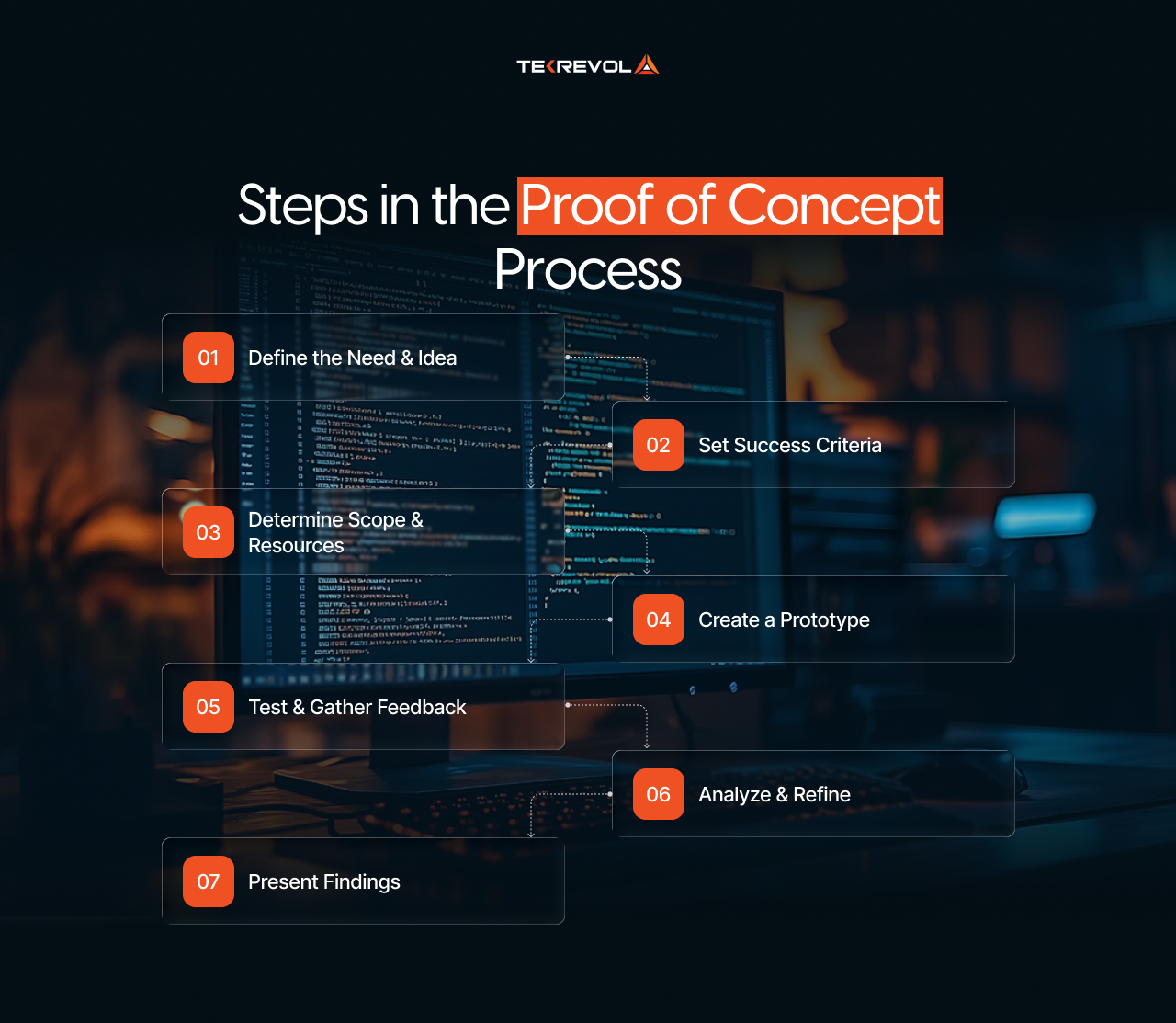
Step 1: Define the Need and Idea
This very first phase among all the steps in proof of concept process is to clearly articulate the problem your solution intends to solve. You must identify the specific user pain points and the target audience. A vague problem leads to a vague proof of concept.
Write a clear problem statement and a concise hypothesis. For instance, the problem is not “customers are slow.” It is “Customers take an average of 15 minutes to manually process inbound invoices, causing a two-day delay in accounts payable.” Your idea’s purpose is to solve this specific, measurable pain point.
Only after clearly defining the problem should you select the core, riskiest technical assumption to test. This initial documentation starts building your proof of concept document. By defining the need first, you ensure the PoC will provide value to users by addressing a real-world concern. Understanding the “for whom” is just as important as the “what”. This step provides the context and clarity for everything that follows.
Step 2: Set Success Criteria
Before starting development, you must define PoC success metrics. The criteria should directly relate to the hypothesis defined in Step 1 and must be quantifiable. You can include metrics for efficiency, error rate, or system stability. Avoid soft metrics like “it looks good” or “the team is happy with it”.
Documenting metrics is a key component of a PoC plan. This documented goal-setting serves as the definitive proof of concept template. If you fall short, you pivot or stop.
Step 3: Determine Scope and Resources
The 3rd stage of steps in proof of concept process involves outlining the boundaries and allocating the average cost of PoC. A well-defined scope prevents the PoC from ballooning into a full product.
Scope means identifying the exact features, functions, and scenarios the PoC will cover. It should only include what is necessary to validate the core hypothesis. For instance, a PoC on database integration will not include a fully designed user interface or scalable security features.
Resources involve budgeting and resource allocation for PoC. This includes human resources like developers, the timebox for completion, and the tools and technologies for PoC development. You must secure a dedicated budget.
Step 4: Create a Prototype
This step turns ideas into something testable. In the context of the proof of concept steps, the prototype focuses on technical demonstration only. It shows how the idea works, not how it looks.
Use the agreed-upon tools and technologies for PoC development. The technology stack should be minimal and focused purely on the test objective. This is the stage where you also perform an initial risk assessment in proof of concept. Identify potential technical roadblocks and plan strategies to mitigate them. It provides a physical object to use in custom software development.
Step 5: Test and Gather Feedback
With the prototype ready, the next steps in proof of concept process are to execute the planned tests. This phase is about collecting objective, measurable data against your defined success criteria.
Have target users or internal stakeholders test the prototype. The testing environment should mirror the eventual production environment as closely as possible. You must collect both quantitative and qualitative data.
Document every test result rigorously. This documentation is a crucial part of your proof of concept template and is necessary for the final presentation. Thorough testing provides the authoritative evidence needed to make an informed decision later on.
Step 6: Analyze and Refine
Once all testing data is collected, you must review the results against the success criteria set in Step 2. The analysis steps in proof of concept process determine the fate of the project.
- Analysis: Did the prototype meet the measurable benchmarks? Identify what worked flawlessly and which areas still contain technical risk. Be honest and objective. A successful PoC provides clear results, whether they are positive or negative.
- Refinement: If the results are close but not perfect, you may decide on a small iteration and a second test cycle. This is the time to make adjustments. If the core assumption failed, you must be ready to stop or pivot the entire idea. Avoid forcing a refinement just to save the project. The process should lead to a clear, data-backed conclusion. All findings must be organized into your final proof of concept document.
Step 7: Present Findings
The final step is to document and present the outcomes to the decision-makers formally. This is the culmination of the PoC process explained. The proof of concept presentation to stakeholders should be structured around three key elements:
- The Problem and Hypothesis: Briefly remind stakeholders what you set out to prove.
- The Data and Results: Present the measurable results against the defined success criteria. Use clear visuals.
- The Recommendation: Based on the evidence, provide a clear recommendation. This is the Go, Pivot, or Stop decision.
- Go: The concept is technically feasible. The next step is transitioning from PoC to full-scale MVP development.
- Pivot: The concept is partially feasible but needs a significant change to the idea or technology.
- Stop: The concept is not feasible. You save the company resources.
This final step secures the stakeholder buy-in necessary to move into the product development stages.
Accelerate POC Development Safely
TekRevol shortens validation time with a disciplined execution process.
Talk to expertsWhat Are Some Proof of Concept Examples?
Seeing real-world applications helps clarify the proof of concept’s meaning. PoC use cases exist across all industries.
Software / SaaS
A SaaS company needs a POC in a software project to integrate a complex third-party payment gateway. The PoC focuses solely on creating a small, isolated module that successfully initiates, verifies, and concludes a transaction using that gateway. The success metric is 100% successful transaction completion without error. This is a common proof of concept example. The test validates the integration, providing the green light for full custom software development.
Healthcare
In healthcare, a PoC could validate a new remote monitoring technology. For example, a company created a simple PoC for a wearable device that passively monitored patient vitals. The PoC tested only the accuracy and reliability of the data transmission to a secure server. It did not include the patient-facing app or the regulatory approval process. If the data transmission were unreliable, the project would stop. This PoC focused on the underlying technology for secure, real-time communication, a core function for healthcare app development services.
Enterprise / Startup
A large enterprise needs a POC to migrate a legacy database to a new cloud architecture. The PoC tests a small subset of the data (e.g., 10,000 records). It confirms data integrity, migration speed, and query performance in the new cloud environment. This validates the fundamental architectural hypothesis before moving billions of records. These real-world PoC scenarios mitigate major infrastructure risk.
Proof of Concept vs MVP vs Prototype: What Comes First?
The Proof of Concept always comes first in the product development lifecycle, followed by the prototype, and then the MVP.
These three items: POC, Prototype, and MVP, represent a progressive sequence of de-risking. The PoC de-risks the technology, the Prototype de-risks the user experience, and the MVP de-risks the business model.
| Feature | Proof of Concept (PoC) | Prototype | Minimum Viable Product (MVP) |
| Primary Goal | Validates technical feasibility. | Validates user experience and design. | Validates market demand and business model. |
| Core Question | Can this core function be built? | How will a user interact with this? | Will users pay for and use this? |
| Audience | Internal technical stakeholders. | Internal design/UX team, limited users. | External, early-adopter customers. |
| Scope | Minimal, focused on one core risk. | Mock-up, non-functional wireframe, or click-through model. | Core set of features for a complete user journey. |
| Outcome | Go/No-Go technical decision. | Design refinement, usability testing. | Launch product, gather real feedback, generate revenue. |
A successful POC in software development validates an integration method. The prototype provides a design mock-up of the user interface. The MVP then bundles the validated technology with the tested interface and launches it to the market.
How to Run a Successful Proof of Concept
Running a successful PoC requires more than just following the steps in proof of concept process; it demands discipline and an honest assessment of the results. These PoC best practices ensure you get maximum value from the process.
- Focus on ONE Hypothesis: Do not try to prove three things at once. Isolate the riskiest element and test only that.
- Timebox It: Set a strict deadline and adhere to it. The PoC must be fast. A good PoC timeline is often completed within 4-12 weeks.
- Document Everything: Treat the proof of concept document as your authoritative record. Log every success criterion, test result, and stakeholder feedback.
- Involve Stakeholders Early: Get buy-in on the success criteria before starting. There should be no surprises during the final presentation.
Common Mistakes to Approach Steps in Proof of Concept Process
- Over-Engineering: Do not worry about clean code or scaling infrastructure. Build the minimum to prove the concept.
- Ignoring a Stop Sign: The purpose is to reduce project risk. If the data clearly shows failure, do not spend more money trying to refine a fundamentally flawed idea.
- Vague Success Metrics: Using non-quantifiable goals like “It performs fast enough.” Metrics must be specific numbers to determine proof of concept success.
- Confusing PoC with a Product: The PoC is not a beta version. It is an experiment.
The goal is achieving proof of concept success by maximizing learning while minimizing investment.
Develop a Proof of Concept with TekRevol
Successfully executing the essential steps in the proof of concept process requires a specialized, rapid-development skillset. While your internal team drives the strategic vision, a consulting partner can provide the technical horsepower to quickly build and validate your riskiest assumptions.
TekRevol specializes in enterprise PoC and MVP development services across complex domains. We provide custom proof of concept development focused on speed and technical validation to ensure the PoC delivers actionable, decision-oriented results.
Secure Your Project Success
Our engineers streamline all steps in proof of concept process swiftly.
Consult with TekReVol