Whenever companies put their money into novel software concepts, AI-driven initiatives, or robotization programs, there is always one question that throws them off at the very first stage. Is it better for us to test the idea with a proof of concept or go straight to a pilot project? In your confusion, when you ponder that question, you end up taking rushed decisions, wasting your budget, and having your expectations get out of sync.
Knowing the differences between a proof of concept and a pilot project is not only a matter of technology. It is a tactical choice that affects the momentum, the costs, the trust of the stakeholders, and the planning for the future success of the whole enterprise. The two methods, which are intended to reduce risk, nevertheless, do have different objectives, and only by utilizing them in the right order can one really unlock business value.
This blog article will help you to understand the difference between a proof of concept and a pilot project. We will also discuss where each of them fits in the custom software development journey and give you a definite answer as to which one should be first and why.
Early Validation in Modern Software Development
Before any successful digital product reaches full-scale development, it goes through validation. This validation ensures that the idea is feasible, valuable, and practical before heavy investments are made.
Validation is especially critical today because software projects are more complex than ever. AI apps and technologies, cloud infrastructure, third-party integrations, and user experience expectations all introduce layers of uncertainty. This is where understanding proof of concept vs pilot becomes essential for decision makers.
Early validation helps businesses test assumptions, reduce unknowns, and make informed go or no-go decisions without risking large-scale failure.
Looking to validate your next digital innovation?
TekRevol engineers structured PoCs and pilots for measurable results.
Book Your Free ConsultationWhy Validation Comes Before Full-Scale Development
Validation is like a safety net that catches problems before the full implementation stage. If this phase is skipped, it usually means you will have to redo the work in a very costly way, or the project will be completely abandoned.
Industry data strongly supports this approach.
- A study shows 70% of digital transformation initiatives end up being unsuccessful because there was no clear validation and alignment of technology with business goals.
- Another study mentions that over 55% of software projects go beyond their initial budget, mainly because the feasibility and operational readiness were not checked at an early stage.
Validation also helps organizations respond to market uncertainty. These numbers clearly show why validation is no longer optional.
This is exactly where proof of concept and pilot projects play distinct but complementary roles.
What Is a Proof of Concept in Software Development
A proof of concept is a small-scale exercise designed to verify whether an idea or technology can work in theory. When people ask what is PoC in software development, the simplest answer is that it focuses on feasibility rather than completeness.
A PoC validates the technical possibility of a solution without worrying about polish, scalability, or full user experience. It is often built quickly using limited features and controlled data to test assumptions before serious investment begins.
Proof of concept compared to pilot projects is far more experimental in nature. It answers the question can this solution work at all.
Why Do We Need a PoC in a Software Project
Organizations use a PoC when uncertainty is high. This could be due to new technology, complex integrations, or innovative use cases.
A PoC helps businesses avoid building the wrong solution by identifying limitations early. It also creates clarity for stakeholders by replacing assumptions with evidence.
Some common reasons businesses rely on a PoC include:
- Validating technical feasibility
- Testing risky integrations or APIs
- Assessing AI services and model accuracy or automation logic
- Gaining leadership approval before scaling
This stage plays a crucial role in the proof of concept vs pilot project decision because it sets the foundation for everything that follows.
Steps in the Proof of Concept Process
Every successful PoC follows a structured approach, even though it remains lightweight. Understanding the steps in proof of concept process ensures clarity and measurable outcomes.
The process usually includes:
- Defining the problem and objective
- Identifying success criteria and assumptions
- Selecting the minimum features needed for validation
- Building a basic technical solution
- Evaluating results against defined criteria
These steps help teams stay focused and avoid unnecessary complexity during early validation.
PoC Development Life Cycle Explained
The PoC development life cycle is intentionally short and focused. It is not meant to replicate full software development cycles.
Typically, the lifecycle includes ideation, feasibility testing, evaluation, and decision making. At the end of this cycle, stakeholders decide whether to move forward, pivot, or stop the initiative entirely.
This lifecycle makes PoCs ideal for experimentation without long-term commitment.
Business Value of a Software PoC
From a business perspective, a PoC delivers clarity and confidence. It transforms abstract ideas into tangible results that leaders can evaluate.
The business value of software PoC includes faster decision-making, reduced financial risk, and improved alignment between technical teams and business goals. It also helps organizations prioritize initiatives based on evidence rather than intuition.
Most importantly, a PoC prevents overinvestment in ideas that are not technically viable.
Average Cost of a Software PoC
The average cost of a software PoC is significantly lower than building a full product or running a pilot. While costs vary by complexity, PoCs are typically designed to stay lean.
Because PoCs focus on core feasibility, they require fewer resources, shorter timelines, and limited infrastructure. This makes them an efficient way to validate ideas without straining budgets.
What Is a Pilot Project in Software Development
A pilot project is a controlled, real-world implementation of a solution that has already proven its feasibility. While a PoC answers whether something can work, a pilot answers whether it will work in practice.
In the pilot project vs proof of concept comparison, pilots involve real users, real workflows, and real operational conditions. They test performance, usability, adoption, and operational impact before full-scale rollout.
A pilot is closer to production but still limited in scope to manage risk.
Key Objectives of a Pilot Project
The primary goal of a pilot is validation in real conditions. This includes measuring how users interact with the system and how well it integrates into existing processes.
Pilots are used to:
- Test usability and user adoption
- Validate performance under real workloads
- Identify operational bottlenecks
- Gather feedback for refinement
These objectives make pilots critical before enterprise-wide deployment.
Proof of Concept vs Pilot Project Quick Overview
| Feature | Proof of Concept (PoC) | Pilot Project |
| Purpose | Validate feasibility and technical viability | Validate real-world performance and operational readiness |
| Primary Question | Can this solution work? | Will this solution work effectively in practice? |
| Scope | Narrow, focused on core technical components | Broader, includes multiple features and real workflows |
| Environment | Controlled or experimental, often internal | Real or near-real production environment with actual users |
| User Involvement | Minimal, often internal stakeholders | High, includes end users and operational teams |
| Data Used | Simulated or limited data | Real or near-real production data |
| Timeframe | Short, often a few days to a few weeks | Longer, can range from a few weeks to months |
| Resource Requirements | Limited resources and budget | Higher resources, more coordination, and infrastructure |
| Outcome | Go/no-go decision on feasibility, identifies technical limitations | Readiness for full deployment, performance metrics, user feedback |
| Risk Level | Low impact is minimal if it fails | Higher, closer to actual operations and business processes |
| Relation to MVP or Prototype | Comes before MVP, focuses on feasibility | Comes after PoC, can inform MVP design or full production rollout |
| Ideal Use Case | New technology, uncertain integrations, high technical risk | Solution ready for real users but needs validation at scale |
Proof of Concept vs Pilot Project Key Differences
Understanding the difference between proof of concept and pilot project helps organizations choose the right approach at the right time.
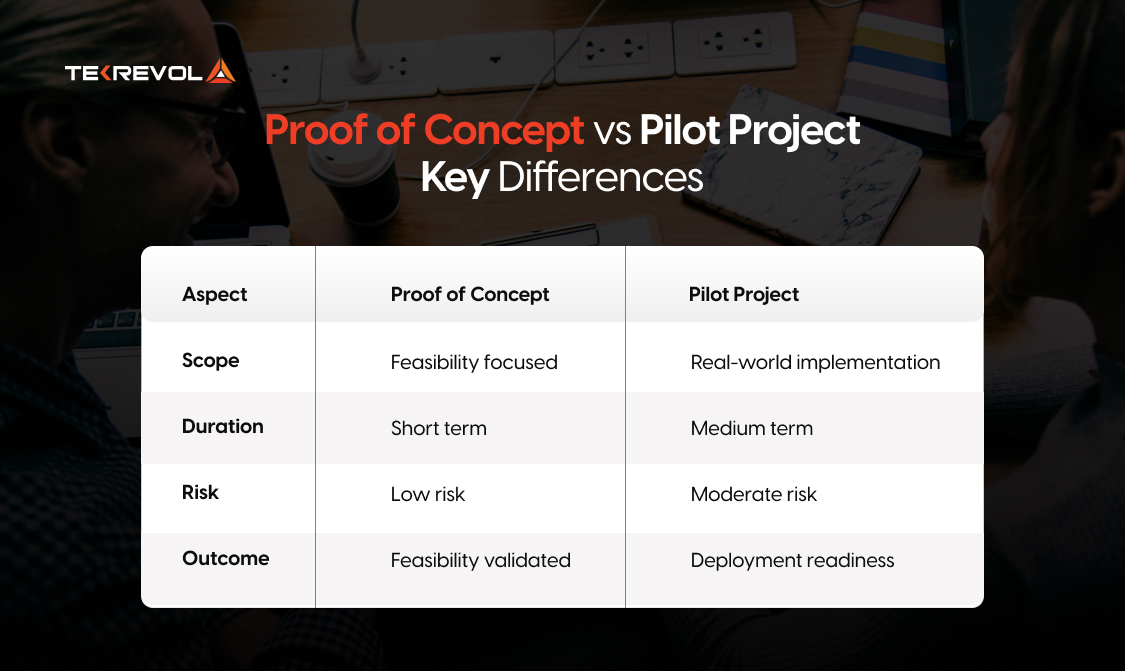
A PoC focuses on feasibility, while a pilot focuses on practicality. PoCs are small and experimental, whereas pilots are structured and closer to production environments.
This distinction lies at the heart of the POC vs pilot project debate.
Confused about PoC vs pilot project execution?
TekRevol helps you plan, execute, and transition from PoC to pilot smoothly.
Start Your Free ConsultationEnvironment and Scope Comparison
PoCs operate in controlled environments with limited data. They often use mock data or simplified workflows.
Pilots, on the other hand, operate in near-real environments. They involve real users, real data, and real operational constraints.
This is a major point when comparing proof of concept vs pilot project strategies.
Time, Cost, and Resource Commitment
PoCs are short-term and low-cost. Pilots require more time, coordination, and resources.
While both aim to reduce risk, pilots represent a larger investment and therefore should only follow once feasibility is confirmed.
This distinction is critical when evaluating proof of concept vs pilot decisions.
Which One Comes First: Proof of Concept or Pilot Project
In most cases, a proof of concept comes first. This sequence allows teams to validate feasibility before exposing the solution to real users or operations.
Skipping a PoC and moving directly to a pilot increases the risk of failure. Without technical validation, pilots may reveal fundamental flaws too late in the process.
This is why in the proof of concept vs pilot project discussion, PoC is almost always the logical starting point.
Are There Exceptions to the Rule
In rare cases, organizations may skip a PoC if the technology is well-known and the risk is minimal. Even then, the pilot effectively absorbs many PoC responsibilities.
However, for AI-driven, business automation, or integration-intensive projects, starting without a PoC is rarely advisable.
From PoC to Pilot: How the Transition Works
Once a PoC succeeds, its findings guide pilot planning. Teams expand scope, prepare real data, and define operational metrics.
This transition ensures continuity and reduces rework. The insights gained during feasibility testing make pilots more focused and effective.
PoC vs MVP vs Prototype Explained
Many teams confuse PoCs with prototypes and MVPs. Understanding PoC vs MVP vs Prototype is essential for choosing the right approach.
A PoC validates feasibility. A prototype focuses on design and user experience. An MVP delivers minimum functionality to test market demand.
In PoC vs MVP software development, the PoC always comes earlier and serves a different purpose entirely.
Common Misconceptions About Proof of Concept and Pilot Projects
One common myth is that a pilot can replace a PoC. In reality, pilots assume feasibility has already been proven.
Another misconception is that PoCs must be production ready. Building an overly complex PoC is contrary to what a PoC is meant to be and hinders the process of learning.
Dispelling such misunderstandings enables teams to make better-informed validation decisions.
Risks of Skipping Validation Stages
When the PoC or pilot phases are skipped, the chances of the projects getting over budget, being poorly adopted, or coming to technical failure increase.
Projects that go from concept to full-scale development without any validation often result in delayed launches and disgruntled stakeholders.
This risk serves as a reminder of how crucial it is to be clear on the sequencing of the proof of concept versus the pilot project.
How Tekrevol Helps You Choose and Execute the Right Approach
In certain instances, it may not be obvious whether to go for a PoC or pilot first. This is where Tekrevol adds strategic value.
Tekrevol helps businesses:
- Assess whether feasibility or real-world validation is needed
- Design focused PoCs with measurable outcomes
- Execute pilots that reflect real operational conditions
- Seamlessly transition from validation to scalable solutions
By aligning technology with business objectives from day one, Tekrevol ensures that innovation moves forward with confidence, clarity, and reduced risk.
Looking to scale your innovative idea with confidence?
TekRevol ensures PoC and pilot projects deliver measurable success.
Schedule Your Free Consultation