A we all know, success is not merely dependent on ideas. An excellent idea can still go down the drain if it is not properly tested, validated, or organized. This is where the POC development life cycle becomes critical. Proof of Concept ensures that organizations invest in solutions that are feasible and aligned with business objectives.
According to Statista, almost 70% of digital projects fail without proper PoC validation. A number of teams go straight for full-scale development without realizing that they have made wrong assumptions, technologies turned out to be incompatible, or the solution simply doesn’t work. A well-defined PoC helps to lessen these risks and gives enterprises the opportunity to test out their ideas with a small investment.
This manual conveys the complete POC creation life cycle, the goals, the success criteria, and the requirements, thus providing an understanding of how companies can take a raw idea and convert it into a validated solution.
By the time you finish with this, you will be able to efficiently implement PoC, circumvent the typical errors, and make your go/no-go decisions with confidence.
What is PoC development?
Understanding what PoC is in software development forms the very basis of the POC development life cycle.
It is a small-scale, focused implementation for any particular idea, feature, or technology that shall allow determination whether it is technically and practically viable. It is, in other words, a controlled experiment, not a full product, to validate core assumptions before significant investment is made.
PoC – Real-World Examples of Usage
- Fintech Startups: Testing blockchain integration for cross-border payments before developing the full platform.
- Medical Apps: AI algorithms testing for diagnostic tools before integrating into patient-facing applications
- Enterprise Software: Verify if a new API can be integrated with existing enterprise systems
PoC development is important in the following scenarios:
- Technologies are new or untested
- Integration with various complex systems is needed.
- Stakeholders require concrete evidence before investing.
Knowing when to apply PoC helps the teams not invest their time in building unwanted features or products that may not work at all or even meet the business requirements.
Ready to validate your software idea before building it?
Tekrevol delivers strategic PoC solutions that reduce risk and cost.
Schedule a Free ConsultationWhy a Structured PoC Development Life Cycle Matters?
A structured POC development life cycle is necessary for dealing with risks, streamlining decision-making, and optimizing resources. In its absence, PoCs are sometimes chaotic, over-engineered, and even incapable of providing meaningful insights.
Key Benefits of a Structured Approach
- Reduces project risk: Early assumption testing cuts down on the risk of failure in later stages. According to Statista, 45% of all IT budgets are wasted on initiatives that never go into production.
- Aligns Stakeholders: Clear objectives and success criteria ensure that all parties have the same expectations, thus minimizing friction later on.
- Improves Decision-making: Quantifiable results allow leadership to make data-driven go or no-go decisions.
- Controls Costs and Timelines: Well-structured PoC prevents scope creep and ensures resources are invested effectively.
- Supports strategic innovation: Quick feasibility validation enables enterprises to test several ideas and invest only in those that seem most promising.
Creating a PoC in software development allows an organization to confidently undertake innovation, knowing ideas will be viable, practical, and strategically aligned.
Complete PoC Development Life Cycle
The POC development life cycle consists of nine carefully planned steps, each building on the other to ensure comprehensive validation and informed decision-making. Here are the steps in the PoC process:
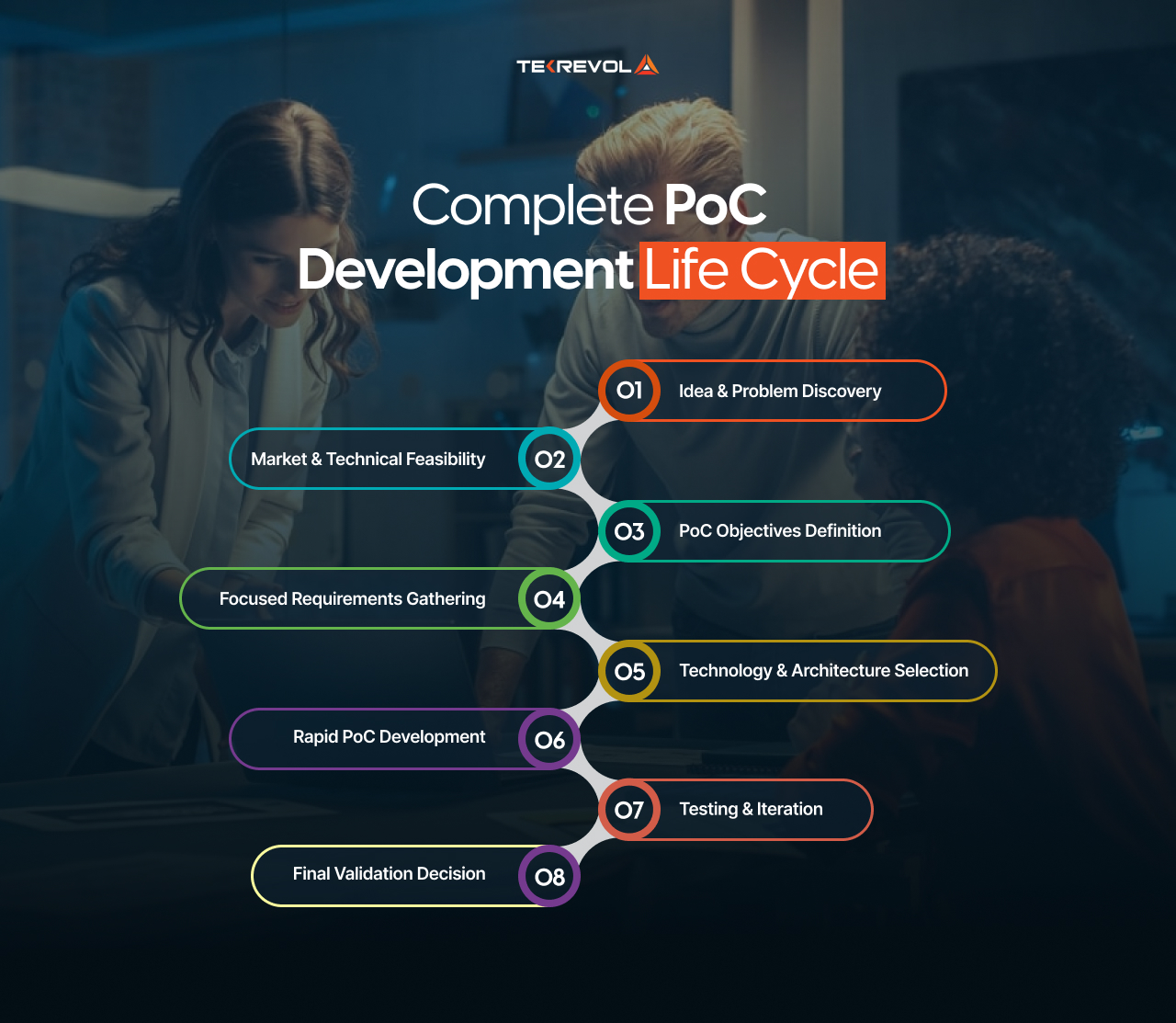
Step 1: Idea Discovery and Problem Identification
Each PoC starts with explicitly stated problem understanding. It is very necessary that teams identify the core challenge the software will aim to solve.
Key activities within this stage include:
- Identify the Business Pain Points: Work out the original cause, instead of just the symptoms.
- Problem scoping: Specify what will be handled by defining the limits.
- Identifying target users: Figure out who the main audience is.
- Align with Business Goals: Check that the concept is in line with the organization’s strategic objectives.
As an example, a business creating an AI-based scheduling tool might discover that the current tools are not able to coordinate multi-time zones efficiently. The PoC would seek to prove that an AI algorithm can handle such complexity.
Step 2: Market and Technical Feasibility Analysis
Feasibility from both market and technical viewpoints has to be assessed before development.
Market feasibility:
- Evaluate the demand and relevance of the idea.
- Competitor and alternative research
- Understand user adoption likelihood
Technical Feasibility:
- Determine whether the existing technologies support the idea.
- Assess system integration complexity
- Assess scalability and security needs
This step ensures that organizations answer this critical question: Can the solution really work, and is there a reason to build it?
Step 3: Definition of PoC Objectives and Success Criteria
Defining PoC objectives prevents ambiguity. Teams have to articulate precisely what the PoC is supposed to validate.
Typical goals include:
- Performance testing under specific conditions
- Validating the integration with existing systems
- Ensuring compliance with technical standards.
- Decreasing uncertainty around new technologies
Along with objectives, the success criteria of PoC need to be defined. The metrics may include:
- Performance benchmarks: speed, load handling
- Reliability of Integrations
- Accuracy of Outputs
- Ease of Deployment
Objectives and success metrics defined by teams ensure that outcomes can be measured objectively, thereby aiding in informed decision-making.
Step 4 – PoC Requirements Gathering
Focused POC requirements gathering avoids unnecessary complexity. This step ensures that the design includes only the must-have features, thus allowing for faster execution.
Key activities:
- Documenting the functional and non-functional requirements
- List assumptions and dependencies
- Prioritize features into must-haves and options.
- eliminating anything not crucial for feasibility testing
This approach ensures the PoC is lightweight with a focus on validation goals.
Step 5: Choosing Technology Stack & Architecture
Technology selection is thus crucial for PoC success. The goal is to choose tools that facilitate rapid experimentation without overcomplication.
Considerations include:
- Speed of development: Selecting frameworks that facilitate quick coding and testing.
- Ease of integration: Selecting technologies that are compatible with your existing systems.
- Scalability potential: Make sure that future MVP or full product development is still possible.
- Team Expertise: Align technologies with the skill set of the developers available
An appropriately chosen stack frees one from bottlenecks and makes a transition from PoC to full development seamless.
Step 6: Rapid PoC Development and Implementation
Implementation starts with core functionality. The emphasis is on validation rather than on user experience or completeness of features.
Best practices include
- Implement essential features only
- Keep code clean and testable
- Continuous collaboration among developers, product managers, and stakeholders
- Avoid overengineering, and avoid unnecessary polish.
This phase represents the hands-on part of the proof of concept process, where ideas get translated into tangible outputs.
Step 7: Testing, Experimentation, and Iteration
PoC is somewhat different from full QA testing, and the objective is to validate assumptions rather than to achieve perfection.
Activities include:
- Functional validation: Does the core solution work as intended?
- Performance evaluation: Can the system handle the expected load or scenarios?
- Integration checks: Does it work with existing systems and data sources?
- Iterative improvements: Rapidly refine elements based on testing results.
This step also brings to the surface challenges in PoC implementation, enabling teams to address them early.
Step 8: Stakeholder Review and Demonstration
Communicate the outcomes of PoC effectively. A well-prepared demonstration translates technical insight into the business value of PoC.
Areas to focus on when reviewing:
- Objective achievement and measurable results
- Technical feasibility and possible limitations
- Cost, Timeline, and Scalability Implications
- Risks and Mitigation Strategies
It also highlights the objective of PoC, which ties in technical validation with the business decisions behind it.
Step 9: Final Validation and Decision Making
The final step determines whether the project should move ahead. Decisions are based on objective metrics established in Step 3.
Possible outcomes:
- Proceed to prototype or MVP: when success criteria are met
- Pivot approach: When partial success indicates adjustments are needed
- Kill the effort: If the idea is not viable or strategically misaligned
Documenting the findings is a way of preserving insights for future projects, should a project be discontinued.
Not sure if your product idea is technically feasible?
Tekrevol helps you test, validate, and decide with confidence.
Talk to Our Experts TodayPoC vs Prototype vs MVP: Everything Explained Clearly
Understanding POC vs MVP vs Prototype prevents confusion and waste of resources.
- PoC: Validates feasibility, technical viability, and assumptions.
- Prototype focuses on design, usability, and user experience.
- MVP: utilizes the minimum functional product to test market demand.
So, in PoC vs MVP in software development, PoC addresses whether it can be built, while MVP tests whether it should be built. Correspondingly, proof of concept vs pilot project differ in audiences, scale, and evaluation criteria.
Proof of Concept Benefits in Software
The benefits of proof of concept in software development are more than just technical validation. The PoC is a great tool for businesses to test the feasibility of their ideas, spot risks early on, and refine their requirements even before a complete development is carried out.
Here is the list of benefits of PoC:
- Identifying and mitigating the risk early
- Budget Optimisation & Cost Savings
- Faster Innovation Cycles
- Increased stakeholder confidence
- Clear insights to make go/no-go decisions
- Reduced risk of project failure
The use of a PoC is a great way to attract investors’ trust and is a sure way to have a stronger product that is ready for the market in the case of both startups and enterprises. In fact, PoC development promotes a greater success rate in new product initiatives among businesses.
Cost and Timeline Expectations of a PoC
PoC timeline usually takes two to eight weeks, depending on the complexity and scope.
The average cost of a software PoC can vary greatly:
- Basic technical feasibility tests: Between five thousand and ten thousand dollars
- Complex integrations, AI features: Between twenty and fifty thousand dollars
- Enterprise-level solutions may be more than $100,000.
PoCs that are properly managed, nevertheless, save a lot of money that could have been lost if infeasible or misaligned projects had been pursued.
Common Challenges in PoC Development and Ways to Avoid Them
Developing a proof of concept (PoC) comes with challenges like unclear requirements, limited resources, and unrealistic timelines. Identifying these risks early and following structured planning ensures smoother PoC execution and maximizes the chances of a successful software validation.
Common challenges in the implementation of a PoC and their solutions are:
| Common PoC Challenges | Solutions |
| Ambiguous objectives and unclarified success criteria | Clarify objectives and success metrics through proper documentation. |
| Poor stakeholder communication | Maintain regular and transparent communication with stakeholders. |
| Over-engineering and scope creep | Keep the scope minimal and focused on validation. |
| Wrong technology choices | Use technologies that the team has expertise in for reliable results. |
Best Practices to Ensure a Successful PoC Development Process
The best practices that successful PoCs follow are:
- Define POC objectives and measurable outcomes from the start.
- Gather focused POC requirements only.
- Keep development lightweight and avoid unnecessary complications.
- Continuously validate assumptions with testing
- Regularly involve stakeholders
- Document each insight for future reference
Conforming to all these best practices makes the POC development life cycle effective and efficient while providing actionable insights.
How Tekrevol Helps You Succeed with PoC Development
We at Tekrevol guide businesses with precision through the POC development lifecycle, from defining objectives to final validation. Our team ensures your PoC provides real insights.
We specialize in
- Gathering focused requirements
- Choosing the right technology stack
- Carrying out rapid, cost-effective PoCs
- Providing actionable outcomes to stakeholders
- Transition smoothly from PoC to prototype, MVP, or full product.
At Tekrevol, your PoC transforms into a strategic tool: minimizing risks while saving costs and accelerating software innovation.
Want to minimize risk before full-scale development?
Tekrevol builds focused PoCs that deliver clear go or no-go insights.
Book a Strategy Call