Most brilliant software ideas fail, often after burning months of development time and a serious chunk of the budget. It’s a common story in software development. Teams get excited about an idea, invest months building it, only to discover the technology isn’t viable, the market isn’t interested, or they’ve been solving a problem that doesn’t exist.
That is precisely why intelligent teams create a Proof of Concept (POC) first. A POC serves as your wake-up call before committing to anything big. It provides the answer to important questions: Can we ever build this? Will it work? Will anyone use it? Done right, it saves you from costly mistakes. Done wrong, it’s just another wasted effort.
The problem is, most teams don’t know the process to build POCs that truly prove anything. They often go too big, resulting in mini-products full of unnecessary features, or too small, learning nothing useful.
In this guide, we will take you through how to create a POC in software development that not only proves the viability of your software concept but also prepares your project for success from the outset.
Let’s dive in!
What Is a Proof of Concept in Software Development?
The PoC in software development is the initial step that will confirm the existence of an idea and that it is worthwhile before investing a considerable amount of time, money, or resources. It is a small-scale program that seeks to collect facts that prove a project is a viable implementation.
If you’re unsure why a PoC matters in software projects, remember it’s meant to answer one fundamental question: Will this idea be worth building? It verifies the technical viability, indicates actual value to users, and indicates to the stakeholders why it is important. When properly executed, it will also reveal weaknesses and constraints in the beginning and give teams the chance to realign their approach or reduce their losses at an early stage.
POCs are not a safety net only. A report has indicated that more than 70% of software projects fail because of vague requirements or technical issues, which clearly indicates the immense importance of initial validation to success.
Unsure if your software idea will work?
Partner with TekRevol to ensure your idea meets real-world needs before development.
Book a PoC Consultation!Why a PoC is Essential Before Full-Scale Development
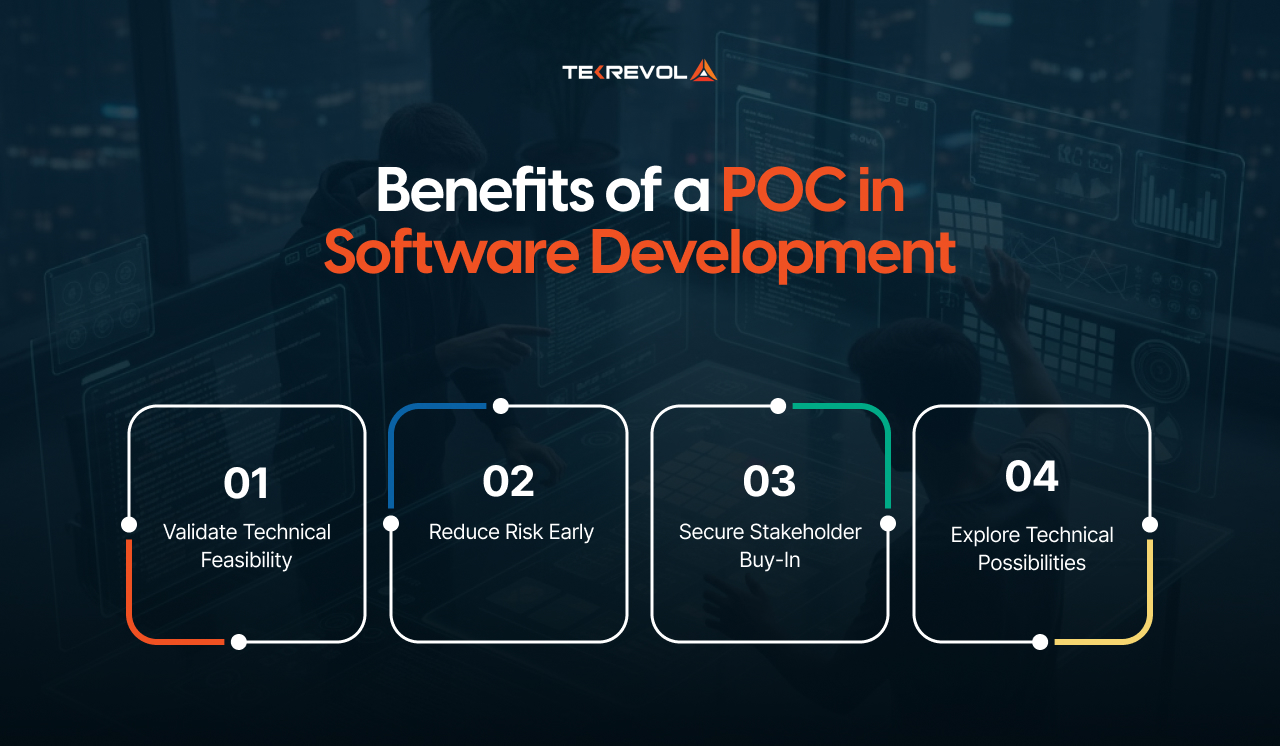
A Proof of Concept (POC) can help you prove the idea and your software, test the feasibility, and reduce the risks before taking big steps. Here are the benefits of proof of concept in software development:
| Reason | How a POC Helps |
| Efficient Use of Resources | Ensures time and budget focus only on viable projects. |
| Stakeholder Confidence | Builds trust by showing the idea has been tested and is feasible. |
| Better Planning | Reveals challenges early, allowing teams to adjust strategy and avoid roadblocks. |
| Risk Reduction | Minimizes costly mistakes by uncovering potential issues before full-scale development. |
Building Blocks of an Effective Proof of Concept
A POC will assist you in trying out concepts and getting clear before spending time and resources. Using a structured PoC in B2B technology projects significantly reduces risk by 53% and raises the likelihood of success to 72%. Any successful POC incorporates some basic components:
| Component | Purpose |
| Problem Statement | Define the challenge or need the project will address. |
| Project Definition | Clarify what the project intends to achieve. |
| Project Goals | Outline expected outcomes and how success will be measured. |
| Required Resources | List the tools, technologies, and people needed to execute the POC. |
How to create a POC in software development: 7 Steps to Validate Your Idea
Before investing heavily in custom software development, you need proof that your idea works. A POC does not need much investment and only takes a few moments to verify that your idea is viable, the technical constraints, and that what you plan to build matches the market. This is your guide to building a POC that provides practical insights.
Step 1: Pinpoint the Problem Worth Solving
Things to know before writing any code and before creating meetings: know what you are attempting to demonstrate. A POC is not about demonstration; it is about proving to yourself that your solution can actually resolve a real problem.
Ask essential questions: What issue does this solve? Who faces it? What will it do when it remains unsolved?
Pro tip: Interview 5-10 prospective users. They will help you either prove what you assume, or they will help you not to construct something that no one needs.
Step 2: Establish Your Success Metrics Upfront
This is the point at which most POCs fail: teams begin to create and do not define what success actually looks like. Key performance indicators are usually a measure of success that you must set before the development process starts.
Do not simply establish such goals as to improve the user experience. Establish measurable and specific criteria:
- Will the users finish a task within less than 3 seconds?
- Is the system capable of supporting 1,000 simultaneous users?
- Do you expect to need more than 2 hours to integrate with your existing database?
- Does it cost less than half a dollar per transaction?
Note: If you’re creating a PoC for someone else, prioritize what they see as success over your own metrics.
Step 3: Map Your Resources with Project Needs
A POC fails when the expectations of time, money, or talent are not realistic. The time frame of POC development will be between 2-4 weeks based on the scope and complexity of the project.
Make an honest inventory:
- Human Resources: Who is available, skilled, and able to dedicate time?
- Technical Resources: Assess the required tech stack and infrastructure for the PoC, and determine what resources you already have versus what needs to be acquired.
- Budget: Include both direct costs (tools, cloud services) and indirect costs (developer time).
- Time: establish a realistic schedule, including holidays, other obligations, and delays.
Select low-weight, scalable technologies for PoC that fit with your existing tech stack. It’s best not to include untested frameworks unless the PoC is intended to validate them.
Step 4: Build Your Execution Roadmap
Any POC that lacks a schedule is likely to be costly. Divide the process into small milestones that have deadlines. Your roadmap should cover:
- What are the features constructed in the first, second, and third stages?
- The checkpoints and progress reviews will be done once a week.
- By whom is the work to be evaluated and when?
- The final presentation date
Take an iterative approach with small cycles, focusing on core functionality and business goals. Avoid trying to perfect every aspect in the first go.
Step 5: Build and Test the Core Functionality
Develop only the essential capabilities and the main features of your POC. Any addition must be done to prove your main point. Key points to follow:
- Make it simple: Construct just enough to test your fundamental hypothesis. Do not have any unnecessary features that will slow you down.
- Iterative development: Develop in a cycle using agile practices and provide flexibility and rapid adjustments to changes.
- Continuous testing: It is applied to uncover the issues at the early stages and test the assumptions in real time.
- Teamwork: This is close alignment between developers, designers, and business analysts to ensure that all critical angles are covered.
- Document it all: Note observations, issues, and decisions during the process to take development in the future and prevent the loss of important data.
Following these steps ensures your prototype remains focused, actionable, and aligned with your POC goals.
Step 6: Gather Feedback and Analyze Results
The time of truth for your POC is testing. It confirms whether your solution is really visually appealing to the user’s needs. Key steps include:
- Test with real users: Do not just use your team members or your friends. Observe interactions, confusion, or hesitation to get the critical insights.
- Measure quantitative data: monitor such parameters as completion rates, error rates, load time, and performance.
- Collect qualitative responses: Interview, survey, and note body language and tone to get to know more.
- Compare to success criteria: Check the outcomes against the success criteria from Step 2. It’s better to spot issues now than pay for mistakes later.
- Discover trends: When several people are experiencing the same problem, it is not an exception and should be considered as an indicator.
Testing assists in fine-tuning your idea, identifying hidden problems, and preparing your POC to take the next step.
Step 7: Make Your Case to Stakeholders
Once you have formulated your PoC, now is the moment to share the results with the stakeholders or the decision-makers. It is made clear and action-specific through a structured presentation. Focus on:
- Key Findings: Discuss the strengths and what were the obstacles.
- Success Criteria Assessment: Demonstrate the performance of the PoC in comparison with the benchmarks established in Step 2.
- Recommendations: Gives recommendations on next steps, be it polishing the idea, proceeding to prototyping, or creating a minimum viable product (MVP).
- Business Impact: How the PoC helps the business achieve its goals or solve the original issue.
- Lessons Learned: Identify lessons that can be used to make future decisions and development.
A successful PoC demonstration can be helpful during the process of helping the stakeholders make informed decisions and form the foundation of scaling the solution to a full-fledged product.
Tips for a strong presentation:
- Use visuals like mockups, charts, and user journey maps to make abstract ideas concrete.
- If the POC shows the idea isn’t viable, frame it as a win; valuable time and resources are saved.
- If moving forward, clarify what changes from the POC to full development, setting realistic expectations for scope, budget, and timeline.
This approach ensures your POC presentation is clear, persuasive, and actionable, helping stakeholders make informed decisions.
Reduce Risk and Test Your Software Idea with TekRevol
Our team helps you build a fully functional PoC to validate feasibility and secure stakeholder confidence
Get Started Today!How to Create a POC in Software Development: Best Practices
For software projects, a well-structured PoC is essential to demonstrate feasibility and potential impact. Using the practices for PoC development, teams not only streamline the process but also emphasize the business value of software PoC to executives and investors.
The following are the best practices of POC development that yield results continuously:
Stay Focused on the Core Idea
Make your PoC lean and purposeful. Only test what is needed to introduce the idea. Additional features blur the focus and retard improvement.
Be Honest About Limitations
Every PoC has constraints. Clearly communicate what it does, and doesn’t. Transparency builds trust and sets realistic expectations in the process of building a proof of concept.
Use Feedback as a Strength
Take criticism as an eye-opener, not a defeat. The candid feedback identifies the gap in the initial stages and assists in streamlining the idea before its development.
Set Clear Timelines
Define start and end dates to maintain momentum. A PoC development lifecycle should move quickly and deliver answers, not drag on for an unlimited time.
Encourage Team Collaboration
Engage interdepartmental teams and encourage communication. Various views give more validation and effective decisions.
Document Insights as You Go
Note assumptions, feedback, difficulties, and insights. This documentation turns out to be a useful resource during scaling or pivoting.
Pros and Cons of Developing a Proof of Concept in Software Development
A Proof of Concept (POC) is an effective process of proving concepts before their full-scale development. Although it has obvious benefits, it is also associated with limitations:
| Pros | Cons |
| Reduces risk by identifying technical challenges early. | Limited scope; may not cover all features of the final product. |
| Builds stakeholder confidence and buy-in. | Requires upfront investment in time, resources, and technology. |
| Saves resources by validating concepts before full development. | Success in a POC doesn’t guarantee final product success. |
Successful PoC Implementations Across Industries
Proofs of Concept (PoCs) play a vital role in testing the idea, certifying technology, and collecting the feedback of users before a serious and costly development. In all industries, PoCs have helped companies to reduce risk, perfect solutions, and verify market demand. The most remarkable ones are the following:
Tesla – Autopilot and Autonomous Driving
The autopilot capabilities of Tesla were tested on their early models, which were equipped with cameras, radar, and sensors. The data obtained on the roads, as part of these PoC, allowed Tesla to refine the algorithms, increase safety, and experiment with the feasibility of semi-autonomous vehicles.
Airbnb – Short-Term Rental Platform
The founders of Airbnb began with a very basic site that allowed individuals to rent air mattresses at a conference. This initial PoC was a way of testing the market with short-term rentals and enabled the team to test the business idea before scaling to a global platform.
Slack – Internal Collaboration Tool
Slack, as an internal tool, has its origin dated back to Tiny Speck, which was a gaming company whose developers developed it to streamline communication amongst each other. The concept test run internally proved that the platform was highly demanded, and therefore, the company switched to Slack as the new platform, which is one of the most important workplace collaboration tools.
Google Cardboard – Affordable VR Testing
A PoC that Google created was a low-cost VR headset to test the possibilities of virtual reality. Basic applications and simple cardboard-based viewers gave the company a chance to understand how interested users are in VR and how they will comment on it, which will inform future VR efforts.
Spotify – Streaming Platform Validation
Experimenting with streaming and user behavior in a small-scale test, Spotify introduced itself to the world market. The PoC offered the company information on user preferences and performance of the platform, thus allowing the company to optimize the service, which was successfully launched globally.
Amazon Go – Cashier-Less Retail
Amazon tested computer vision, sensors, and AI on its small scale in several of its stores to explore the idea of a cashier-less shopping experience. The PoC validated the technology and customer experience to roll out to multiple locations with a fully functioning cashier-less model.
Partner with TekRevol to Build a Successful PoC
The Proof of Concept (PoC) is the most important initial work towards the conversion of innovative ideas into software solutions. At TekRevol, we have been successful in guiding companies to test their ideas and concepts with PoCs and successfully transform them into full-fledged products.
If you’re unsure whether to start with a PoC, Prototype, or MVP, our app developers guide you through each stage, clarifying their purpose and helping you choose the right approach for your project.
We have the experience to make each PoC designed, oriented, and aligned to your business goals to offer understandable knowledge and practical results.
By partnering with TekRevol, you gain more than just validation; you gain a roadmap for success. Our expertise helps you uncover opportunities, optimize solutions, and make confident decisions before committing to full-scale development.
Our team also guides PoC project cost estimates, helping you plan your budget effectively while minimizing risks.
Don’t leave your idea to chance.
Partner with TekRevol to validate your concept and turn it into a scalable solution.
Discuss Your Idea Now!