


The mobile gaming market pulls in billions yearly from millions of regular buyers. In such a saturated market, game monetization is no side task anymore. It is essential for long-term success. Yet figuring out how to monetize a game often proves tougher than building the game.
Effective game monetization relies on high player retention and long-term user engagement metrics. You must understand different game monetization models, like subscriptions and rewarded ads, to build a stable business.
This guide dives into contemporary game monetization strategies focused on boosting user engagement and player happiness throughout the stages of the game development lifecycle. Learn how to monetize a game online successfully, all while fostering a sustainable game economy.
How Game Monetization Works [The Core Principles]
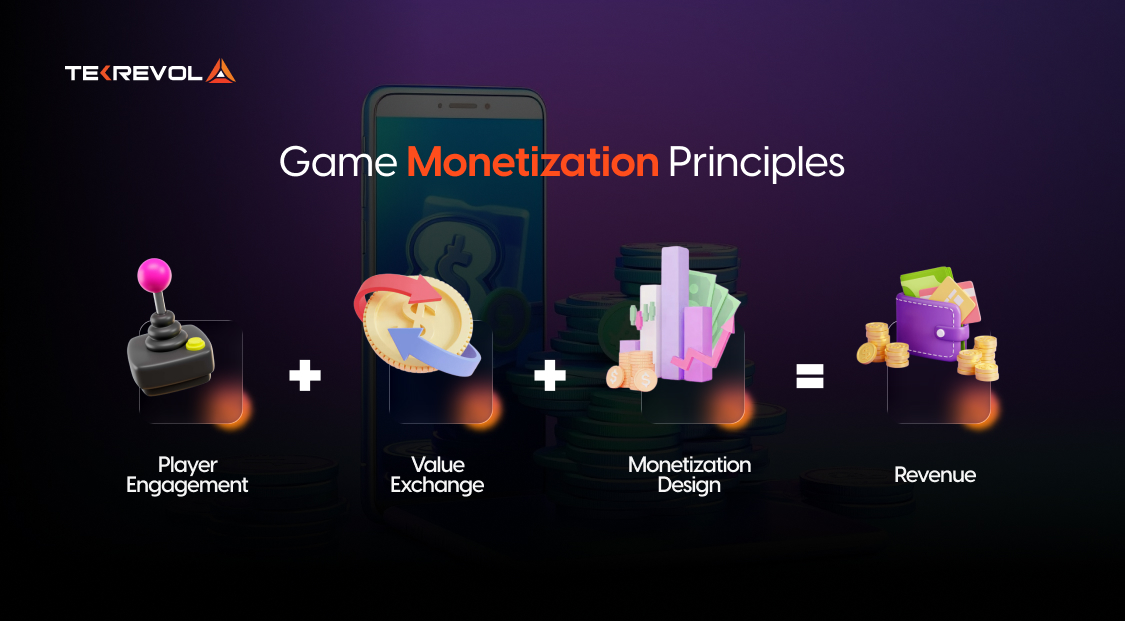
Game monetization is the strategic exchange of digital value for player time or money. You succeed when you align your game economy design with the natural flow of your gameplay loop.
A high-quality monetization funnel never feels like a roadblock to the player. So, work with a mobile game development company that will emphasize player retention as the foundation of your profit.
The Value Exchange
Players spend only when they see real value exceeding the price. Monetize via direct purchases or by offering player attention to advertisers. Striking this balance keeps your game monetization methods ethical and powerful for the long haul.
Engagement as Currency
User engagement is the primary driver of every successful monetization strategy framework. A player who stays for months is far more valuable than one who spends on day one and quits. You must minimize your churn rate to maximize the lifetime value (LTV) of your audience.
Design Integration.
Monetization should never be an afterthought in your production schedule. You must monetize a mobile game by weaving revenue triggers into the core mechanics. This approach prevents the experience from feeling like a series of greedy interruptions.
Struggling with Revenue Leaks?
Tekrevol optimizes game monetization principles for steady revenue growth.
Get in TouchWhy Players Spend Money in Games [Behavioral Economics]
Players click buy when an item’s felt value surpasses its price tag. They snag items to flaunt their style or claim a competitive upper hand. As er report by NewZoo, global gaming revenue is projected to hit $197 billion by the end of 2025.
Mobile game revenue statistics highlight that the platform alone will generate $108 billion of that total through various game monetization methods. This massive spending is driven by below psychological triggers.
- Convenience and Time represent the biggest spending category for modern gamers. About 34% of players pay to unlock exclusive content or skip repetitive tasks.
- Cosmetic Expression allows players to show off their identity within a digital community. Cosmetics monetization through skins and avatar accounts for 29% of all microtransactions.
- Social Competition triggers spending when players want to keep up with their friends. Research shows that playing with friends is one of the top three motivators for monetizing a mobile game.
Data from the eMarketer 2025 survey shows that about 32% actively ignore ads, and an almost equal share find them helpful. If you ignore these whales in your game economy design, you lose your primary source of income. Balancing these two groups is the secret to how to monetize a game successfully.
Different Types of Game Monetization Models With Use Cases
Game monetization models vary from in-app purchases and rewarded advertising to premium pricing and recurring subscriptions. Top US game developers often use these models in tandem to create a hybrid system that extracts value from every player segment.
Selecting the right model depends on your genre and target player demographics to avoid friction.
| Monetization Model | Best For | % of Total Revenue | Key Benefit |
| In-App Purchases (IAP) | RPG and Strategy games | 62% | Highest revenue potential from “whales.” |
| In-Game Ads (IAA) | Casual and Hyper-casual titles | 26% | Monetizes 100% of your player base for free |
| Subscriptions | Live-service and Simulation games | 12% | Provides steady and predictable recurring income |
| Hybrid Models | Hybrid-casual and Battle Royale | N/A | Maximizes LTV by mixing ads with optional IAPs |
In-App Purchases (IAP)
In this model, you design your virtual store that feels like a natural extension of the gameplay rather than a separate marketplace. A successful game monetization example as Accio is Genshin Impact, which generated over $0.8 billion in 2025 through its character-driven shop.
You can categorize your in-game purchases into two primary types. Consumables are items that players use up, like health potions or extra lives. These drive recurring revenue because players must buy them again once they are gone. Non-consumables are permanent unlocks, such as new characters or level packs. These are highly effective for player retention as they provide lasting value to the user’s account.
Successful developers prioritize cosmetics monetization to avoid the “pay to win” label. Selling skins and emotes allows you to earn revenue without ruining the competitive balance. You can also supplement these sales with in-app advertising to earn from non-paying users.
In-Game Advertising
In-game advertising strategies are the most effective way to monetize a mobile game with a massive casual audience. This is the primary method for those looking for how to monetize a game for free while keeping the lights on.
Forbes predicts that the global in-game advertising market will grow to roughly $12.3 billion by 2028. This model treats ads as an optional reward rather than an intrusive interruption. Players choose to watch a short video in exchange for a benefit like a life or a currency boost.
You can also show interstitial ads or banner ads during natural breaks in gameplay, like between levels. While the revenue per user is lower than IAP, the sheer scale of the audience can lead to significant mobile game revenue.
Use ad mediation to ensure you are always showing the highest-paying ads to your players. This approach maximizes ad revenue in mobile games without requiring a single direct payment from the player.
Premium Paid Games
The one-time purchase model is still a viable app store pricing strategy for high-quality narrative experiences. Premium pricing usually ranges from $4.99 to $69.99, depending on the scale of the project. It signals to the player that your game is a complete and high-end product.
While this model has a higher barrier to entry, it often results in higher initial player loyalty. When using this model, must focus on high-quality app store optimization to stand out in a crowded market.
Freemium or Free-to-Play (F2P)
This is the primary method for those looking for how to monetize a game for free while keeping the lights on. The freemium model allows users to download the game for free while offering optional in-game purchases. This lowers the entry barrier and allows you to reach a massive global audience.
Revenue is generated through a small percentage of “whales” who spend significantly, and a larger group of “minnows” who make small purchases. Most game monetization examples, like Candy Crush or Roblox, use this strategy to maintain millions of daily active users.
Subscription-Based Monetization
Subscriptions are the ultimate tool for generating recurring revenue in modern gaming as they offer players exclusive benefits or content for a recurring monthly fee. The battle pass and season pass models have revolutionized how players engage with long-term titles.
These systems reward players for their time and effort over a specific season or month. This strategy is a cornerstone of mobile game marketing because it creates a predictable and steady income stream.
Hybrid Monetization
The hybrid monetization approach combines multiple revenue streams into a single blended revenue model. For example, a game might offer a subscription for hardcore fans and rewarded ads for casual users.
This freemium monetization strategy ensures that every segment of your audience can contribute to your success. It is the most robust way to manage game monetization in a volatile market.
How Do You Monetize a Game [Step-by-Step Framework]
To monetize a mobile game effectively, you should identify the target player persona and select a model that aligns with your core gameplay loop. You must integrate revenue triggers naturally and use analytics to optimize pricing and engagement over time.
Follow these steps to build a mobile game marketing plan that works for your players and your bank account.
1. Identify your target player persona
Research your audience on platforms like how to monetize a game reddit to understand their spending limits. You must know if your players value competition, relaxation,, or social status.
2. Choose the right monetization model
Pick a model that complements your core loop, like IAP for RPGs or ads for hyper-casual puzzles. Your choice should feel like a natural extension of the fun.
3. Design monetization around core gameplay
To advertise your mobile games, integrate your shop and triggers so they do not break the immersion of the player. The best game monetization process feels invisible to the average user.
4. Implement monetization tools
Use a reliable game monetization SDK to handle transactions and ad delivery securely. This ensures a smooth experience for your users and accurate data for your team.
5. Test, iterate, and optimize
Use game analytics tools to monitor player behavior and adjust your pricing or ad frequency. Constant monetization planning is required to keep your economy balanced as your game grows.
This game monetization process is crucial for avoiding the mistakes that often lead to low user engagement. Many developers share their findings on how to monetize a game in Reddit threads to improve industry standards.
Confused by complex game economics?
Tekrevol builds custom frameworks to monetize a game.
Connect with UsBest Game Monetization Strategies According to Game Type
Different platforms and genres demand tailored game monetization approaches for success. Mobile games thrive with ads plus small purchases, while PC games favor premium sales and add-ons. Here’s which strategy fits each genre or platform best:
Add Image
Mobile Games
Mobile game monetization requires a deep understanding of iOS and Android monetization differences. You should advertise your mobile games through targeted campaigns to attract high LTV users. Focus on high-frequency interactions that provide immediate value to the player.
PC & Console Games
These players often love DLC monetization, which gives them new levels or stories to play after the initial sale. Some premium games on Steam often see a second life through seasonal bundles and community items. You might even explore web3 game development services to offer players true ownership of their digital assets.
Casual vs Hardcore Games
Casual game monetization thrives on high volume ad impressions and low-cost power-ups. Hardcore gamer spending is driven by deep meta systems and competitive advantages. You must tailor your strategy to the specific intensity of your gameplay.
Essential Tools & Platforms For Game Monetization
Platforms like Google AdMob or Unity Ads simplify the process of monetizing mobile games with ads, while Firebase reveals player behavior patterns. These gaming monetization tools tackle the tough tech details, freeing you to refine your game.
- Unity Ads excels for developers needing high fill rates and seamless setup.
- Google AdMob delivers top-tier targeting and a vast global advertiser network.
- ironSource provides premier mediation to boost daily earnings.
- Firebase Analytics tracks user paths and pinpoints spending hurdles.
A strong game monetization SDK keeps your store secure and reliable for everyone.
Game Monetization KPIs That Actually Matter
To master how to monetize a mobile game, move beyond simple revenue totals and track specific key performance indicators (KPIs). Data-driven optimization is the only way to stay competitive.
Use game analytics tools to monitor these metrics daily and adjust your mobile game marketing strategies based on real player behavior.
| KPI | Definition | Why It Matters |
| LTV | Lifetime Value | Predicts the total profit from a single player journey |
| CAC | Customer Acquisition Cost | Shows if you are spending too much to find new users |
| ARPU | Avg Revenue Per User | Measures the overall financial health of your total base |
| ARPPU | Avg Revenue Per Paying User | Highlights the spending power of your core fans |
A successful game maintains a high LTV vs CAC ratio to ensure sustainable growth. You must also track retention D1/D7/D30 to see if players find your world worth revisiting. High ROAS and a strong K-Factor indicate that your game is growing organically and profitably. Tracking whale vs minnow spend helps you create tailored offers for different budget levels.
Common Game Monetization Mistakes
Many developers focus so hard on immediate profit that they ignore the long-term health of their game economy. Avoiding these errors is essential for anyone trying to monetize a mobile game in the competitive market where user patience is low.
Aggressive Interstitial Ad Frequency
One of the fastest ways to increase your churn rate is by forcing too many ads on your players. If a user sees an ad every 60-seconds they will likely delete the app. Successful game monetization models treat ads as a reward or a natural break rather than an interruption.
The Pay to Win Trap
Creating an environment where players can buy power often destroys the competitive integrity of your game. In the USA, players are increasingly vocal about avoiding games that feel like “money pits.” If a paying user can easily beat a skilled free user, your player satisfaction will drop. Focus your microtransactions on cosmetics or convenience to keep the playing field level for everyone.
Confusing Store UI
If players can’t find or navigate your store, you lose mobile game revenue. Make in-game purchases easy to understand. Provide clear descriptions of what players buy. Skip complicated currency conversions and hidden costs. They create user friction and spike refund rates. Simple and transparent game design is a hallmark of the most successful monetization methods.
Ignoring the Non-Payer Experience
Since 95% of your players may never spend money, you must ensure their experience remains high quality. These users provide the scale and social activity that keep your game alive for the “whales.” If you treat non-spenders like second-class citizens, your community will shrink rapidly. Use rewarded video ads to give these players access to premium features without requiring a credit card.
Failing to Test and Iterate
Many set their monetization strategy once and never look back. Must track how players interact with your prices and ad placements. A/B testing different offers or ad frequencies is the only way to find your optimal ARPU. A stagnant economy leads to bored players and falling lifetime value (LTV). Consistent updates and live ops events are necessary to keep your mobile game monetization healthy and profitable.
Conclusion
Your quest for how to monetize a game ends here. Effective game monetization is a skill that you can learn with a little bit of practice and a lot of heart. To make money from your title, focus on player-first monetization, and you will build a business that people are happy to support.
A scalable monetization strategy expands with your game and delivers steady revenue. Need help scaling your title? Reach out to our digital marketing agency for pro advice. Remember, long-term monetization thrives on trust and exceptional gameplay.
Want better conversion rates?
Get expert help to build winning game monetization plans.
Discuss Your Project


