



- Unity uses C# and has an easier learning curve. That makes it the go-to choice for beginners, indie developers, and mobile games.
- Unreal Engine 5 uses C++ and Blueprints. It leads on cinematic graphics through tools like Nanite and Lumen.
- More developers now name Unreal Engine as their primary tool than Unity. That’s a first, according to GDC’s 2026 industry survey.
- Unity still ships more total games and dominates mobile. Unreal Engine dominates revenue per title and AAA production.
- Unity Pro costs $2,310 per seat per year in 2026. Unreal Engine charges no upfront fee, only a royalty once your game passes $1 million in revenue.
- Neither engine is the “correct” answer. The right one depends on your game’s scope, your team’s skills, and your budget.
You finally have the idea. The story is clear in your head. The gameplay loop makes sense. You open your laptop and click “New Project.” Then you freeze. Unity or Unreal Engine? Every game creator hits this wall eventually. It feels bigger than it should.
Here’s the real problem. Both engines are genuinely excellent. There’s no simple “winner” to Google your way out of this. Unity gets you moving fast. It has an easier learning curve and a huge asset library. Unreal Engine 5 gives you cinematic, near-photorealistic graphics that Unity still can’t fully match.
The right choice depends on your game, your budget, and your team. It doesn’t depend on which engine has more hype this year. If you’re weighing this for a real project, talk it through with a mobile game development company early. It can save you months of rework later.
This guide walks through both engines in plain terms. We’ll cover graphics, pricing, learning curve, mobile and VR support, and real project examples. By the end, you’ll be able to pick with confidence instead of guessing.
What Is Unity, and What Is It Best For?
Unreal Engine was introduced by Epic Games back in 1998 for complex 3D game development, high-fidelity gameplay, and cinematic graphics. Unreal Engine truly provides you with all the tools to create film-style, real-time simulation games.
- According to Sensortower in 2024, more than 28% of new games on Steam were developed by Unreal Engine. Second-largest share of game development on the platform.
- Another report also states that games that were powered by Unreal Engine were sold 31% per unit as compared to Unity.
Unity is a beginner-friendly, cross-platform game engine. It’s best known for mobile games, indie projects, and AR or VR apps. Unity was built to get developers from idea to playable prototype fast. That speed is still its biggest strength today.
Unity isn’t just for games anymore, either. It also powers training simulations, product visualization, and design tools across industries like automotive and education. If you’re weighing Unity game development for your next project, that flexibility is a big part of the appeal.
Unity currently powers around 70% of the top-grossing mobile games on the market, according to Unity’s own developer data. That’s a huge reason it remains the default choice for mobile-first studios.
What Is Unreal Engine, and What Is It Best For?
Unity is known as the perfect choice for indie game developers, AR/VR creators, and mobile gaming studios that look to create versatile and cross-platform games easily and instantly.
But, here’s the real catch: Unity is not limited to game development anymore; it also powers educational software, healthcare simulations, and automotive designs. It is helping various industries with the 3D capabilities by visualizing and simulating in unique ways.
- As per the official Unity report, 71% of the top 1000 mobile games were created using the Unity engine.
- Another report states that over half of the games (51%) released on Steam were powered by Unity, sharing the largest game development among other engines.
If your game leans heavily on visuals and scale, our Unreal Engine game development team can help. We’ll tell you if that extra horsepower is worth it for your project.
Unreal Engine vs Unity: Key Differences
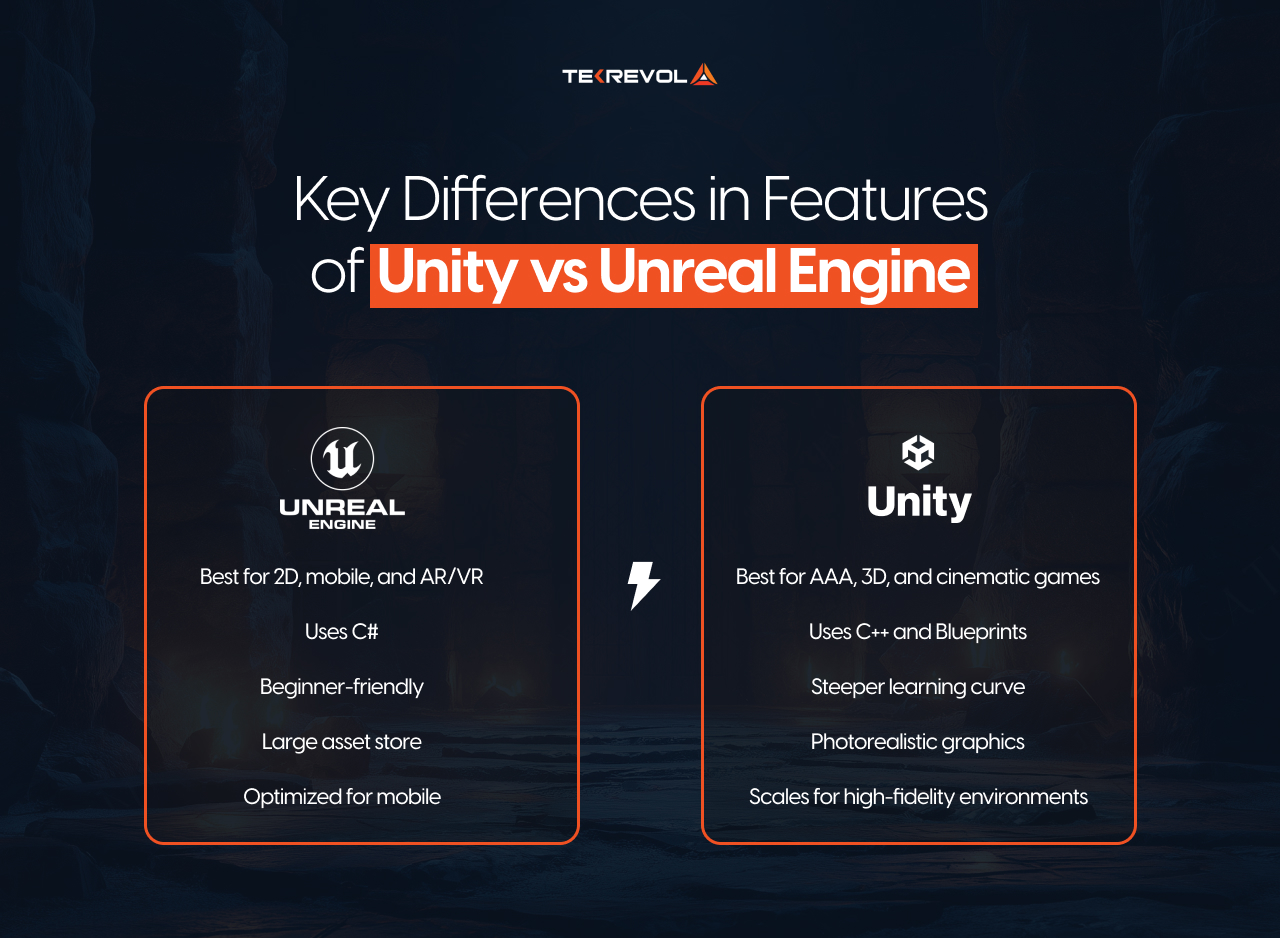
When we debate about Unity vs Unreal Engine 5, we cannot ignore that both of them are leading in the industry, but in completely different ways. The real thing is which one exactly fits the vision and goals of your game.
Unity is known for faster development and accessibility, which makes it an ideal choice for a mobile app development company focused on cross-platform and mobile game development.
Meanwhile, Unreal Engine 5 is known as the beast for creating high-end 3D graphics and realistic rendering. This is the major reason big gaming studios adopt it for creating AAA games.
Below is a quick overview of Unity vs Unreal Engine comparison, so that you can easily spot their key differences.
| Category | Unity | Unreal Engine 5 |
| Primary Use | 2D mobile game development, AR/VR, indie projects | 3D, AAA games, film, and simulation |
| Programming Language | C# | C++ and Blueprints |
| Graphics Quality | Strong for mobile and mid-tier visuals (HDRP & URP pipelines) | Industry-leading photorealistic graphics (Nanite and Lumen) |
| Ease of Use | Easy learning curve for beginners | Steeper learning curve |
| Performance | Optimized for mobile and lightweight builds | Optimized for large-scale, high-fidelity 3D environments |
| Asset Store and Marketplace | Huge library of ready-made assets and plugins | Smaller store, but includes higher-quality cinematic assets |
| Cross-Platform Support | 25+ platforms, including mobile, console, AR/VR | 15+ platforms with deep integration for PC and consoles |
| Community and Support | Larger beginner and indie community | Strong professional and enterprise-level support |
| Best For | Quick prototyping, 2D/3D mobile titles, AR/VR apps | AAA games, cinematic experiences, virtual production |
Unity vs Unreal Engine: List of Features
The main difference in Unreal Engine vs Unity lies in their list of features, like graphics, performance, and cross-platform development. Both of them have their own system designed to fill specific developer goals.
Let’s check each of them out.
Graphics and Rendering
Unity:
Unity has 2 main pipelines for rendering: Universal Render Pipeline (URP) for creating light and mobile-friendly graphics, and High Definition Render Pipeline (HDRP) to produce advanced graphics for PC and console.
URP allows game creators to optimize games across multiple devices, and HDRP allows them to create high-fidelity visuals without requiring a heavy system. The strength of Unity lies in balancing the quality of visuals with smooth performance, specifically for mobile and AR/VR games.
Unreal Engine:
On the other side, we have Unreal Engine 5. It uses Nanite and Lumen to redefine 3D graphics for big titles.
Nanite works on handling complex geometry by streaming ultra-detailed assets, while Lumen helps with global illumination to give a real direction to lighting and reflections. As Unreal Engine is dominating the field of 3D rendering, it has become the most preferred choice for creating AAA games.
Scripting and workflow
Unity:
Unity game development uses C# as its scripting language, which is widely popular for being simple and beginner-friendly. This makes Unity ideal for indie game creators and for those teams that want to work fast.
It also lets creators quickly prototype and iterate by combining the visual editor and component-based system.
Unreal Engine:
Unreal Engine is powered by C++, which makes it a bit complex for beginner creators; however, it offers deep control for huge and complex games.
Another thing that makes Unreal Engine stand out is its node-based tool called “Blueprint Visual Scripting” that allows you to visually create the logic without the need to write a single line of code. This flexibility promotes smooth collaboration between designers and programmers.
Asset Stores and Content Pipeline
Unity:
Unity’s Asset Store contains 1000s of ready-made assets, 3D models, scripts, and plugins, which help creators to speed up the development process without creating anything from scratch. This is the massive advantage for small teams and indie studios that cuts the development time and costs.
Unreal Engine:
Unreal has the Unreal Marketplace, which has mainly less assets as compared to Unity, but all of them are high-quality and production-ready. Most of them are produced by Epic Games, yes, the one that introduced Unreal Engine in the industry. Unreal Engine provides developers with access to realistic textures and 3D models with monthly free asset drops and Quixel Megascans integrations.
Cross-Platform Deployment and XR Capabilities
Unity:
Unity supports more than 25 platforms, which include iOS, Xbox, PlayStation, Switch, Windows, Android games, and essential XR devices like Meta Quest and HoloLens.
When it comes to Unreal Engine vs Unity, it’s clear that Unity takes the lead in mobile and AR/VR games with its compatibility and cross-platform flexibility.
Unreal Engine:
Well, Unreal Engine also supports many platforms, but it is mainly created for PC, consoles, and next-gen hardware. It is mainly used in VR simulations, film production, and structure, by using powerful XR tools.
Its 3D rendering capabilities make sure that everything within the game appears stunning, mainly in high-performance VR or cinematic experiences.
Performance, Optimization, and Scalability
Unity:
Unity is made to deliver smooth performance on different devices, from PCs to mobile phones. It has a lightweight runtime and other powerful tools for optimization that allow creators to manage the game performance with ease.
Different tools like the Profiler and Burst Compiler let teams track the usage of CPU and GPU, fix issues, and make games run smoother and faster without causing any trouble.
This flexibility in Unity makes it the best choice for basic 3D and 2D games that can perform flawlessly across platforms.
Unreal Engine:
Unreal Engine is all about raw power and scalability. It is creative to deal with the detailed 3D worlds and complex gameplay.
Advanced tools like Nanite and Lumen make it easier for creators to handle large environments while creating attractive graphics. This helps developers focus on working creatively rather than manual optimization.
So when we talk about Unreal Engine vs Unity for creating top-tier cinematic AAA games, Unreal Engine takes the lead for sure.
Create the Next Hit That Players Remember
Whether you choose Unity or Unreal Engine, our team always delivers the desired gameplay with the right tools.
Talk To Our Experts Now!Unreal Engine vs Unity: Subscription Tiers in 2025
When you think about the pricing and licensing of both engines, you need to know that Unreal Engine vs Unity is a typical business decision rather than a mere technical choice with huge implications for your budget, size of the team, and the way you scale the game.
Unity Pricing Tiers and Subscription Models
On 1st January 2025, Unity cancelled its controversial “Runtime Free” model and had to return to the seat-based subscription structure.
Now, the updated subscription terms look like this:
- Unity Personal is free, and the revenue and funding cap has been increased from $100,000 to $200,000 for creators.
- As for Unity Pro, there is an 8% increase in the subscription price per seat, making it $2,200 annually.
- The price of Unity Enterprise has also experienced a hike of 25% for large-scale studios that easily generate revenue over $25 million.
For creators comparing Unreal Engine vs Unity, this shows that Unity offers predictable subscriptions and low barriers for beginners.
Unreal Engine 5 Royalties and Licensing Terms
- You do not need to pay for anything up front to develop your game in Unreal Engine. Epic Games starts charging you once your game earns a specific revenue of $1 million. This factor differentiates the pricing tier a bit for Unreal Engine vs Unity.
- Unlike Unity, on January 1, 2025, Unreal Engine decided to introduce a program “Launch Everywhere with Epic“, in which they dropped the royalty rate from 5% to 3.5% for those games that launch on Epic Games Store across different platforms.
So, those comparing Unreal Engine vs Unity can clearly see that the cost of Unreal Engine scales with the success of your game, which can be good for high-revenue games, but makes things complex for smaller projects.
Popular Games Powered By Unity
| Game | Year Released | Platform | Genre | A Quick Overview |
| Among Us | 2018 | PC, Mobile, Consoles | Social Deduction | A multiplayer 2D game where crewmates have to catch the imposter. |
| Pokémon GO | 2016 | iOS, Android | AR / Adventure | AR blended with the real world to catch the Pokémon |
| Beat Saber | 2018 | PC VR, PS VR | Rhythm / VR | VR rhythm slasher promoting Unity’s strong XR tools. |
| Call of Duty: Mobile | 2019 | iOS, Android | FPS / Battle Royale | Mobile shooter battleground game. |
| Cuphead | 2017 | PC, Consoles | Action / Platformer | 1930s-style hand-drawn game. |
| Genshin Impact | 2020 | PC, PS, Mobile | Open-World RPG | Massive anime-style world. |
| Fall Guys | 2020 | PC, Consoles | Party / Battle Royale | Chaotic multiplayer game with colorful and fun characters |
| Untitled Goose Game | 2019 | PC, Consoles | Stealth / Sandbox | Indie hit featuring a playful goose causing mischief. |
| Subnautica | 2018 | PC, Consoles | Survival / Exploration | Deep-sea survival adventure. |
| Hollow Knight | 2017 | PC, Consoles | Action / Metroidvania | Hand-drawn indie classic with smooth Unity performance. |
Popular Games Powered By Unreal Engine
| Game | Year Released | Platform | Genre | A Quick Overview |
| Fortnite | 2017 | PC, Consoles, Mobile | Battle Royale | Build, fight, and survive in one of the most popular multiplayer battle royales. |
| Valorant | 2020 | PC | Tactical Shooter | Team-based shooter mixing gunplay with unique agent abilities. |
| Dead by Daylight | 2016 | PC, Consoles | Horror / Survival | One player hunts down four survivors trying to escape deadly arenas. |
| PUBG: Battlegrounds | 2017 | PC, Consoles, Mobile | Battle Royale | 100 players fight for survival on realistic maps. |
| Street Fighter 6 | 2023 | PS5, Xbox, PC | Fighting | Classic fighting franchise returns with modern visuals and global competition. |
| The Witcher 3: Wild Hunt | 2015 | PC, Consoles | Action RPG | Follow Geralt of Rivia on an epic journey through a vast open world of monsters and magic. |
| Tetris Effect | 2018 | PC, Consoles, VR | Puzzle / Music | An exquisite reinvention of Tetris, blending visuals, music, and rhythm. |
| Batman: Arkham Knight | 2015 | PC, Consoles | Action / Adventure | Become Batman and defend Gotham City. |
| Rocket League | 2015 | PC, Consoles | Sports / Action | Soccer meets cars in a fast-paced multiplayer game. |
| Tekken 8 | 2024 | PS5, Xbox, PC | Fighting | The latest entry in the iconic fight. |
Unity vs Unreal Engine: Which Should You Choose for Your Game?
Match your engine to your project, not to whichever one sounds more impressive. Use this scorecard as a starting point.
| Your Situation | Recommended Engine |
| Mobile game or indie MVP | Unity |
| Tight budget, need to launch fast | Unity |
| AAA-quality 3D or cinematic visuals | Unreal Engine |
| Large open-world or console game | Unreal Engine |
| First game, limited coding experience | Unity |
| VR or AR app for multiple devices | Unity |
| High-end architectural or training visualization | Unreal Engine |
Level Up Your Next Big Game With TekRevol
The debate of Unity vs Unreal Engine may never end, but we can definitely end your confusion on which game development partner you should go with. At TekRevol, we turn every game idea possible with our skills in similar game development engines like Unity and Unreal Engine.
If you think of an immersive 3D game with cinematic graphics, the ones built using Unreal Engine 5.5, or even if you dream of speeding up the game development process of your 2D cross-platform indie game, just like those powered by Unity, our expert team is always ready to take the lead and make your imagination run in the real world.
For TekRevol, it is never about Unreal Engine vs Unity. We can easily handle your game goals with Unreal Engine and Unity, and help you scale your game in the industry just like other hit titles.
Ready to Build a Game Players Actually Remember?
Let TekRevol ease the confusion between Unreal Engine vs Unity and bring your game ideas to life.
Start My Game Development Journey


