- Reactive AI agents respond to input instantly. They have no memory and follow fixed rules.
- Proactive AI agents plan ahead. They use memory, learning, and prediction to act before something happens.
- Reflex agents and goal-based agents are the technical names behind reactive and proactive behavior.
- Most real businesses end up using a hybrid: reactive agents for speed, proactive agents for strategy.
- Your data maturity, not your budget, is usually the real deciding factor between the two.
- Even tools like ChatGPT are reactive by default. True proactive behavior needs memory and a trigger system built on top.
Picture two customer service tools. One waits for a customer to type “where is my order.” It replies right away. The other notices a delivery is running late. It messages the customer before they even ask. Both are AI agents. Only one of them is thinking ahead.
That’s the whole reactive vs proactive AI split in one example. A reactive AI agent responds to what’s happening right now. It uses fixed rules and has no memory of the past. A proactive AI agent uses memory, prediction, and planning. It acts before a problem shows up.
That’s why so many teams now pair simple reactive bots with AI development services. Together, they build the smarter, forward-looking layer on top. Neither type is “better” on its own. The right pick depends on the job you’re asking it to do.
What Is a Reactive AI Agent?
A reactive AI agent is a system that responds only to what it sees right now. It has no memory of anything that happened before. Think of it as a reflex, not a decision. You give it an input. It gives you an output. Then it forgets the interaction the second it’s done.
This is the simplest and oldest type of AI agent. It’s still one of the most widely used. A lot of business tasks just don’t need anything more complex.
If you’ve searched what is reactive agent or reactive ai meaning, here’s the short version. No memory. No planning. Just an instant match between input and action.
Reactive AI Key Features
- No memory: A reactive agent never stores past interactions or outcomes.
- Instant action: It responds the moment it receives an input, with no delay for analysis.
- Low complexity: Reactive agents need less computing power and less data than proactive ones.
Examples of Reactive AI Agents
- Chatbots: Answering based on a keyword match, not the conversation history.
- Spam filters: Flagging an email the moment it matches a known pattern.
- Security systems: Triggering an alarm the second motion is detected, regardless of context.
What Is a Proactive AI Agent?
A proactive AI agent is a system that plans ahead using memory and prediction. It doesn’t just react to whatever happens next. It doesn’t wait for a problem to show up. It looks at patterns and forecasts what’s likely to happen.
Then it acts to get ahead of it. This is what people usually mean when they search for a proactive AI agent or proactive artificial intelligence. It’s an agent with a goal. Not just a rulebook.
A reactive agent asks, “What just happened?” A proactive agent asks, “What’s likely to happen next?” It also asks, “What should I do about it?” That shift in mindset is the whole point of proactive AI. They’re built for planning, forecasting, and personalization.
Proactive AI Key Features
- Memory and learning: Proactive agents remember past interactions and use them to improve.
- Prediction-based decisions: They use forecasting models to plan several steps ahead.
- Adaptability: They change their behavior as conditions change. They don’t just run the same fixed rule every time.
Examples of Proactive AI Agents
- Autonomous vehicles: Predicting traffic conditions and adjusting driving behavior in advance.
- Predictive maintenance: Flagging a machine for repair before it actually breaks down.
- Virtual assistants: Booking a meeting or sending a reminder before you even ask.
Partner with Tekrevol to Build Smarter AI Chatbots and Agents
Avoiding outdated bots is only half the battle; success depends on having the right AI chatbot development company guiding your transformation.
Get in TouchReactive vs. Proactive AI Agents: Comparison Table
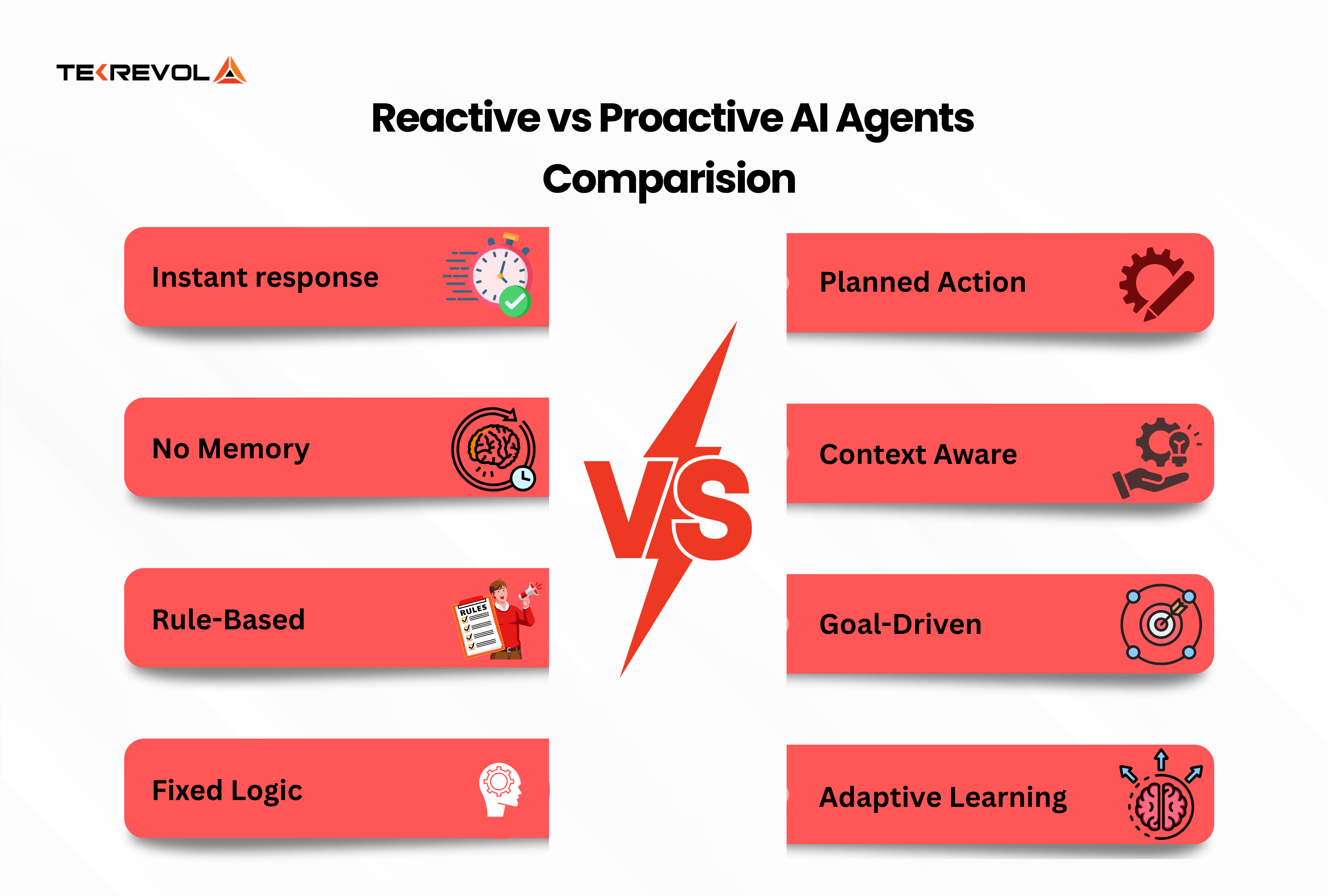
Here’s a transparent comparison between reactive AI agents and proactive AI agents, in areas that count the most. This is where the difference is self-evident.
| Feature | Reactive AI Agents | Proactive AI Agents |
| Decision-Making Approach | Immediate response to current stimuli | Anticipates future events and plans actions accordingly |
| Memory and Context Awareness | Stateless or limited context retention | Maintains context and history to guide decisions |
| Goal Orientation | Not goal-oriented; responds based on pre-set rules | Operates toward defined objectives or long-term outcomes |
| Adaptability | Low; does not learn or adapt over time | High; adapts behavior using machine learning and data insights |
| Learning Capability | Usually fixed logic; minimal or no learning | Supports learning algorithms and continuous improvement |
| Complexity of Tasks Handled | Best for simple, repetitive, rule-based tasks | Suitable for complex, dynamic, and multi-step tasks |
| Example Use Cases | Spam filters, auto-reply bots, rule-based QA | Smart assistants, predictive maintenance, AI sales forecasting |
| Scalability | Scalable for low-variation, high-volume tasks | Scalable for evolving and data-driven workflows |
| Data Dependency | Minimal data requirement | Requires significant historical and contextual data |
| Execution Speed | Fast due to straightforward logic | Slightly slower due to planning and forecasting |
| Best Fit For | Real-time processing with minimal complexity | Strategic planning, personalization, and anticipatory workflows |
| Business Function Alignment | Operational tasks, routine automation | Customer experience, resource planning, and intelligent decision support |
What Are the Different Types of AI Agents?
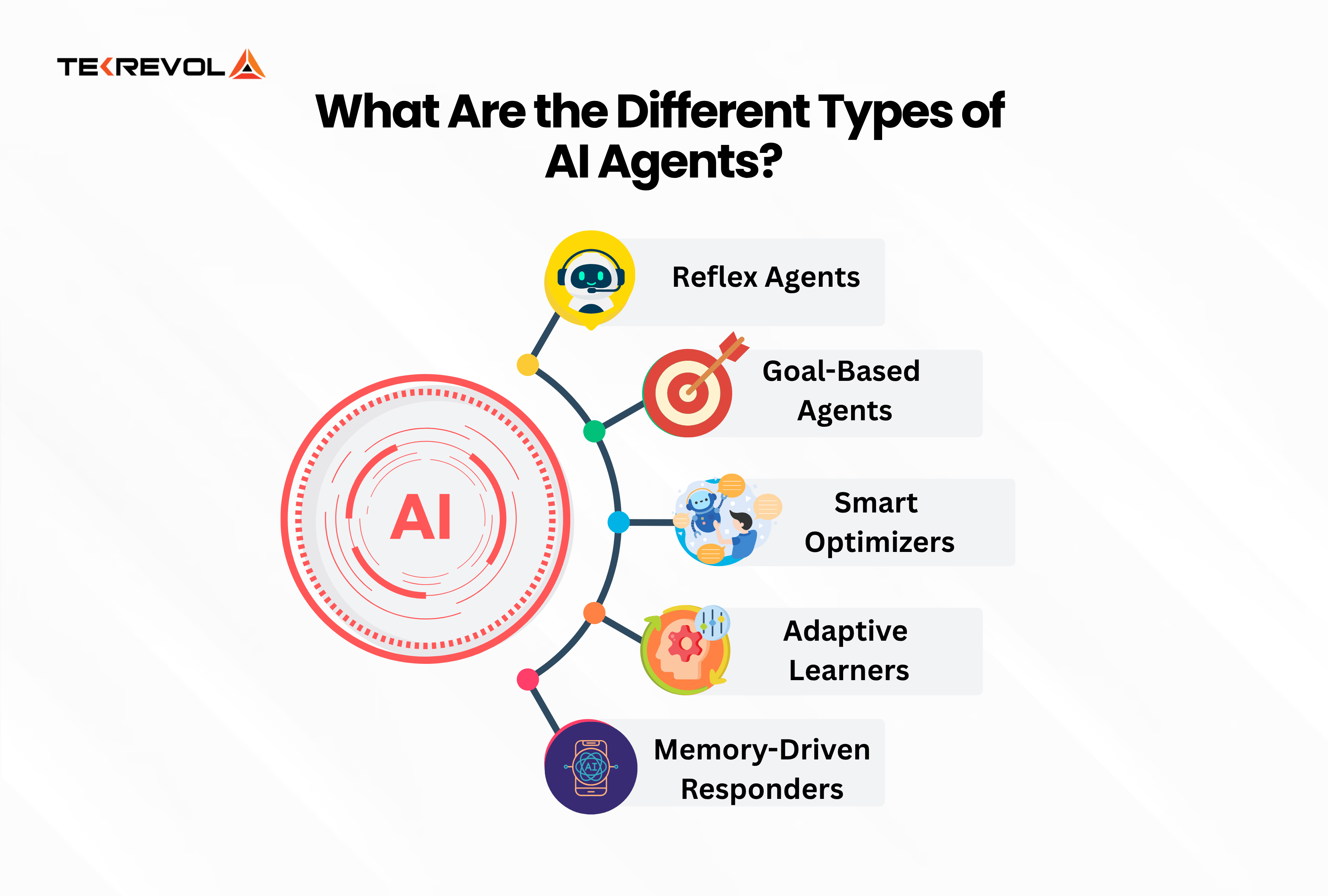
There are various types of AI agents, each with varying purposes in the reactive AI vs proactive spectrum. There are a few important ones:
- Reflex agents: These agents execute simple actions upon direct stimuli. They are rapid and need little processing.
- Model-based reflex agents: These agents have an internal world model and are able to modify their reactions according to past states.
- Goal-based agents: These agents set goals and use forecasting and planning to achieve them.
- Utility-based agents: These agents maximize their activities based on a utility function that calculates the relative worth of several options.
- Learning agents: These agents, which frequently employ machine learning techniques, are able to gain knowledge from experience and gradually enhance their performance.
What Are the Key Differences Between Reflex and Goal-Based AI Agents?
When contrasting Reactive vs. Proactive, one needs to point out the difference between reflex agents and goal-based agents, which are both subsets of the latter category of reactive AI and the former category of proactive AI, respectively.
Reflex agents: These agents have a straightforward stimulus-response scheme. They do not look ahead and plan for the future. Reflex agents are appropriate when instantaneous responses to environmental stimuli must be generated, but no optimization for long-term objectives is possible.
Goal-based agents: These are intrinsic, proactive agents. They seek particular goals through planning, learning, and adaptation by forecasting the future. Goal-based agents are optimal for more sophisticated environments where they need to plan strategically.
Overall, reflex agents are reactive, whereas goal-based agents have proactive decision-making, so they can plan ahead and optimize for later results.
How Do Goal-Based AI Agents Outperform Reflex Agents?
Goal-based agents are better suited for a world where strategic planning is desirable. They operate by building a model of the world and anticipating how a variety of actions will result in the accomplishment of some particular goal. This capacity for anticipating future results and adapting their actions in light of this makes goal-based agents more flexible and efficient in changing worlds.
For instance, in supply chain management, an AI implemented into business operations based on goals can forecast inventory requirements, modify buying strategies, and optimize delivery schedules according to expected demand. Reflex agents, on the other hand, would be restricted to responding to short-term inventory shortages or delays without taking into account long-term trends.
Is Reactive or Proactive AI Better for Your Company?
Well, the betterment of Reactive vs. Proactive depends on your company’s goals and objectives, data maturity, and your use case.
| Feature | Reactive AI Agents | Proactive AI Agents |
| Memory | No | Yes |
| Learning | No | Yes |
| Triggers | External only | External and internal (goals) |
| Flexibility | Low | High |
| Best For | Real-time actions | Strategic decision-making |
If you’re performing structured, repetitive tasks, reactive AI works fine. But for intelligent workflows, personalization, or predictive AI automation agency, goal-based agents deliver the difference.
Team Up with Tekrevol for Next-Gen AI Agent Development
You don’t just need automation—you need intelligent action. Let our AI agent development services elevate how your business operates.
Contact UsWhen Should You Use Reactive AI Agents vs. Proactive AI Agents?
The kind and complexity of the work at hand determine whether to use proactive or reactive AI agents.
- Reactive AI agents are best suited for tasks that entail fast, real-time responses with little decision-making. They work well in situations when judgments don’t need complex planning or foresight, and the input and result are both straightforward and predictable.
- Proactive AI agents are more suitable for cases that involve planning, prediction, and adaptation. They perform well in dynamic environments with complexity, where decisions must be made not only on the current environment but also on predictions of the future.
Keep these factors in mind when choosing between reactive AI vs proactive AI:
- Task complexity: Is the task simple, or does it involve strategic planning?
- Time sensitivity: Is the work sensitive to immediate responses, or can it be served with planning?
- Resources available: Can you pay for the computing resources and data required by proactive AI, or will reactive AI do?
How to Select the Appropriate AI Agent for Your Workflow?
Selecting the appropriate type of AI agent is determined by your existing maturity and business objectives. Here is a basic template:
| Business Stage | Recommended AI Agent | Example Tools |
| Just starting | Reactive / Reflex | ChatGPT for auto-replies, Make.com |
| Mid-level maturity | Goal-based | Salesforce Einstein, n8n |
| High maturity/scaling | Utility or learning agent | Custom-built AI agent with TensorFlow or OpenAI models |
As your enterprise expands, the combination of proactive AI agents with workflow AI automation apps in a structured manner results in a hybrid system—swift, smart, and agile.
How Do Decision-Making Processes Differ in Reactive and Proactive AI Agents?
The decision-making mechanisms of AI agents are central to making them effective. Although both reactive and proactive AI agents make decisions, there are very different mechanisms behind the decisions.
Decision-Making in Reactive AI Agents
In reactive AI, the decision-making is fairly simple. The action of the agent depends upon a predetermined set of rules or current sensory input. There is no need for any planning or reasoning in reactive AI agents. They only depend upon the input given to them.
Let’s take an example of a security system that is reactive. As soon as it detects any sort of motion, the alarm will ring no matter what is the weather, what time of day, or any other contextual factors. It only reacts to the input.
Decision-Making in Proactive AI Agents
Proactive AI agents, however, employ more advanced decision models. Proactive agents draw on internal models and information to forecast future states, evaluate various courses of action, and select the one that will best enable them to achieve their objectives. Proactive agents make use of learning and optimization when deciding, enabling them to get progressively better over time.
For example, a personal assistant based on AI not only follows your instructions—it can proactively project your needs, like setting a meeting or sending an alert prior to a deadline.
How Tekrevol Enables Proactive AI Agents That Work
At Tekrevol, we support businesses transform from basic automation to smart, decision-making systems. From reactive agents for notifications to goal-oriented agents that propel business results, we build, develop, and integrate AI to suit your industry and tech stack.
From logistics with AI to healthcare workflows, we, as an AI agent development company, make your automation transformation scalable and aligned with your strategic vision.
Let’s discuss creating AI that reacts less than it leads.
Ready to Build an AI Agent That Actually Thinks Ahead?
From choosing between reactive and proactive models to full design and development, we'll help you build an AI agent that fits your workflow and scales with your business.
Start My AI Agent Project