



- AI app development costs run from about $20,000 for a pilot to $350,000 for enterprise builds.
- Data readiness and system integration move your budget more than the AI model you choose.
- Model choice swings monthly API bills from roughly $55 to $3,000 on identical app traffic.
- Data preparation and post-launch maintenance usually eat far more budget than actual model training does.
- Offshore senior AI engineers cost roughly a third of North American rates for comparable production work.
- Most AI budgets break on integration and compliance work, not on the machine learning itself.
An AI budget carries a different kind of risk than a normal software budget. If a website comes in 20% over, nobody remembers by Christmas. If an AI project triples and then gets quietly shelved a year later, people remember who signed it off. Being careful with this number isn’t hesitation. It’s the right instinct.
AI app development costs run between $20,000 and $350,000 in 2026. A pilot lands at $20,000 to $50,000. A production build costs $50,000 to $150,000. Enterprise systems start at $150,000. And the cost to build an AI app is only half of it, because your total AI development cost carries a monthly bill after launch.
This guide outlines expected costs across project scale, high-impact features, key industry sectors, and regional developer rates. You will also learn what hidden maintenance expenses affect your long-term budget and how to structure your development roadmap to control overall costs.
How Much Does AI App Development Cost in 2026?
AI app development cost typically ranges from $40,000 for a focused MVP to $400,000 or more for an enterprise-grade platform. The final price depends on model complexity, data preparation needs, integration requirements, and continuous inference infrastructure.
Pilots start near $20,000. Production apps with real integrations land between $50,000 and $150,000. Enterprise systems carrying compliance requirements begin at $150,000 and often exceed $350,000.
| Project Scale | What you get | Build Cost | Timeline |
| Pilot/proof of concept | One narrow use case, sample data, no production integrations | $20,000–$50,000 | 3–8 weeks |
| Production MVP | Real users, live data, two or three integrations, basic monitoring | $50,000–$150,000 | 3–6 months |
| Enterprise system | Multiple workflows, regulated data, audit trails, SSO, human review | $150,000–$350,000+ | 6–18 months |
Notice the timeline column. Scope drives cost, but timeline drives it too, since most of the bill is people-hours. Our AI development services deliver scoped AI builds in a 4- to 12-week window, which is where the pilot and lean MVP tiers usually land.
Not sure which tier your idea falls into?
We'll scope your concept against real build ranges and send you a written estimate with a timeline attached. No charge, no commitment.
Schedule Your Free ConsultationWhich Factors Affect AI Development Cost
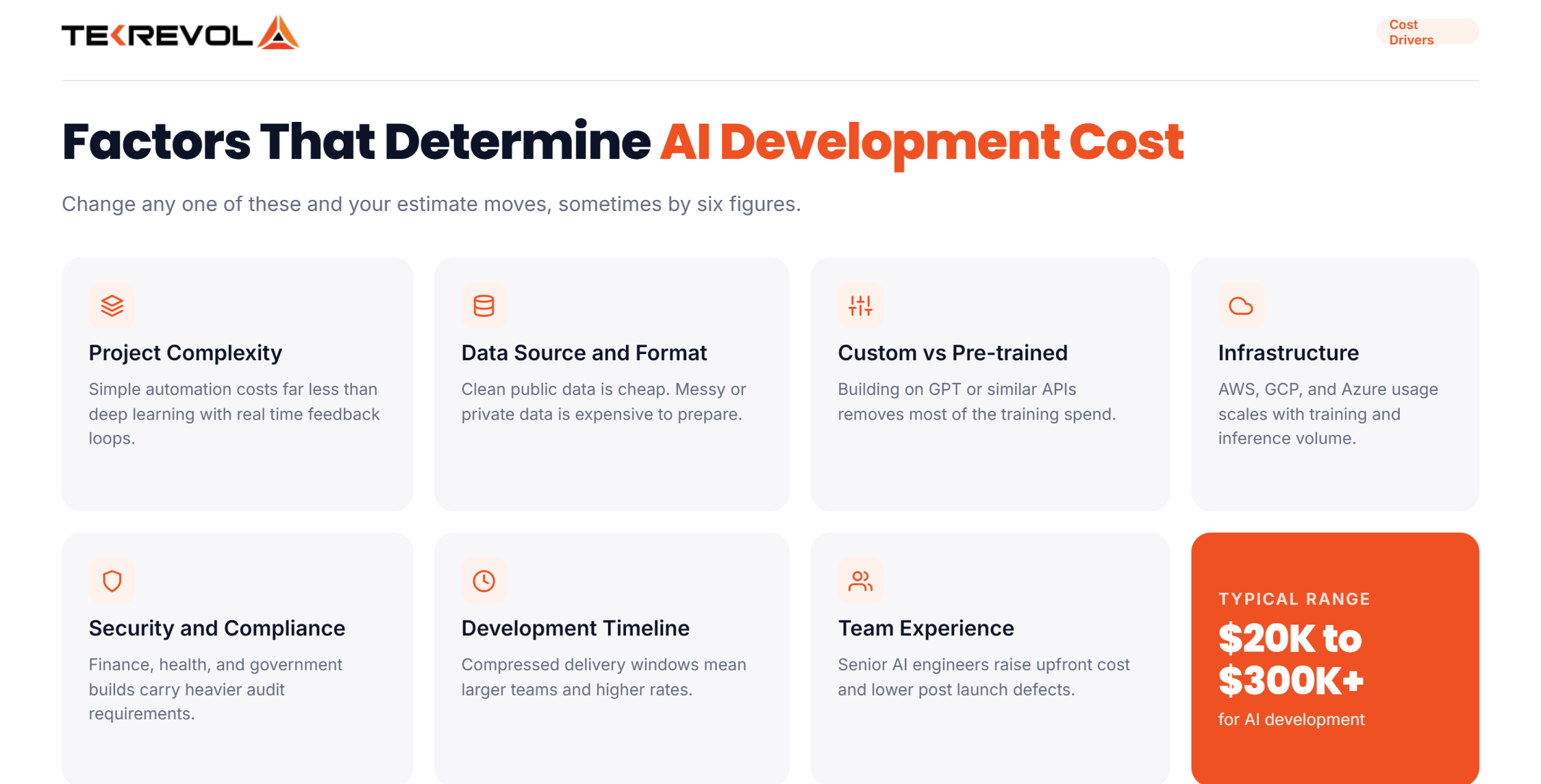
Core factors influencing AI development pricing include model selection, data readiness, architectural complexity, and security compliance standards. Each element shifts your upfront engineering costs and long-term operating budget.
1. Data Preparation and Ingestion
This is where most of the effort goes. Your model can only work with what you feed it, so getting data into usable shape moves the number here by answering:
- How many systems your data currently sits in
- Whether the formats are consistent enough to merge without manual cleanup
- Whether anyone has labeled it, and how specialised that labeling has to be
Plan for data preparation to take 20% to 25% of your build. Clean data in one place sits at the low end of that. At TekRevol, we spend substantial time cleaning datasets, building automated pipelines, labeling assets, and setting up vector databases. Unorganized data can add $15,000 to $50,000 to your upfront engineering timeline.
2. Model Choice: API vs Fine-Tuning vs Proprietary
Using public APIs like OpenAI or Gemini keeps initial engineering costs low. Fine-tuning an open-weight model (like Llama 3) requires higher setup costs ($30,000–$90,000) but gives you tighter data control and lowers long-term token pricing at high volumes. Building a custom proprietary model from scratch requires high-end GPU compute, driving costs past $250,000.
The main cost separators:
- Whether a pretrained model gets you most of the way there
- How much domain-specific data the solution needs to learn from
- Whether outputs are suggestions a human reviews, or decisions the system makes alone
3. AI Infrastructure
Infrastructure is the line people underestimate because it looks like a fixed cost and behaves like a variable one. It covers cloud compute, storage, vector databases, GPU access, and the MLOps tooling that keeps everything observable in production.
What makes it move:
- How often your app calls a model, and at what response time
- Whether you’re running managed cloud services or your own hardware
- How much data you’re storing and retrieving on every request
Small deployments stay modest. Costs climb sharply once traffic scales, because you’re paying per request rather than per month. On-premises hardware carries a high upfront cost that only pays off at sustained high volume, so most teams start managed and revisit later.
4. Integration Method
Connecting AI models to existing CRMs, ERPs, or data warehouses directly impacts backend engineering workload. What determines the effort:
- Whether the systems you’re connecting to have documented, modern APIs
- How many separate systems need to exchange data with the app
- Whether user permissions and roles have to carry across from existing tools
Standard REST API webhooks require minimal development effort, while custom middleware pipelines designed to connect AI engines with legacy enterprise databases or real-time event-driven architectures require extensive synchronization and latency testing.
5. Regulatory Compliance and Security
Industries subject to strict data laws like healthcare and finance require rigorous security layers, audit logging, and data protection protocols. Meeting standards like HIPAA, SOC 2, or GDPR adds engineering time for privacy guardrails, row-level access controls in vector memory, and data anonymization pipelines, increasing total budgets by 15% to 25%.
Compliance costs recur. Setup is a one-time build, but audits, renewals, and documentation continue every year the app runs. Teams that treat this as a checkbox rather than a program end up paying for it twice.
6. Development Team Size and Expertise
AI projects are labor-heavy rather than compute-heavy, so team cost dominates roughly 70% of your build. Composition matters more than headcount, since one senior engineer who’s shipped production AI before saves months of expensive learning.
What shifts the total:
- Where your team sits, since rates vary by a factor of four across regions
- Whether you’re hiring in-house, engaging an agency, or augmenting staff
- How much AI-specific seniority the project actually requires
A solo AI hire is the expensive option in disguise. There’s nobody to review the work, and the mistakes surface after launch when they cost the most to fix.
AI App Development Cost by Use Case/Type
AI development cost by use case varies between $20,000 for conversational chatbots and $90,000+ for multi-agent autonomous workflows. The underlying algorithmic complexity dictates total engineering requirements.
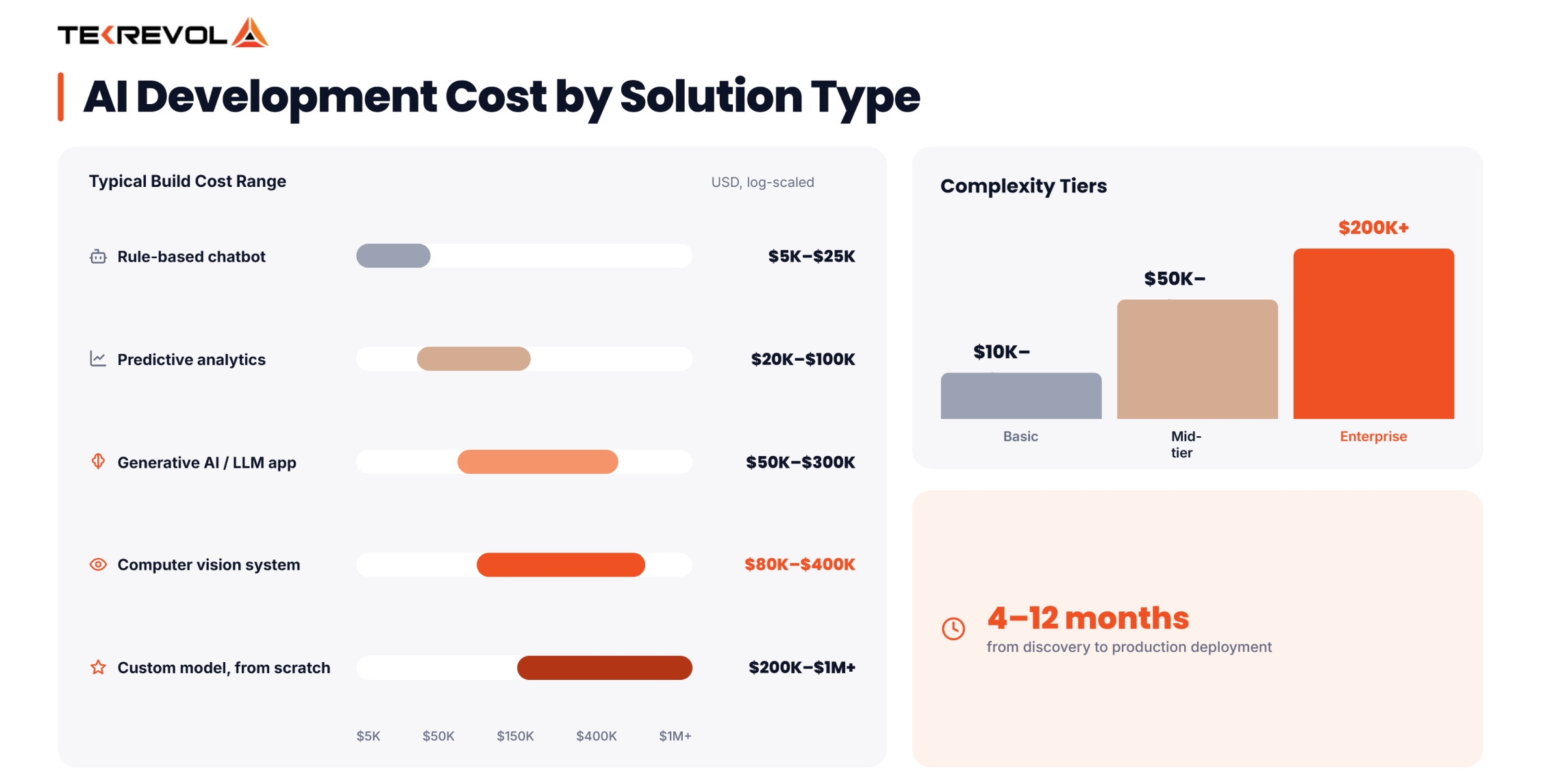
| Use Case | Build Cost | Key Drivers |
| AI chatbot/support assistant | $20,000 – $50,000 | Knowledge base quality, handoff rules, tone tuning |
| Document Q&A / RAG search | $30,000–$120,000 | Document volume, chunking strategy, permissions model |
| Recommendation Engine | $50,000–$180,000 | Catalog size, event tracking maturity, cold-start handling |
| Predictive Analytics | $60,000–$200,000 | Historical data depth, feature engineering, forecast horizon |
| Agentic AI/workflow Automation | $80,000–$200,000+ | Tools it can call, error recovery, human approval gates |
| Generative AI product | $80,000–$250,000+ | Output quality bar, safety filtering, evaluation infrastructure |
| Computer Vision | $60,000–$300,000+ | Annotation volume, lighting and angle variance, edge deployment |
| Fraud detection | $80,000–$250,000+ | Label scarcity, false positive tolerance, real-time latency |
Conversational chatbots using basic API endpoints are simple to deploy quickly. Conversely, computer vision systems that process real-time video streams demand specialized image processing pipelines and higher compute capacity.
How Much AI Development Can Cost by Industry?
AI app development cost by industry tracks regulatory burden. Education and retail projects start near $40,000. Healthcare and fintech pass $150,000 before production code ships, because compliance controls and specialist data labeling are mandatory.
| Industry | Cost Range | Features Included |
| Education | $40,000–$150,000 | Content tagging, light regulation, forgiving accuracy bar |
| Real estate | $50,000–$120,000 | Licensed valuation data, geographic model variance |
| Retail and ecommerce | $40,000–$300,000 | Catalog annotation at scale, retraining as inventory turns |
| Manufacturing | $100,000–$700,000 | Sensor pipelines, edge hardware, downtime cost of errors |
| Logistics | $100,000–$700,000 | Real-time inference latency, route data, edge deployment |
| Fintech | $100,000–$800,000 | Explainability requirements, fraud label scarcity, audit trails |
| Healthcare | $150,000–$1,200,000 | HIPAA controls, clinician-annotated data, validation cycles |
Higher regulation doesn’t automatically mean a bigger bill. Scope discipline matters more, and our healthcare app development services plan for compliance overhead from day one rather than discovering it mid-build.
What’s Included in AI App Development Costs? (Breakdown by Phases)
The cost to build an AI app is divided across six phases: discovery, data engineering, model training, Testing and evaluation, deployment and integration, and maintenance. Data preparation and maintenance together take roughly half the budget. Model training, the phase most people assume is expensive, accounts for about 15%.
Understanding stage allocations prevents overruns in artificial intelligence cost estimation during development.
|
Phase |
Share of budget | Typical Duration |
What happens |
| Discovery and scoping | 5–10% | 1–3 weeks | Use case definition, feasibility, success metrics, architecture |
| Data preparation | 20–25% | 3–8 weeks | Sourcing, cleaning, labeling, privacy review, pipeline setup |
| Model training or fine-tuning | ~15% | 2–6 weeks | Model selection, fine-tuning, prompt and retrieval design |
| Testing and evaluation | 10% | 2–4 weeks | Accuracy benchmarks, edge cases, bias review, red teaming |
| Deployment and integration | 15% | 3–8 weeks | CRM, ERP, data warehouse, auth, and user-facing app |
| Maintenance and monitoring | 25–30% | Ongoing | Drift detection, retraining, incident response, upgrades |
Phase allocations prioritize data engineering, as poor data quality directly impacts model accuracy. Teams that already run solid custom software development foundations consistently spend less here, because their data is already structured and accessible. System design and UI creation run concurrently with model training to ensure smooth integration before deployment.
How Much Does It Cost to Maintain an AI App?
Maintaining an AI app costs $2,000 to $12,000 per month in production. Maintenance covers API token usage, server infrastructure, performance monitoring, and quarterly model recalibration.
Model API charges alone range from $55 to $3,000 monthly for a mid-sized app, and the variable that moves that number is which model you run.
Current LLM API Prices
We pulled these from the providers’ own published pricing pages. Prices are per million tokens.
| Model | Provider | Input / 1M | Output / 1M |
| Gemini 2.5 Flash-Lite | $0.10 | $0.40 | |
| GPT-5.6-luna | OpenAI | $0.10 | $0.60 |
| Gemini 3.5 Flash-Lite | $0.30 | $2.50 | |
| Gemini 3.7 Flash | $0.75* | $3.75* | |
| GPT-5.6-terra | OpenAI | $1.00 | $6.00 |
| Claude Sonnet 5 | Anthropic | $2.00 | $10.00 |
| GPT-5.6-sol | OpenAI | $2.50 | $15.00 |
| Claude Opus 5 | Anthropic | $5.00 | $25.00 |
Google lists Gemini 3.7 Flash at promotional pricing through December 31, 2026, doubling to $1.50 input and $7.50 output on January 1, 2027. Sources: OpenAI’s published API pricing, Anthropic’s Claude pricing documentation, and Google’s Gemini API pricing page. List prices change often, so verify before budgeting.
The rest of the monthly bill
- Cloud hosting and vector database: $500 to $20,000 monthly, scaling with traffic. Our cloud services team right-sizes this after the first month of real usage.
- Monitoring and MLOps tooling: $2,000 to $8,000 monthly for production-grade observability.
- Support and maintenance retainer: $2,000 to $10,000 monthly, depending on response time commitments.
- Human review staffing: roughly 0.5 to 2 reviewers per 100,000 decisions per month.
A mid-sized production AI app realistically runs $5,000 to $12,000 monthly all in.
Generative AI vs Traditional Machine Learning: Which Costs More?
Generative AI costs more upfront and far more to run. Traditional machine learning front-loads spend into data and training, then serves predictions almost free. The right choice depends on request volume, not sophistication.
|
Dimension |
Traditional Machine Learning |
Generative AI |
| Build cost | $40,000–$150,000 | $80,000–$250,000+ |
| Training data needed | Large labeled dataset | Pretrained base plus small fine-tune set |
| Upfront training spend | Higher, custom model training | Lower, fine-tuning at $2,000–$30,000 |
| Cost per request after launch | Near zero once deployed | Ongoing per-token charge, permanently |
| Maintenance burden | Scheduled retraining cycles | Prompt upkeep, evals, model version churn |
| Where the money lands | Front-loaded into the build | Back-loaded into monthly operations |
High volume plus simple output points to traditional ML. A recommendation engine serving millions of predictions daily is far cheaper this way, because inference costs nothing once trained.
Low volume plus complex output points to generative AI. A document assistant handling a few thousand queries skips custom training entirely.
Cost of AI Development by Region: In-House vs Offshore
Cost to build an AI app by region ranges from $30 per hour in offshore regions to $200 per hour in North America, depending on region and seniority. North American seniors top the market. South and Southeast Asian specialists deliver comparable production work at roughly a third of that rate.
Choosing between in-house development and offshore partnerships impacts overall project velocity and total cost.
| Region | Mid-level AI/ML engineer | Senior AI/ML engineer |
| North America | $80–$150/hr | $150–$280/hr |
| Western Europe | $70–$120/hr | $110–$190/hr |
| Eastern Europe | $40–$80/hr | $55–$110/hr |
| Latin America | $35–$70/hr | $45–$90/hr |
| South / Southeast Asia | $25–$60/hr | $30–$75/hr |
Building an in-house team involves ongoing salaries, benefits, and infrastructure expenses. Partnering with an established AI development agency using a hybrid delivery model provides specialized talent while keeping project costs balanced.
AI Developer Hiring Cost in 2026: What’s the Rate?
How you hire matters more than where your AI developer is located. Here are available hiring model cost estimates:
| Hiring model | Annual cost (US) | Best when |
| In-house ML engineer | $220,000–$340,000 fully loaded | AI is core to your product long term |
| Specialist agency | $180,000–$420,000 equivalent | You need a full team fast with delivery accountability |
| Staff augmentation | $130,000–$280,000 equivalent | You have an engineering lead but lack AI specialists |
| Senior freelancer | $120,000–$240,000 equivalent | Scope is narrow and well-defined |
In-house isn’t cheap. One ML engineer costs more than most pilot projects, and a solo AI hire has nobody to review their work. That’s why IT staff augmentation has become the default for mid-market companies. You keep architectural control and rent specialist skills only while you need them.
Jobs Generally Needed for AI Development:
- AI/ML Engineer: Creates and trains AI models
- Data Scientist: Prepares and analyzes training data
- Backend Developer: Builds APIs and integrations.
- Frontend Developer / UI Designer: Creates the user-facing interface
- DevOps Engineer: Handles cloud deployments and CI/CD.
- QA Tester: Verifies model accuracy and app stability.
A full team of developers hired for 4–6 months will cost $60,000 – $250,000.
Hidden Costs to Consider in AI Development
Hidden AI costs add 15% to 25% of your build price every year. Factors that blow up AI app development budgets include unmonitored API consumption, vector database storage expansion, data pipeline changes, and continuous guardrail tuning. Preparing for these factors keeps your operating budget predictable.
- Model Drift & Retraining ($24k–$120k/yr): AI accuracy degrades over time, requiring unbudgeted retraining.
- Data Annotation ($10k–$60k/yr): Labeling new data is a continuous requirement, not a one-time setup step.
- MLOps Licensing ($24k–$96k/yr): Platform tools charge per seat or model, scaling up costs as the app succeeds.
- Human-in-the-Loop Review (0.5–2 reviewers per 100k monthly decisions): Requires ongoing human staffing rather than pure tech infrastructure.
- HIPAA Compliance ($15k–$40k setup, $10k–$30k recurring): Demands an ongoing operational program rather than a single checkbox.
- GDPR Compliance ($10k–$28k setup, $3k–$11k recurring): Requires continuous engineering for data residency and user deletion requests.
- EU AI Act Conformity ($20k–$80k in year one): High-risk applications face new, mandatory regulatory costs often missing from older budgets.
- General Maintenance Buffer (15–25% of build cost): System upkeep is frequently skipped during initial estimates until critical features break.
Implementing rate limiting and caching layers helps maintain control over month-to-month cloud operational expenditures.
How to Cut AI Development Expenses
AI-powered app development may seem like a money pit if you don’t plan carefully. The good news? You don’t need to blow through dollars to develop a high-performing AI application.
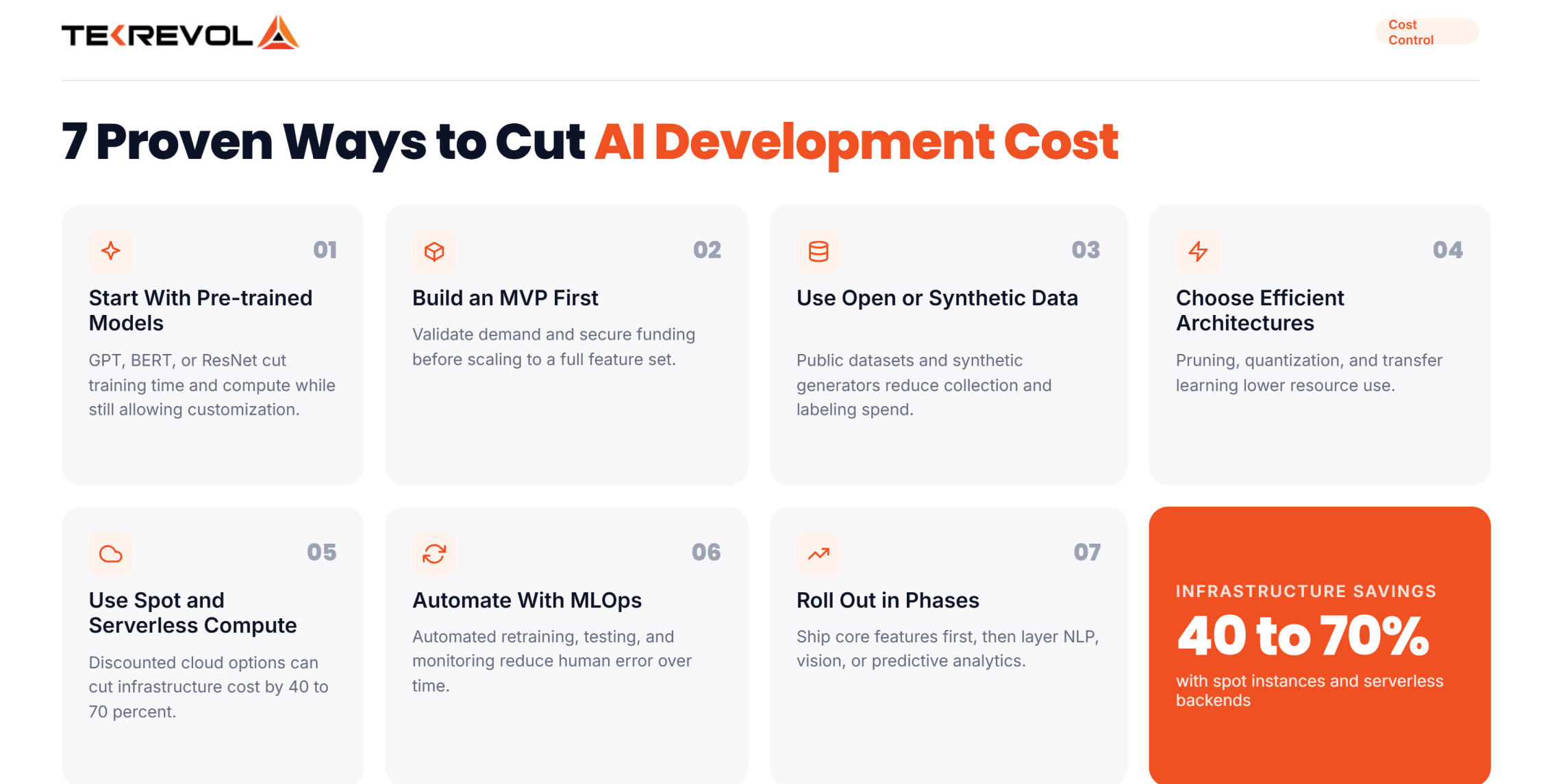
Start with pretrained models, ship one narrow pilot, route queries by difficulty, cache aggressively, and phase the rollout. Together, these routinely cut first-year spend by 40%.
- Start with pretrained models: Custom training costs $100,000+ and is unnecessary for most business problems. Fine-tuning an existing model runs $2,000 to $30,000.
- Ship one narrow use case first: A $30,000 pilot that proves value beats a $200,000 platform that proves nothing, and it makes the next budget conversation easier internally.
- Route queries by difficulty: Model choice swings monthly bills 54 times. Send routine queries to a small model and reserve the expensive one for hard cases.
- Cache everything stable: System prompts and retrieved documents repeat constantly. Cached input is discounted up to 90%, which often cuts a third off the monthly bill.
- Phase the rollout: Launch to one team, region, or segment first. You catch expensive mistakes while they’re still cheap to fix.
Three things we’d never cut: evaluation infrastructure, monitoring, and data quality work. Deferred spending on those compounds into a rebuild.
Partner With TekRevol for AI App Development
If you’re mapping AI development costs for a 2026 investment, partner with TekRevol to get scoped estimates instead of ranges. We’ve run discovery sprints for companies from scale-ups to listed enterprises, and the pattern is consistent: the projects that stay on budget are the ones that invested in scoping first.
Our AI development services break down every project, covering model selection, data preparation requirements, integration mapping, and an infrastructure estimate. You go into the build with a number you can defend, not a range you have to explain.
We bring:
- In-house AI engineers and consultants
- Experience across healthcare, finance, and retail
- End-to-end project support: idea to post-launch
- A clear understanding of cost control and ROI optimization
You can see how that plays out across our project portfolio, from a fact-checking chatbot at 98% accuracy to an enterprise operations app cutting reporting errors by 46%. Whether you’re looking for a tailored chatbot, SaaS AI solution, or industry-level analytics, we possess the means and expertise to assist.
Ready to scope your AI application with confidence?
Schedule a technical consultation with our engineering team to map out your architecture and receive a fixed-price discovery roadmap.
Lets Connect!


