- The social media market is worth $234B in 2026 with 5.66B users, but organic reach is just 1–4%, making owned platforms the smarter investment.
- Facebook remains the world’s largest platform at 3.07 billion MAUs, but TikTok leads on engagement time at 1 hour 37 minutes per day, proving size and attention are no longer the same metric.
- Short-form video dominates social media, driving over 70% of engagement and generating 3.2x more interaction than static content.
- Building a custom social media app in 2026 costs between $20,000 and $300,000+, depending on complexity and other factors
- DAU/MAU ratio is your most important platform health metric. Niche communities outperform general networks because relevance drives daily returns.
“Remember when the biggest online debate was whether to post selfies on Facebook or Instagram? Fast forward to 2026, and now we’re juggling TikToks, Threads, YouTube Shorts, and whatever new app Gen Z swears will ‘change the game’ this week.”
Social media isn’t just social anymore; it’s business, branding, storytelling, and customer service all rolled into one never-ending feed. And if you’re a brand trying to cut through the noise, knowing where your audience actually lives online isn’t optional; it’s the whole game.
So, what is the most used social media platform in 2026? Facebook still wears the crown with 3.07 billion monthly active users, trailed closely by YouTube at 2.85 billion. But size alone doesn’t tell the full story. Engagement, demographics, and platform behavior matter just as much as raw numbers.
But here is the thing most reports won’t tell you: the same scale that makes these platforms irresistible also makes them dangerous to depend on.
This guide cuts through the noise with data that actually matters, platform-by-platform user statistics, engagement trends, and the emerging business case for building your own social platform. At TekRevol, it’s the foundation of every social media marketing engagement we run, because platform decisions made on bad data are expensive mistakes.
The numbers tell the story. Let’s get into them.
Social Media App Market: 2026 Outlook
The global social media market is valued at $234 billion in 2026 and is growing fast. With 5.66 billion active users spending an average of 2 hours and 21 minutes daily on apps, the audience has never been bigger or more fragmented.
Organic reach on major platforms has collapsed to 1–4%, pushing smart businesses toward building their own branded platforms to own their audience, their data, and their community.
Global Social Media Statistics at a Glance (2026)
Let’s start with the big picture. In 2026, there are now 5.66 billion active social media user identities worldwide, that’s 68.7% of the total global population.
Over the previous 12 months, social platforms added around 259 million new user identities, an annual growth rate of about 4.8%. Somewhere out there, a grandma just signed up for Instagram, and a teenager abandoned Facebook for TikTok. The cycle continues.
Here are the headline figures every decision-maker needs on hand:
| Metric | 2026 Stat |
| Total global social media users | 5.66 billion (68.7% of the global population) |
| Year-over-year growth | +4.8% / ~259 million new users |
| Average daily time spent | 2 hours 21 minutes |
| Average platforms used per month | 6.75 platforms per month |
| Mobile access | 99%+ of users via smartphone |
| Social commerce market size | $2.11 trillion (up from $1.63T in 2025) |
| Short-form video engagement share | 70%+ of all social media engagement |
| DM-based interaction share | 41% of total social media communication |
| Global social media ad spend | $317.33 billion |
What these numbers collectively signal is not just growth. They signal a structural shift in how people communicate, discover products, build communities, and make purchasing decisions.
Social media is no longer a channel alongside others — it’s the primary arena where brand relevance is won or lost. The businesses winning in 2026 have stopped treating social as a place to post and started treating it as infrastructure to own.
Read the Stats, But Still Unsure What to Do?
TekRevol helps you turn market intelligence into a custom social platform your brand owns, controls, and monetizes—built for long-term growth and engagement.
Get Your Custom Build Roadmap!Top 10 Social Media Platforms by Active Users [Updated]
Let’s get into the leaderboard. We’re talking MAUs here — Monthly Active Users — the metric that separates the big players from the apps your cousin downloaded once and never opened again.
So, what is the most used social media platform in 2026? Here you go:
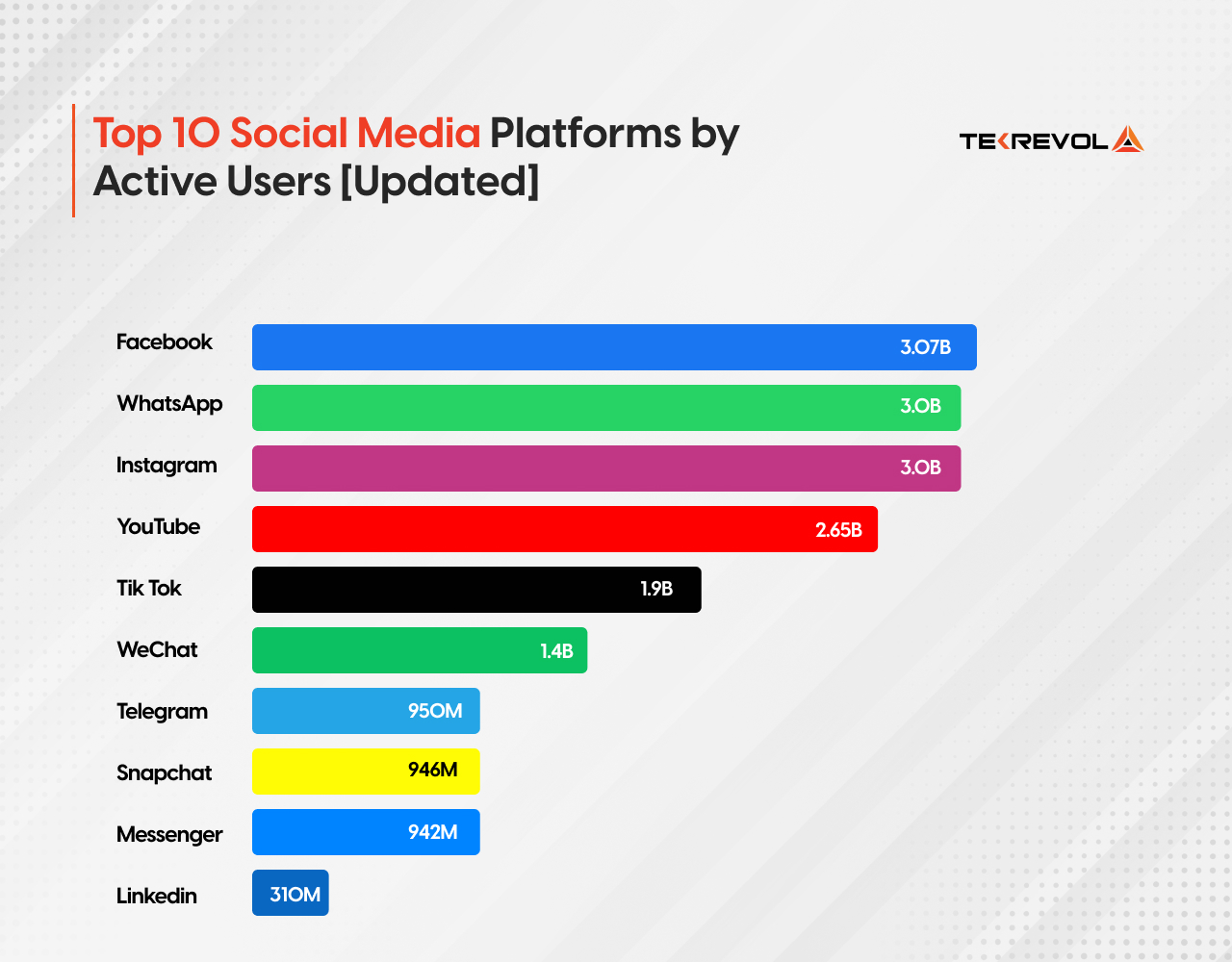
1. Facebook – 3.07 Billion MAUs
Still the undisputed king by classic social network metrics. Facebook leads with 3.07 billion monthly active users, and it reaches roughly a third of the global adult population. Groups, Marketplace, and events keep it stickier than the “it’s for boomers” jokes suggest.
2. WhatsApp – 3.0 Billion MAUs
WhatsApp is the most-used messaging app globally, with 3.0 billion MAU. The rise of WhatsApp Channels has transformed it from a simple chat app into a broadcast media giant, with businesses enjoying email-crushing open rates.
3. Instagram – 3 billion MAUs
Instagram has crossed 3 billion monthly active users, making it one of only four platforms to reach that threshold alongside Facebook, YouTube, and WhatsApp. Instagram crossed the 3 billion MAU mark in September 2025. The platform grew approximately 8% year-over-year in 2025, outpacing thanks to a younger demographic and Gen Z’s obsession with Stories and Reels. It’s one of the top social media apps for branding, lifestyle content, and #ad life.
4. YouTube – 2.85B
YouTube is the world’s second-largest search engine and the top platform for long-form video marketing, with 2.85 billion MAU. YouTube Shorts now competes directly with TikTok and Instagram Reels, pulling in over 70 billion daily views globally.
5. TikTok – 1.99 Billion MAUs
TikTok has exceeded 1.99 billion monthly active users in 2026, though some estimates push closer to 1.9B. The typical TikTok user spent 1 hour 37 minutes per day in the app, and opened it about 10 times per day on average. No other platform wins on pure intensity of engagement.
6. WeChat – 1.34–1.4 Billion MAUs
A Chinese powerhouse, WeChat has a total user base of around 1.309–1.4 billion users. It’s the all-in-one super-app for payments, commerce, and messaging in the Chinese market.
If you’re looking at social media platforms in China or entering the Asian market, this is where your audience lives.
7. Telegram – 950 Million MAUs
Telegram has grown to around 950 million MAU, carving out its niche among privacy advocates, crypto communities, developers, and niche interest groups. What makes it strategically interesting for businesses is its channel infrastructure, unlimited broadcast subscribers, zero algorithmic interference, and near-100% message delivery rates.
For brands burned by declining organic reach, it is the rare platform where your message actually lands.
8. Snapchat – 946 million MAUs
Snapchat maintains 946 million monthly active users, with some sources citing 850M. It remains the platform of choice for Gen Z and Gen Alpha with its AR filters, Bitmoji integrations, and Snap Maps. It may not be the largest, but it’s undeniably one of the top social media apps for Gen Alpha and younger millennials.
9. Facebook Messenger – 942 Million MAUs
Messenger sits at 942 million MAU — quietly massive, especially for business communication and Meta’s family ecosystem. While it lives in Facebook’s shadow, Messenger powers a significant chunk of customer service conversations globally. Businesses use it for automated responses, appointment booking, and direct sales through Messenger ads, making it one of the most underrated tools in a brand’s social stack.
10. LinkedIn – 310 Million MAUs / 1.2 Billion Members
LinkedIn has crossed 1 billion members globally, with an estimated 310 million MAU. It’s the dominant B2B platform and increasingly a content powerhouse; comments and engagement are surging in 2026.
Top Social Media Platforms in 2026 by MAUs
| Rank | Platform | Monthly Active Users |
| 1 | 3.07 Billion | |
| 2 | 3.0 Billion | |
| 3 | 3.0 Billion | |
| 4 | YouTube | 2.85 Billion |
| 5 | TikTok | 1.99 billion |
| 6 | 1.40 Billion | |
| 7 | Telegram | 950 Million |
| 8 | Snapchat | 946 Million |
| 9 | Facebook Messenger | 942 Million |
| 10 | 310 Million |
As the most popular social media platforms continue to evolve in 2026, staying up to date on these stats can give your digital strategy the edge it needs. TekRevol’s digital marketing services are already helping brands capitalize on this emerging platform to drive real conversions.
Emerging Social Media Platforms in 2026
The biggest platforms have long ruled the digital kingdom. But 2026 is serving up serious contenders, platforms shaking up norms, focusing on niche audiences, and doing things differently.
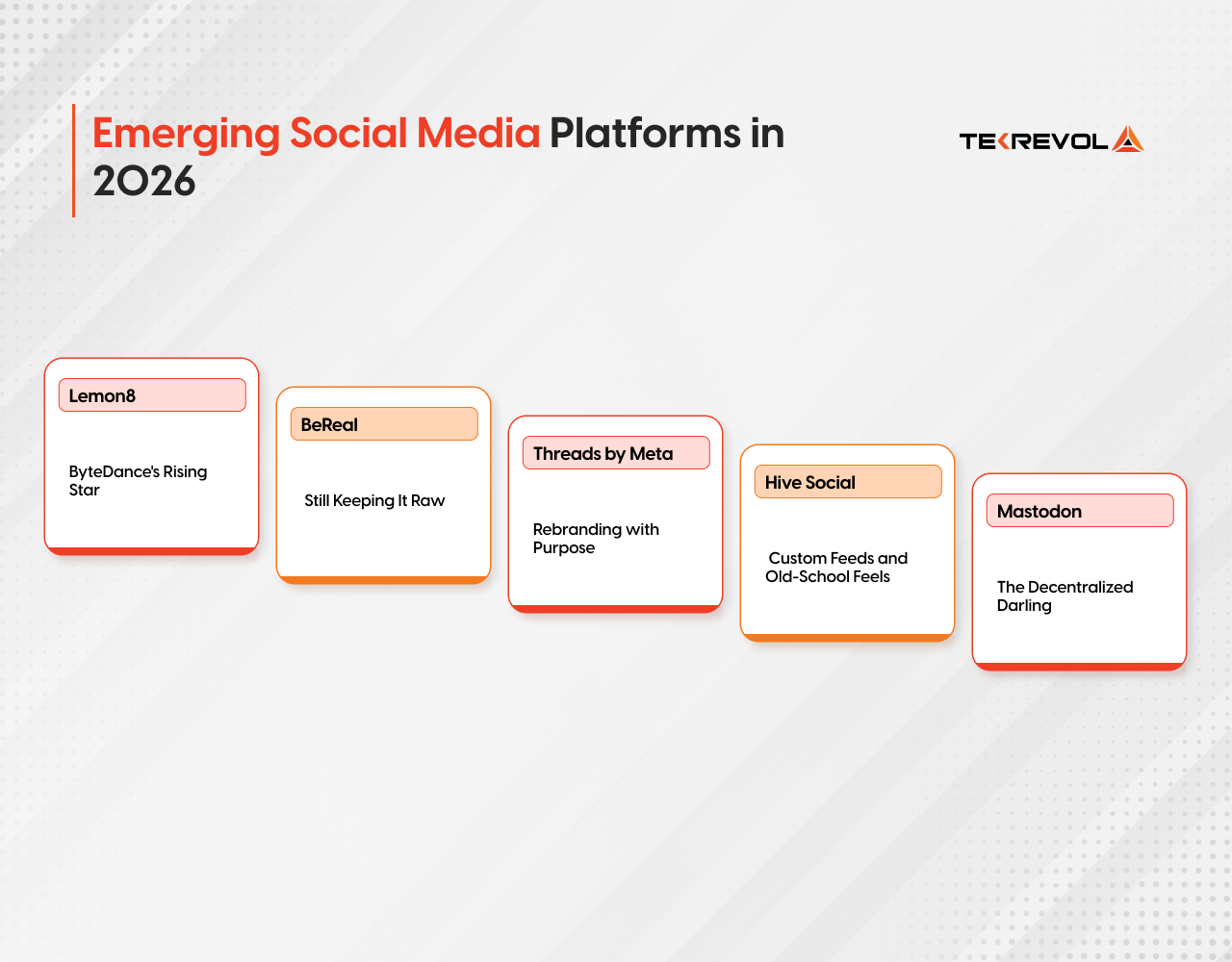
1. Lemon8 – ByteDance’s Rising Star
Imagine Instagram and Pinterest had a minimalist, aesthetic baby, that’s Lemon8. Owned by TikTok’s parent company, ByteDance, Lemon8 is designed for lifestyle creators who love to share wellness routines, beauty tips, and hyper-curated posts.
- Global Downloads: Over 50 million downloads across iOS and Android as of early 2026
- User Base: Reached approximately 23 million monthly active users globally, a 56% increase from early 2025
Though it’s still growing, Lemon8 is on track to join the ranks of the top social media platforms if the momentum continues.
2. BeReal – Still Keeping It Raw
Launched as the anti-Instagram, BeReal prompts users to share one unfiltered photo a day. The idea? Authenticity over aesthetics.
- Monthly Active Users: Over 40M MAUs monthly active users worldwide as of 2026
- Engagement: 72% daily engagement rate among active users, one of the highest of any social platform
It’s not the answer to what is the most popular social media app, but it’s earned a place in the list of popular social media apps, redefining user expectations.
3. Threads by Meta – Rebranding with Purpose
Threads had a rocky start, but Meta stuck with it. In 2026, it’s stronger, faster, and now properly linked with Instagram to fuel discussions (and debates).
- Monthly Active Users: Over 400 million MAUs globally as of early 2026
- Daily Active Users: Over 141 million daily active users — surpassing X on mobile for the first time
It’s quickly becoming one of the most popular social media platforms, particularly for users who miss Twitter’s original charm without the chaos.
4. Hive Social – Custom Feeds and Old-School Feels
Hive saw a massive spike in interest as users looked for a more customizable, ad-light experience. It’s a mashup of Twitter, Instagram, and MySpace (yes, that MySpace).
- User Base: An estimated 3–5 million active users in 2026 (third-party estimates, no official figures published)
- Notable Feature: Users love the retro profile song option. (Nostalgia sells!)
It’s not the most used social media platform, but it’s a cult favorite, and cults can grow big fast in the digital world.
5. Mastodon – The Decentralized Darling
In the post-Elon Twitter world, many sought alternatives that billionaires didn’t run on vibes alone. Mastodon offered a decentralized model with no ads and user-controlled servers.
- Registered Accounts: Over 10.5 million registered accounts across more than 10,000 independent servers as of April 2026
- Monthly Active Users: Approximately 750,000–1 million monthly active users — a smaller but exceptionally intentional and engaged audience
Among popular social media platforms, Mastodon is the quiet disruptor, not flashy, but steadily climbing the charts.
Honorable Mentions
These aren’t yet among the top social media platforms, but they’re worth keeping an eye on:
- Fanbase: Built for monetizing smaller followings
- Clapper: Think TikTok, but slower and more community-focused
- Geneva: Growing fast among digital communities and micro-groups
If you’re still stuck asking, ” What is the most popular social media app?, don’t overlook the new kids on the block. The next big thing could be one pivot (or viral trend) away from overtaking the giants.
And in 2026, social media platforms are evolving faster than ever, so keep your eyes open and your notifications on.
Social Media Engagement Trends: What the Numbers Tell Us
Raw user counts tell you where people are. Engagement data tells you what they are actually doing, and why it matters for your social media engagement rates strategy.
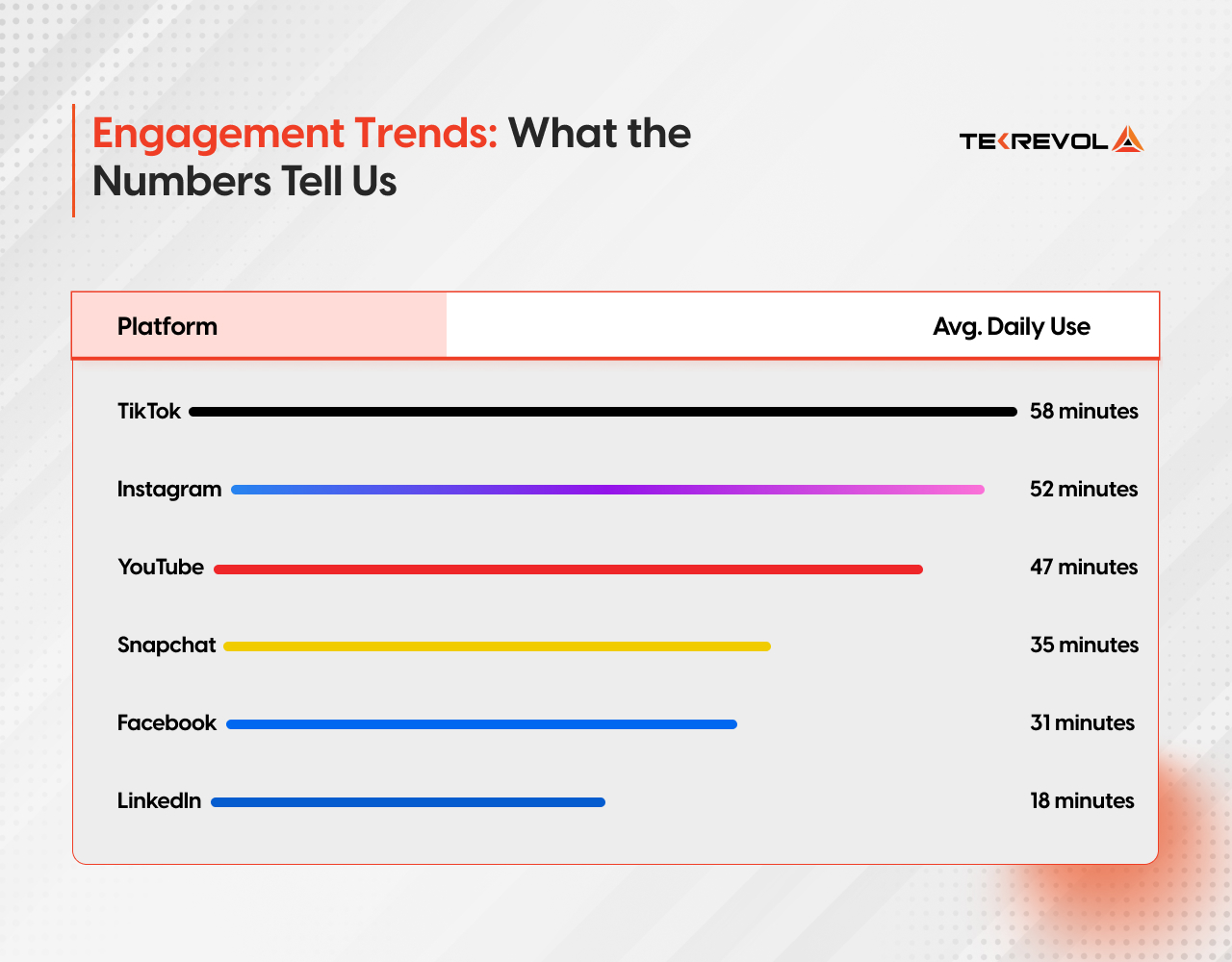
Average Daily Time Spent Per Platform (2026)
| Platform | Avg. Daily Use | Primary Engagement Format | Key Insight |
| TikTok | 1 hour 37 minutes | Short-form video, Livestreams | 90% of users follow at least one creator |
| 52 minutes | Reels, Stories, DMs | 67% of Reels views come from non-followers | |
| YouTube | 47 minutes | Shorts, Long-form, Tutorials | 87% of content consumed on mobile |
| Snapchat | 35 minutes | Snaps, Stories, Spotlight | Used daily by 90% of U.S. Gen Z teens |
| 33 minutes | Groups, Videos, Events | 75% of engagement now happens in private groups | |
| 18 minutes | Articles, Posts, DMs | Highest engagement quality of any platform |
What’s Actually Working in 2026
The platforms keep changing. The content formats keep evolving. But underneath all of it, the same pattern keeps emerging, and the data makes it impossible to ignore.
Here is what is actually driving results right now:
- Short-form video dominates everything: capturing 70%+ of all platform engagement across every major network and generating 3.2x the engagement of static posts
- Instagram leads on engagement quality: averaging a 0.48% engagement rate, approximately three times Facebook’s 0.15%
- Private beats public: DM and group engagement have now surpassed public comment engagement, meaning people are actively moving conversations into spaces that feel safer and more personal.
- AI-assisted content is no longer optional: 72% of marketers report better results when using AI in their content creation process.
And here is what that pattern is quietly telling you: users are already self-selecting into smaller, more focused communities. They are doing it organically, on every platform, every day. The brands that win the next five years are the ones who build those communities themselves, rather than hoping an algorithm serves them the right audience on someone else’s terms.
Who Is Actually Using Social Media Platforms
Now that we’ve revealed the top social media platforms by user count, let’s break it down by who is actually using these platforms.
Gen Z (Ages 10–25): The Video-First Generation
Gen Z practically lives online, and their taste in popular social media platforms is wildly different from their millennial cousins. They favor fast, visual, and authentic content.
- TikTok is the undisputed leader here. If you’re wondering what the most popular social media app for Gen Z is, this is it, no contest.
- Snapchat commands daily usage among 90% of U.S. Gen Z teens
- Instagram still holds strong, particularly with Reels and Stories, though TikTok is nipping at its heels.
For Gen Z, these top social media apps aren’t just entertainment; they’re search engines, trendsetters, and communication tools rolled into one.
Millennials (Ages 26–41): The Cross-Platform Generation
Millennials are the glue between old-school Facebookers and TikTok-scrolling teens. They’re active across multiple social media platforms, often using them for both fun and function.
- Facebook is still a millennial go-to, especially for events, groups, and family connections.
- Instagram is equally popular, with this generation driving much of its eCommerce and influencer traction.
- YouTube dominates long-form content here, from “how-to” videos to educational deep dives.
Millennials are the primary driver of social commerce adoption and the demographic most likely to purchase through influencer recommendations.
Gen X and Boomers (Ages 42+): The Underestimated Majority
Ah, yes, the demographic that made Minion memes and recipe videos viral. Gen X and Boomers may not bounce between apps like Gen Z, but they still make up a massive chunk of the digital population.
- Facebook is, by far, the most used social media platform among these age groups — 71% of U.S. adults aged 50–64 use it regularly.
- YouTube is also big here, particularly for tutorials, news, and nostalgia-fueled content.
- WhatsApp is surprisingly popular among international Gen X and Boomer users for family group chats and cross-border communication.
These users may not be fueling the next viral dance challenge, but they’re loyal, engaged, and often the ones holding the household purchasing power. Ignore them at your own risk.
Understanding demographic trends helps marketers, brands, and creators target their content more effectively across the most popular social media platforms in 2026. Whether you’re marketing lip gloss or life insurance, a smart social media marketing strategy means showing up where your audience actually hangs out — not just where the masses are.
Social Media Usage by Region: Where Your Audience Actually Lives.
Global MAU numbers reveal scale. Regional data reveals strategy. Here’s where your audience actually lives in 2026:
| Region | #1 Platform | Notable Insight |
| United States | YouTube | 84% of U.S. adults use it. Facebook at 177.5M users, Instagram at 143.3M, TikTok at 136M MAUs |
| India | 500M total social media users. WhatsApp reaches 80.8% of internet users. Instagram has 517M users, Facebook has 679M | |
| China | WeChat 1.3B MAUs, Douyin 750M, Weibo 600M | |
| Europe | Facebook & Instagram | TikTok has 169M monthly active users across EU member states |
| Latin America | WhatsApp penetration exceeds 95%. Brazil is TikTok’s 3rd largest market globally at 91.7M users | |
| Africa | Nigeria and South Africa lead adoption with rapidly growing user bases |
For any brand operating across multiple markets, this table is not optional reading. Posting the same content strategy across regions without accounting for platform dominance is one of the fastest ways to waste a marketing budget in 2026. TekRevol social media marketing services help brands cut through the noise with data-driven strategies built for every market.
The Platform Dependency Trap
Every number above represents an opportunity. But it is an opportunity built entirely on someone else’s infrastructure.
And in 2026, the most strategically aware CMOs, brand founders, and community managers are asking a fundamentally different question.
It is no longer: “Which platform should we be posting on?”
It is: “Why are we building our entire audience on a platform we don’t own?”
The followers you have earned on Instagram belong to Instagram. The behavioral data generated by your TikTok audience belongs to TikTok. The engagement history, the community relationships, the purchase signals, all of it sits on third-party infrastructure controlled by companies whose business incentives are not aligned with yours.
And the moment those companies change their rules, which they do, constantly, without warning, you absorb the impact.
This is not a theoretical concern. It is a documented, recurring, and accelerating business risk. And the numbers prove it.
Platform dependency risk is no longer a fringe concern for cautious marketers. It is the defining strategic vulnerability of 2026 for any brand that has built its audience entirely on rented infrastructure.
The Hidden Risk: Why Businesses Are Moving Away from Rented Platforms
Platform dependency risk is no longer a fringe concern for cautious marketers. It is the defining strategic vulnerability of 2026 for any brand that has built its audience entirely on rented infrastructure.
The Algorithm Collapse
Facebook’s organic reach in 2012: approximately 16% of followers reached per post. Facebook’s organic reach in 2026: 1–2%.
That is not a gradual decline. That is a near-total elimination of the value proposition that caused millions of businesses to build their entire community strategy on the platform in the first place.
Between 2024 and 2025 alone, LinkedIn’s organic reach slid 34%. Instagram’s algorithm increasingly buries non-video content without paid amplification. TikTok’s discovery algorithm, while still powerful for organic reach, is opaque, unpredictable, and entirely outside any brand’s control.
What this means in practice: the audience you spent years building on these platforms is now effectively behind a paywall. You pay to reach the followers you already have. That is the model. And the cost goes up every year.
The Data Ownership Gap
Meta and Google remain the dominant customer acquisition channels for most digital businesses, with a large majority of advertisers allocating budget to these platforms (PwC, HubSpot industry reports).
Every piece of behavioral data generated by those customer interactions, the browsing patterns, the purchase signals, the content preferences, the demographic profiles, belongs to the platform.
You can’t export your followers or their data. You don’t own the audience—you’re building on rented land controlled by the platform.
Academic research published in Frontiers in Communication (2025) describes this dynamic as “reliance on digital distribution that is structurally fragile and unevenly distributed.” The fragility is not a bug. It is a feature for the platforms.
The Cost Escalation Problem
- Meta CPMs are rising year-over-year as ad inventory becomes saturated and competition intensifies.
- TikTok’s ad saturation is flattening engagement returns as the platform matures.
- YouTube’s monetization algorithm changes have cost creators and brands millions without warning. The Adpocalypse precedent saw over 250 major brands, including Pepsi, Walmart, and Starbucks, suddenly stripped of ad placements overnight.
- India’s TikTok ban eliminated billions in brand reach with zero warning; regulatory risk is a live and growing threat across multiple markets.
The Trust Equation
Edelman’s Trust Barometer and other consumer studies consistently show that trust is now a key driver of purchasing decisions, alongside price and quality. Research also indicates that consumers are more likely to trust brands that reflect their values and culture.
However, brands reliant on algorithm-driven platforms have limited control over the context in which they appear, and that context significantly influences perception and trust.
The strategic imperative is no longer debatable: owned media strategy, built around first-party data, direct community relationships, and platform independence, is the foundation of durable brand equity in 2026.
Renting a Platform vs. Owning Your App: The Business Case
The decision to invest in a custom social or community platform should be evaluated against the same criteria as any strategic technology investment: total cost of ownership, competitive differentiation, and long-term asset value.
This is the foundation of every owned media strategy that actually compounds over time, moving from rented reach to infrastructure your brand controls permanently
| Criteria | Renting (Existing Platforms) | Owning (Your Social App) |
| Data Ownership | The platform owns user data | You own 100% of the user data |
| Algorithm Control | Changes without notice | Your rules, your feed logic |
| Audience Access | Pay-to-reach, organic declining | Direct, ungated access |
| Monetization | Limited to platform tools | Custom: subscriptions, in-app commerce |
| Branding | Competes with rival brands | Fully white-labeled experience |
| User Experience | Shared UX constraints | Designed for your community |
| Analytics Depth | Aggregated, limited export | Full behavioral data, custom events |
| Long-term Risk | Platform shutdown/policy shifts | Asset you own and control |
This is the foundation of every owned media strategy that actually compounds over time, moving from rented reach to infrastructure your brand controls permanently.
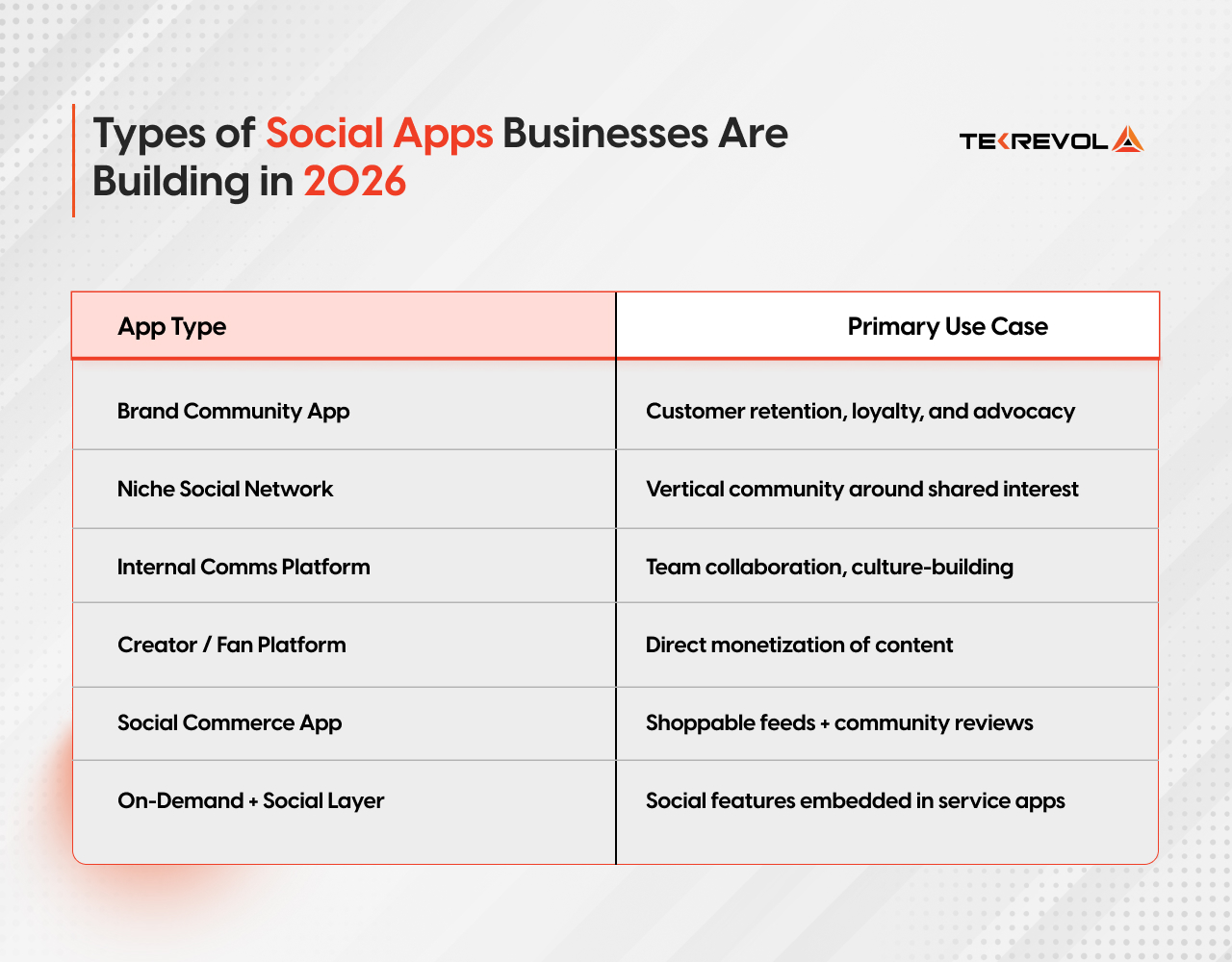
Types of Social Apps Businesses Are Building in 2026
The conversation around building your own social media platform has matured significantly.
It is no longer about replicating Facebook or TikTok. It’s about identifying the specific social layer your customers need that no existing platform delivers effectively.
| App Type | Primary Use Case | Example Industries |
| Brand Community App | Customer retention, loyalty, and advocacy | Retail, FMCG, Lifestyle |
| Niche Social Network | Vertical community around shared interest | Fitness, Finance, Parenting |
| Internal Comms Platform | Team collaboration, culture-building | Enterprises, Remote Teams |
| Creator / Fan Platform | Direct monetization of content | Media, Entertainment, Education |
| Social Commerce App | Shoppable feeds + community reviews | eCommerce, D2C Brands |
| On-Demand + Social Layer | Social features embedded in service apps | Delivery, Healthcare, Marketplaces |
Here is what each of these looks like in practice.
Brand Community Apps
These apps are built for direct-to-consumer brands that have already earned a loyal customer base and want to deepen those relationships outside of a platform that also shows competitor ads. Think a premium skincare brand with a members-only community for routines, reviews, and early product access, all hosted on infrastructure the brand controls entirely.
Niche Social Networks
These are one of the highest-growth categories in niche social network development right now. General platforms are too broad for depth. A platform built specifically for independent financial advisors, competitive cyclists, or homeschooling parents will consistently outperform a general network on engagement because the content relevance is absolute. Monetization options, memberships, directories, sponsored programming, and marketplace features are also significantly stronger in a defined vertical.
Internal Communications Platforms
Internal Communications Platforms address a real and growing enterprise need. As remote and hybrid work becomes the permanent default, enterprises are replacing fragmented Slack channels, email threads, and outdated intranet portals with cohesive social experiences that actually drive culture and knowledge sharing at scale. Getting this right demands more than off-the-shelf tools; it takes a custom software development company that understands enterprise culture from the ground up.
Creator and Fan Platforms
These platforms enable direct monetization between creators and their audiences, eliminating the platform tax that YouTube, Instagram, and TikTok impose. Subscription tiers, pay-per-view content, live streaming, digital merchandise, and tipping mechanics can all be built into a single owned environment where the creator and the platform owner, not the distribution platform, keep the revenue.
Social Commerce Apps
These apps combine community engagement with integrated purchase capability. Rather than paying Instagram Shopping commissions or TikTok Shop fees, brands build their own shoppable community, where product discovery, peer reviews, creator content, and checkout happen in one owned, data-rich environment.
On-Demand and Social Layer Apps
Increasingly common across delivery, healthcare, and marketplace platforms. As an on-demand app development company, TekRevol has seen firsthand how adding social features, community forums, peer reviews, and live Q&A dramatically increases retention and lifetime value in categories where commoditization is a constant threat.
Still Deciding Between Building and Staying on Existing Platforms?
TekRevol helps you shape your concept, validate the market, scope the build, and launch with confidence—so you can make the right strategic move.
Book a Free Consultation Now!Must-Have Features for Your Social Media App in 2026
Whether you’re building a niche community or a full-scale network, certain features are non-negotiable. Here’s how to think about it: launch lean, then earn the right to add complexity.
Core MVP Features (Launch With These)
- User profiles & authentication (including SSO and multi-factor)
- Personalized content feed with a basic algorithm
- Content creation & posting (text, image, video)
- Real-time notifications & push alerts
- Direct messaging and group chat
- Content discovery (search + hashtags/tags)
- Basic reporting and moderation tools
- Privacy settings and user-level controls
Growth-Stage Features (Add After Product-Market Fit)
- AI-powered content recommendations
- Live streaming with interactive elements (polls, reactions, Q&A)
- In-app social commerce and payments
- Creator monetization tools (subscriptions, tipping, paid content tiers)
- Stories / ephemeral content format
- Advanced analytics dashboard
- AR filters and interactive media
- Community groups and channels
- Referral and gamification systems
2026 Non-Negotiables: Security & Compliance
This is not optional and not something you add later. Build it in from day one, or you will rebuild the entire platform.
- End-to-end encryption for all messaging
- GDPR and CCPA compliance by architecture
- Hybrid AI + human content moderation system
- User data export and right-to-deletion tools
- Rate limiting and bot prevention
- Clear terms of service and community guidelines before the first user
How to Build Your Own Social Media App: The 5-Step Framework
You’re convinced the opportunity is real. Here’s how to actually execute it without burning six figures on the wrong decisions.
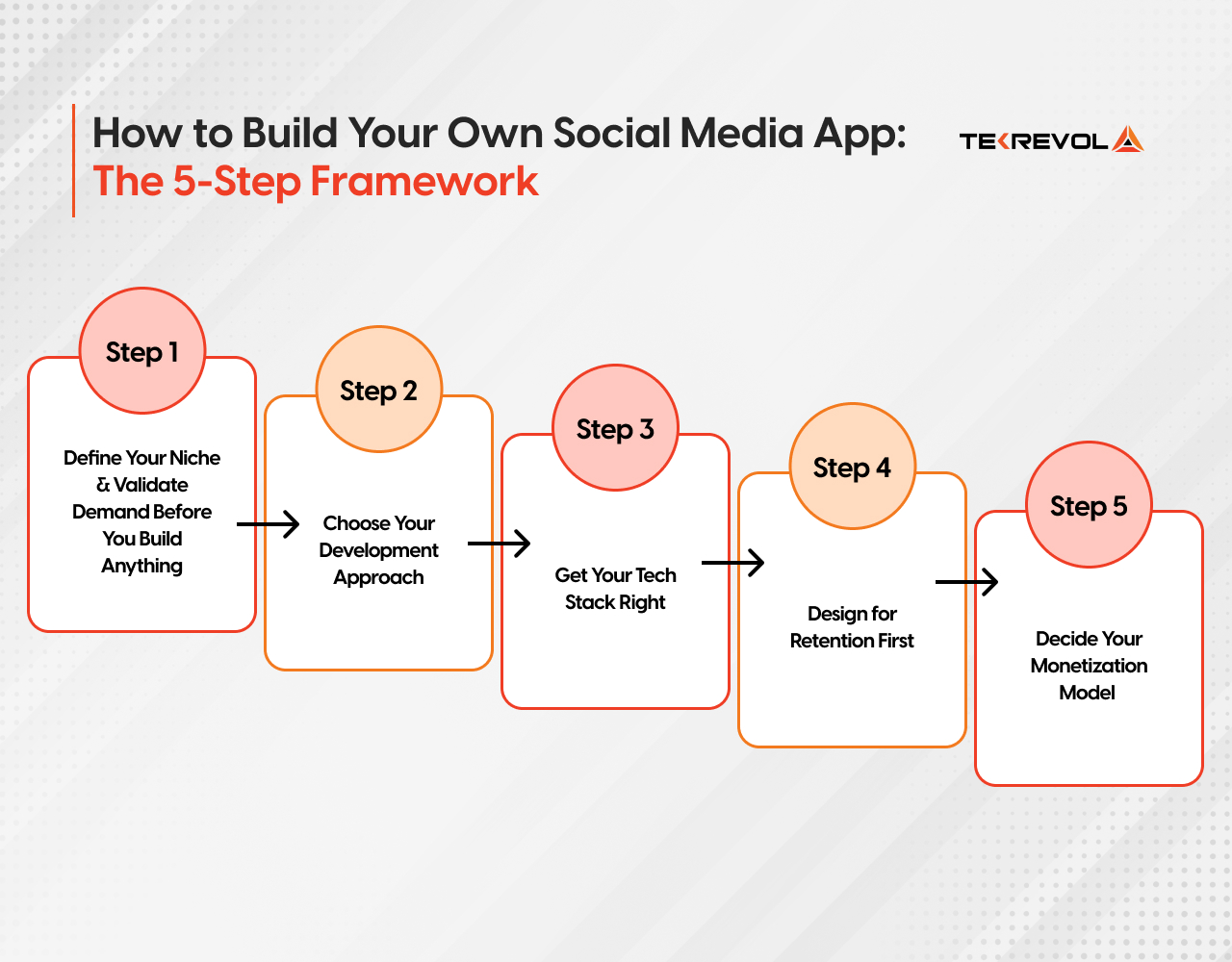
Step 1: Define Your Niche and Validate Demand Before You Build Anything
Questions to answer before writing a single line of code:
- Who specifically is this for? (Not “everyone” — narrow it)
- What is the core engagement loop? (What brings them back tomorrow?)
- What does this platform do that no existing app does for this community?
Step 2: Choose Your Development Approach
| Approach | Timeline | Estimated Cost | Best For |
| Custom from scratch | 6–12 months | $80,000–$300,000+ | Funded startups with specific technical requirements |
| White-label platform-based | 2–4 months | $20,000–$80,000 | Faster MVP with defined niche needs |
| No-code (Bubble, Adalo, FlutterFlow) | 2–8 weeks | $5,000–$30,000 | Validation phase, bootstrapped founders |
| AI-augmented development | 6 weeks–4 months | $25,000–$150,000 | Best cost-to-speed ratio in 2026 |
Step 3: Get Your Tech Stack Right
- Frontend: React Native or Flutter to build a mobile app. React.js or Next.js for the web.
- Backend: Node.js, Python/Django, or Go. Real-time infrastructure via WebSockets, WebRTC, or Firebase.
- Database: PostgreSQL (relational), MongoDB (document-based), Redis (caching and real-time).
- Media & Storage: AWS S3 or Cloudflare R2 for scalable media delivery. CDN from day one — not after you go viral.
- AI/ML: TensorFlow or custom recommendation models for feed personalization. NLP models for content moderation.
Step 4: Design for Retention First
Most social apps don’t fail due to weak tech; they fail because users don’t return. Retention must be built in from day one.
Personalization, community features, and interactive content formats (polls, live events, challenges) must be built into the product from day one, not bolted on after the fact. Engagement strategy is a product and engineering problem, not a marketing one.
Step 5: Decide Your Monetization Model
The model you choose shapes your algorithm, your data infrastructure, your UX, and your long-term unit economics.
| Monetization Model | Best For | Key Benefit |
| Ad-Supported | General audience platforms | High revenue at scale |
| Subscription | Niche & professional communities | Predictable, stable revenue |
| In-App Purchases | Creator, gaming & live-streaming | High-margin digital goods |
| Creator Revenue Share | Content-driven platforms | Attracts quality creators |
| Social Commerce Fees | Product-adjacent communities | Monetizes purchase intent |
| Data Licensing | Scaling platforms | B2B revenue layer |
How Much Does It Cost to Build a Social Media App in 2026?
This is the question every founder asks. Here’s the honest answer, broken down by complexity tier.
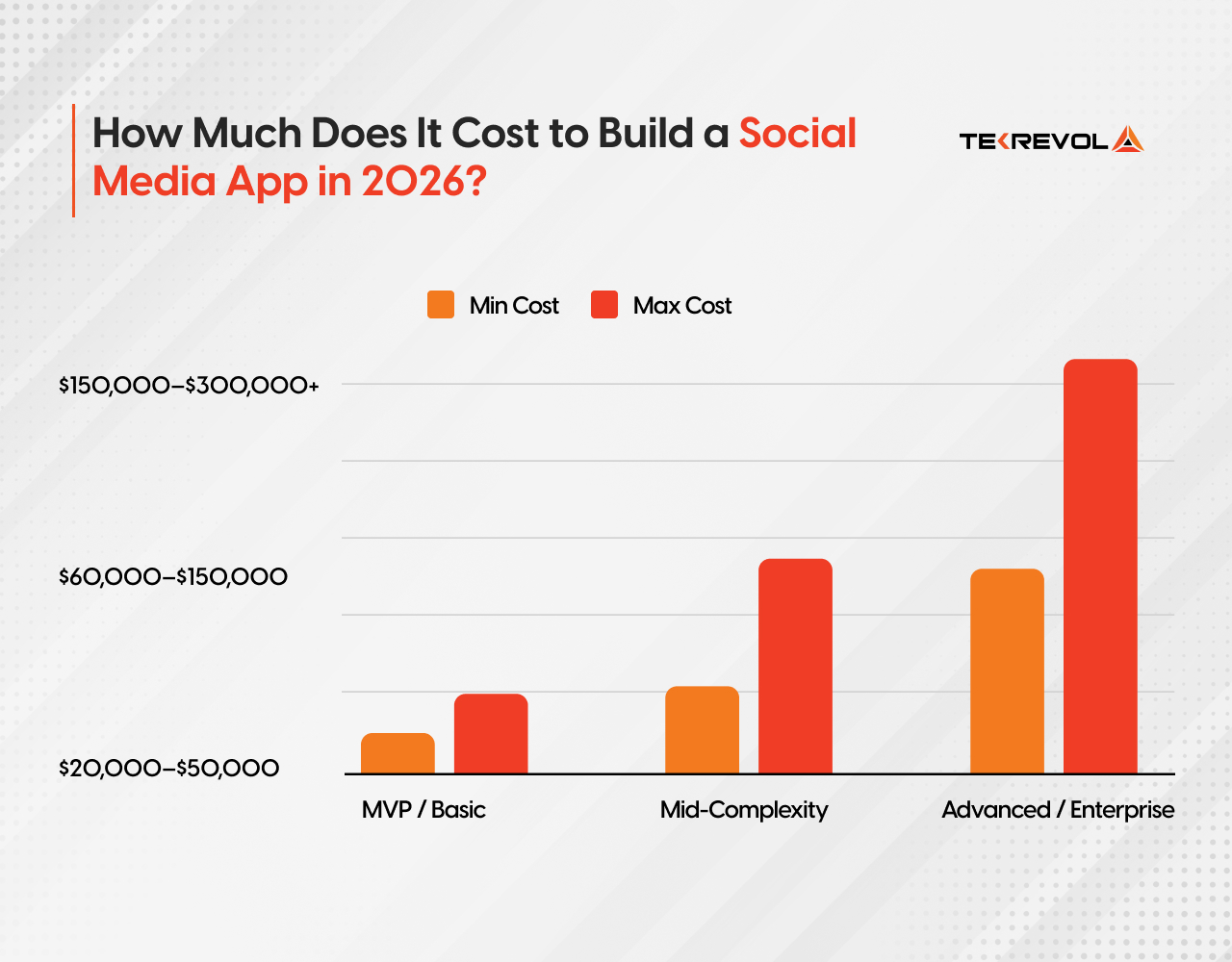
Development Cost by App Tier
| App Tier | What’s Included | Estimated Cost |
| MVP / Basic | Profiles, feed, messaging, notifications, basic moderation | $20,000–$50,000 |
| Mid-Complexity | + Live streaming, AI recommendations, social commerce, advanced analytics | $60,000–$150,000 |
| Advanced / Enterprise | Full AI stack, AR/VR, global scalability, custom moderation infrastructure | $150,000–$300,000+ |
The Real Challenges of Building a Social Platform (And How to Solve Them)
Building a custom social media app is one of the highest-upside investments a brand can make in 2026. It is also one of the most technically demanding. Here are the challenges you will actually face, and how to approach them.
The Cold Start Problem
Every social platform launches with zero users into a product where value comes from other users. Solve this by seeding with a pre-existing community before launch, a newsletter list, a Discord server, and an invite-only beta. Never launch publicly to no one.
Retention is the Real Metric
Most users abandon new apps within days of downloading them. The platforms that keep users deliver personalized value fast and build habits through meaningful interaction. This is a product engineering problem, not a marketing one.
Scalability Under Viral Load
Going viral before your infrastructure is ready usually means a catastrophic outage that permanently damages trust. Build cloud-native architecture from day one, use CDNs, and design for horizontal scaling. The cost is marginal at launch. The value is existential at scale.
Content Moderation at Scale
You are legally and reputationally liable for everything hosted on your platform. The 2026 standard is a hybrid system, AI models for volume and speed, human review for nuance and appeals. Build your moderation infrastructure before your first 100 users, not after your first crisis.
Data Privacy and Compliance
GDPR, CCPA, and the EU Digital Services Act all apply depending on where your users are, not where your servers are. These are architectural commitments that must be made before the first line of production code. Building compliance retroactively costs five to ten times more than doing it right the first time.
The Niche Social Network Opportunity — Why Smaller Wins Bigger
Here’s a counterintuitive truth that most social media advice ignores: in 2026, 50,000 highly engaged niche community app members are worth more than 5 million passive scrollers on a general platform.
General platforms are too broad for depth. A platform built specifically for independent financial advisors, competitive cyclists, competitive homeschooling parents, or boutique hotel owners will consistently outperform a general network on every metric that actually matters — engagement rate, retention, conversion, and monetization potential.
The industries with the highest niche social network development platform potential in 2026:
- Health, fitness, and wellness (highest creator monetization potential)
- Personal finance and investment communities
- Gaming and esports (strong in-app purchase behavior)
- Professional education and certification
- Real estate investment and property
- B2B professional networks by vertical
- Parenting communities by developmental stage
- Creative industries (photography, design, music production)
The DAU/MAU ratio, the ratio of daily to monthly active users, is the clearest signal of whether a social platform has genuine community health.
Top-tier apps like TikTok achieve DAU/MAU ratios above 50%. The average social app sits around 20%. Niche platforms consistently outperform general platforms on this metric because relevance drives habit.
The window is open. Niche-first movers are locking in loyal communities right now. The technology barrier has never been lower, and the audience fragmentation has never created a better opening.
What’s Coming Next: The Future of Social Media App Development
Staying ahead of social media trends isn’t optional anymore; it’s the difference between building a platform that leads the market and one that plays catch-up. Here’s what the next wave looks like:
AI-native platforms will define the next generation. Feeds, moderation, content creation, and community matching are all AI-driven by default. The question is no longer whether AI will be in your platform, but how well you implement it.
Voice-first social is emerging as audio-led communities mature. The Clubhouse model failed in its first iteration, but the behavior it identified, real-time audio community, is real and growing.
Spatial and AR social is moving from experimental to expected. Location-aware social experiences, AR overlays on the physical world, and immersive community interactions are early-stage but on a clear trajectory.
Blockchain and decentralized social put user-owned data and creator-owned monetization at the center of platform architecture. Mastodon is the early signal. The full wave hasn’t hit yet.
Super-app architecture: social plus commerce plus payments plus services in one owned environment, is the end state most ambitious brands are building toward. WeChat in China is the proof of concept. Western markets haven’t seen it yet. The first brand to build it authentically for its community wins a decade-long moat.
Creator Economy 2.0 will be defined by platforms built specifically around direct creator-to-fan monetization, eliminating the intermediary cut that every major platform currently takes.
How TekRevol Helps Businesses Build Social Products
TekRevol is a full-service mobile app development company with over a decade of experience building digital products that millions of people actually use. From niche community platforms to full-scale social networks, we’ve designed, engineered, and launched custom social media applications for startups, D2C brands, and enterprise clients across North America, the Middle East, Europe, and Asia.
On the marketing side, our social media team managed campaigns across Facebook, Instagram, TikTok, LinkedIn, and YouTube for brands at every stage, from zero-follower launches to multi-million dollar paid acquisition funnels.
What we offer:
- Custom social media app development, full product lifecycle from strategy and UX through engineering, launch, and scaling.
- Social media marketing, paid social, organic growth, content creation, and community management across every major platform.
- First-party data infrastructure, platforms built so your audience data, behavioral insights, and community relationships belong to you permanently.
- End-to-end partnership: one team covering both the platform you own and the platforms you perform on, with a single goal: sustainable audience growth.
If you are ready to build a social product that your business owns, we will build it. If you need to grow faster on the platforms that already exist, we will do that too. Either way, you do not have to figure it out alone.
Claim Your Free Strategy Session, Worth $500
TekRevol helps brands convert ad spend into owned platform infrastructure. Book your free consultation and receive a custom cost breakdown tailored to your growth strategy.
Let's Connect!