



- Dog training app development requires lessons, video tutorials, progress tracking, breed-specific programs, and gamification to keep users engaged.
- A dog training app costs around $25,000–$45,000 for an MVP and $60,000–$100,000 for a full AI-powered platform.
- Gamification features like streaks, XP, and badges are essential for improving retention and reducing churn.
- Video streaming requires CDN infrastructure and adaptive delivery, adding $8,000–$18,000 to development costs.
- TekRevol develops dog training apps with gamification, streaming, and AI-powered personalization.
The global pet tech market was valued at approximately $14.61 billion in 2025 and is projected to exceed $61 billion by 2035, reflecting strong long-term growth across the industry.
New dog owners want professional guidance. They just do not want to drive somewhere to get it. A well-built dog training app gives them structure, accountability, and expert instruction from their phone.
The challenge is not building the content. It is keeping users engaged long enough to actually change their dog’s behavior, which takes weeks, not days. That requires gamification mechanics and video content architecture, both technically non-trivial to implement well.
As a mobile app development company with proven experience in engagement-driven apps, TekRevol breaks down exactly what it takes for a dog training app development that retains users and generates sustainable subscription revenue.
The Pet Tech App Market in 2026
The pet tech market is one of the fastest-growing consumer tech categories globally, with dog training apps specifically projected to grow at 18.5% CAGR through 2033.
This growth is driven by rising pet ownership, the pandemic-era adoption wave, and increasing owner willingness to pay for digital solutions.
The verified market picture:
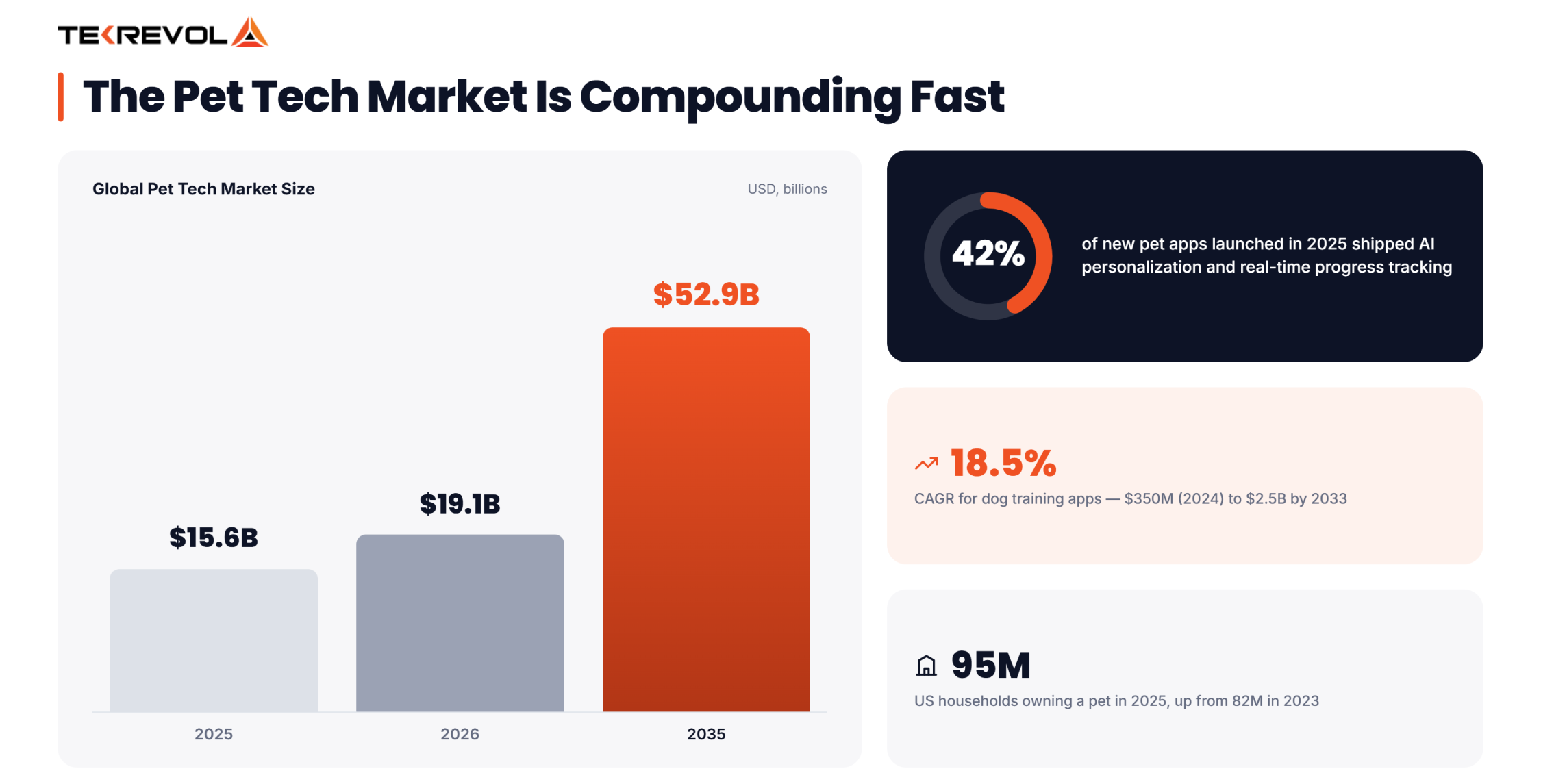
- The global pet tech market was valued at USD 15.6 billion in 2025. The market is expected to grow from USD 19.1 billion in 2026 to USD 52.9 billion in 2035
- US alone: 95 million households owned at least one pet in 2025, up from 82 million in 2023
- Dog training apps market: $350 million in 2024, projected to reach $2.5 billion by 2033 at 18.5% CAGR
- Dog training apps market alternative estimate: $1.03 billion in 2023, projected at $3.5 billion by 2031 at 14.53% CAGR
- 42% of new apps launched in 2025 integrated AI-based personalized training and real-time progress tracking
Why Dog Training Is the Highest-Engagement Pet App Category
GPS trackers and smart feeders are passive products. Users check them occasionally.
Dog training apps demand active daily participation. A user opens the app, watches a lesson, runs a training session with their dog, logs the result, earns a streak point, and shares progress with the community.
That daily active loop creates engagement metrics that most consumer apps can only aim for, making this category especially well-suited for cross-platform app development focused on scalable user growth.
The pandemic adoption wave added an estimated 23 million households to US pet ownership between 2020 and 2022.
Many of those dogs are now adolescents, the exact age when behavior problems peak and owners most need structured training guidance. That creates sustained demand well into 2026 and beyond.
Apps like Dogo (5 million+ downloads), Pupford, and GoodPup have proven that the subscription model works. The market is growing. The early entrants do not own it. There is meaningful room for a well-built, well-differentiated product.
The Pet Tech Market Is at $14.6 Billion and Climbing. Where Is Your App?
Dog training apps drive high engagement through subscriptions and retention, and TekRevol builds scalable pet tech apps for long-term user growth.
Let's Build My Pet AppCore Features of a Dog Training App
A dog training app needs five core features: a structured training curriculum, step-by-step lessons with video demonstrations, a progress and milestone tracker, breed-specific programs, and trainer-to-user messaging. These form the functional foundation before any gamification layer, inspired by modern mobile game development services or AI-driven personalization, is added.
Structured Training Curriculum
The curriculum is your product’s spine. It needs to be organized into clear learning paths, beginner basics (sit, stay, come), intermediate skills, advanced commands, and problem behavior correction (barking, jumping, leash pulling).
Each learning path should be broken into sessions that a user can complete in 5–15 minutes. Short sessions match the attention span of both the dog and the owner.
Curriculum structure should be editable by trainers from a content management panel, not hardcoded into the app. You will update content over time. Build the CMS from the start.
Step-by-Step Lessons with Video
Text instructions are not enough for dog training. Owners need to see the technique. Video is non-negotiable.
Each lesson should follow a consistent structure: explanation of the goal → video demonstration → step-by-step written guide → session exercise with a timer → log result.
Video hosting and delivery is a separate technical problem from lesson structure, addressed in the video architecture section below.
Progress and Milestone Tracker
Users need to see where their dog has been, where they are now, and what comes next. A visual progress tracker, a checklist of completed lessons, a percentage through each curriculum, training session log with dates and notes, keeps users oriented and motivated.
The training session log is also data. Over time, it tells you which lessons users complete (content quality signal) and where they drop off (UX and difficulty signal). Build it to be queryable from your analytics dashboard.
Breed-Specific Programs
A Labrador Retriever puppy and a 3-year-old Chihuahua have completely different training needs. Breed-specific programs signal to users that your app understands their dog, not just dogs in general.
At minimum, segment programs by size class (small, medium, large), age (puppy, adult, senior), and common breed temperament categories (working breeds, toy breeds, sporting breeds). Top-tier implementations have dedicated programs for the 20–30 most popular breeds.
This also solves an onboarding problem. When users input their dog’s breed and age during signup, they see a personalized curriculum immediately, which creates a strong first session impression and reduces early churn.
Trainer-to-User Messaging
Access to a real trainer is a premium differentiator. Not every user needs it, but the users who do will pay significantly more for it.
Trainer messaging works as a subscription tier: basic users get the curriculum, premium users get async text and video messaging with a certified trainer.
This model is similar to how businesses create a messaging app experience that increases user engagement and recurring revenue. It also creates a revenue stream for professional trainers who want to go digital; they earn from the platform, while you earn a commission.
Build messaging as a simple in-app chat, text, and short video clips, not a full real-time video call system. Async is sufficient and far cheaper to build.
Gamification: The Retention Engine of Dog Training Apps
Gamification is the single most important retention mechanism when you develop a pet care app focused on long-term user engagement.
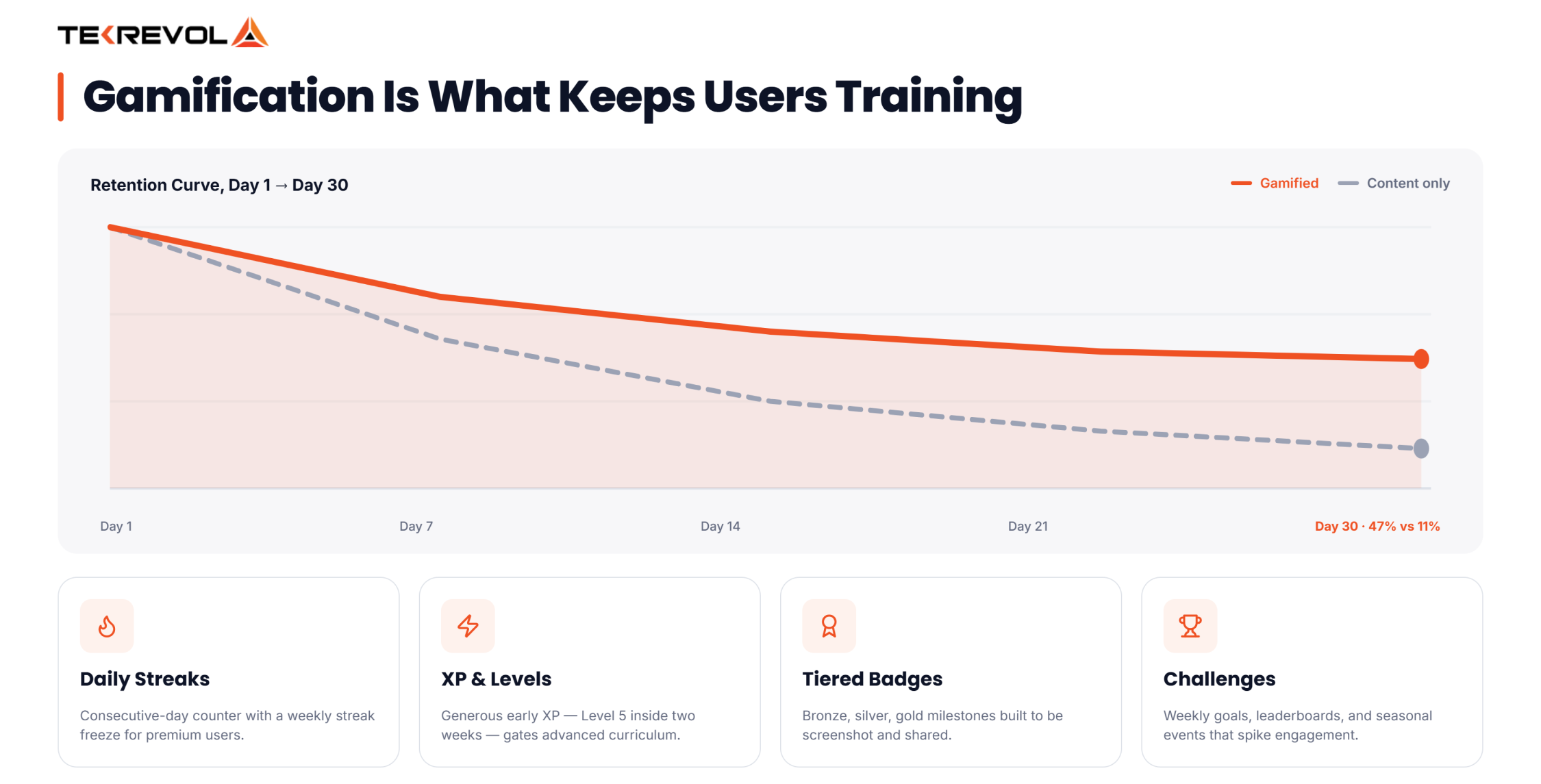
Streak systems, achievement badges, XP progression, and challenge modes keep users returning daily far more effectively than content quality alone, using the same behavioral mechanics that make Duolingo one of the highest-retention apps in the world.
Most dog training apps have decent content. Very few have gamification done right. That gap is where you build a competitive advantage.
Duolingo is the reference model. It has a ~47% Day-30 retention rate, extraordinary for a free app. The content (language lessons) is functional. The gamification (streaks, XP, leaderboards, leagues) is what keeps people opening it every morning. Dog training has the same opportunity.
Daily Streak System
A streak tracks how many consecutive days a user has completed at least one training session. Miss a day, and the streak resets to zero.
This sounds simple. The psychological pull of not wanting to break a streak is one of the most powerful retention mechanics in consumer apps. Duolingo built an entire user behavior pattern on it. Snapchat’s streaks keep teenagers opening the app multiple times per day.
For a dog training app, a daily streak aligns perfectly with behavior change science; consistent daily practice is exactly how dogs learn. The streak mechanic and the training science point in the same direction.
Implementation details that matter:
- Streak freeze: Let premium users protect their streak if they miss a day (one free per week). Duolingo uses this, it reduces churn on days when life gets in the way without eliminating streak pressure entirely.
- Visual celebration on streak milestones: Day 7, Day 30, Day 100, animate these. They are sharing moments. Users post Day-100 streak screenshots to social media, which is a free acquisition.
- Daily reminder notification: Timed to the user’s preferred training window, with streak-specific copy: “Don’t break your 14-day streak, Max is counting on you.”
Achievement Badges and Milestones
Badges mark moments of progress. First lesson completed. First command mastered. First week done. 10 commands trained. First advanced course finished.
Design badges to be visually appealing, and users share them. Every badge shared on Instagram or TikTok is an ad you did not pay for.
Tier your badges: bronze for early milestones, silver for intermediate, gold for advanced achievements. This creates a visible collection that shows experienced users how far they have come and how far they could still go.
XP and Level Progression
Every training session earns XP points. Points accumulate into levels. Higher levels unlock new content, profile customization options, or community features.
The level system serves two purposes. First, it creates a visible status; users want to level up. Second, it justifies progressive content unlocking, advanced curriculum unlocks at higher levels, creating a natural content pacing system that prevents users from skipping ahead before they are ready.
Keep the XP math generous early. Users should reach Level 5 within their first two weeks. Early momentum is when you either hook a user or lose them forever.
Challenge Mode and Competitions
Weekly challenges: train 5 sessions this week, teach your dog a new command in 3 days, complete the recall course, and create urgency and community engagement simultaneously.
Community leaderboards showing top streaks and highest XP create social motivation. Users who see friends on the leaderboard open the app to compete. This works even for introverted users who would never post about their dog training publicly; the leaderboard pull is sufficient.
Seasonal events, a “Puppy Bowl Challenge” in February, a “New Year New Dog” January challenge, create marketing calendar moments and spike engagement without requiring new content development.
Video Content Architecture for Dog Training Apps
Video streaming in a dog training app requires a dedicated CDN video hosting platform (Mux or Cloudflare Stream), adaptive bitrate delivery that adjusts quality to the user’s connection speed, offline download for premium users, and a trainer-facing upload workflow, and it is technically more complex and costly than most founders expect.
Video is the core media type of a dog training app. Getting it wrong means buffering, quality drops on mobile networks, and users abandoning lessons before they finish.
Why You Cannot Use YouTube or Basic Storage
Hosting training videos on YouTube and embedding them is a common shortcut that fails for three reasons: YouTube autoplay and recommendations pull users off your app; you have no playback analytics, and YouTube does not support offline downloads.
Storing raw video files in AWS S3 and serving them directly is equally wrong. Raw video files are large, un-transcoded for mobile, and served without adaptive streaming. A user on 4G watching a 1080p video file from S3 will buffer constantly.
You need a purpose-built video infrastructure. The two best options for a dog training app in 2026:
Mux: Purpose-built for developer video infrastructure. Handles transcoding, adaptive HLS streaming, playback analytics (watch time, rebuffering rate, drop-off points per video), and DRM for premium content protection.
Per-minute storage and per-minute streaming pricing make costs predictable. Strong React Native SDK support.
Cloudflare Stream: Competitive with Mux on price. Strong global CDN performance. Simpler analytics than Mux. Good choice if you are already using Cloudflare infrastructure.
Adaptive Bitrate Streaming
Adaptive bitrate (ABR) streaming, specifically HLS (HTTP Live Streaming), automatically adjusts video quality based on the user’s current network speed.
A user on WiFi gets 1080p. The same user switching to LTE mid-lesson gets 720p. Drop to a weaker signal, and it steps down to 480p. The video never stops. The quality degrades gracefully instead of buffering.
This is table-stakes for any video app in 2026. Both Mux and Cloudflare Stream handle ABR transcoding automatically when you upload a source video.
Offline Download for Premium Users
Premium subscription users expect to download lessons for offline use. This is especially valuable for dog training, as users often train outdoors where connectivity is unreliable.
Offline download requires:
- Encrypted local storage of downloaded video files (preventing sharing outside the app)
- Download queue management (users may queue multiple lessons)
- Expiry logic — downloaded content should expire after a set period (30 days is standard) or when subscription lapses
- DRM (Digital Rights Management) — Mux supports FairPlay (iOS) and Widevine (Android) for downloaded content protection
Offline download adds $5,000–$10,000 to development cost. For a premium subscription-focused dog training app, it is worth it.
Trainer Content Upload Workflow
Trainers need a simple way to upload new lessons without involving a developer. This means a web-based content management interface where trainers can:
- Upload a video file (Mux or Cloudflare Stream handles transcoding automatically)
- Add title, lesson description, breed tags, and curriculum position
- Preview before publishing
- Edit metadata post-publish
Build this CMS from the start. Running trainer content updates through a developer is unsustainable at scale.
Video Streaming Is Harder Than It Looks. Build It Right the First Time.
TekRevol builds dog training apps with scalable video infrastructure, adaptive streaming, offline access, and trainer management systems.
Get My Video Stack ScopedAI and Personalization Features in Dog Training Apps
AI personalization in dog training apps, including personalized training plans based on breed, age, and problem behavior, is achievable with a rule-based recommendation engine at the MVP stage.
Many businesses partner with an AI development company to later expand these systems with advanced capabilities like computer vision for behavior detection in V2 and beyond.
AI-Personalized Training Plans
The simplest form of personalization uses a rule-based engine, not a trained ML model. At onboarding, the user inputs: breed, age, current behavior problems (barking, biting, leash pulling, separation anxiety), previous training experience, and daily time available.
The rule engine maps these inputs to a curriculum sequence: “4-month-old Border Collie with leash pulling issues, 15 minutes per day → starts on Puppy Foundations Track, adds Leash Manners module in Week 2.”
This is not AI in the ML sense. But it produces genuinely personalized recommendations, and it is buildable at MVP cost. True ML-based recommendation (learning from session completion patterns across your user base) is a V2 feature once you have enough behavioral data.
Camera-Based Behavior Detection
Apps like Puppr have begun experimenting with AI that analyzes a dog’s position from a smartphone camera and provides real-time feedback, “your dog’s sit isn’t square, try moving the treat slightly back.”
This uses pose estimation models similar to MediaPipe’s Pose solution, adapted for quadruped anatomy. It is technically emerging, the labeled training datasets for dog poses are still limited compared to human pose datasets. Reliable, production-ready dog pose detection is not yet standard in this category.
For 2026, this is a V2 feature to monitor and prototype. For MVP, it is a differentiator to mention in your roadmap, not a feature to commit to in launch scope.
Personalized Daily Training Reminders
Smart notifications based on the user’s historical training time are straightforward to implement and meaningfully effective. If a user consistently trains between 7–8 am, the daily reminder fires at 6:50 am. If they typically train after 8 pm, it adjusts.
Firebase Cloud Messaging handles the delivery, while the personalization logic runs server-side through scalable cloud consulting services that analyze a user’s last 14 training session timestamps to determine their preferred training window.
Tech Stack for a Dog Training App
The recommended tech stack for a dog training app in 2026 is React Native for cross-platform frontend, Node.js for backend, Mux or Cloudflare Stream for video, PostgreSQL for database, Firebase Cloud Messaging for push notifications, and a rule-based engine for personalization at the MVP stage.
| Layer | Technology | Purpose |
| Frontend | React Native (iOS + Android) | Single codebase, strong video player library support |
| Backend | Node.js (Express or Fastify) | REST API, gamification logic, notification scheduling |
| Video Infrastructure | Mux or Cloudflare Stream | Transcoding, adaptive HLS streaming, and playback analytics |
| Video Player | react-native-video + Mux Player SDK | Adaptive playback, progress tracking, and offline support |
| Database | PostgreSQL | User accounts, lesson data, progress records, trainer content |
| Caching | Redis | Session state, leaderboard data, streak cache |
| Push Notifications | Firebase Cloud Messaging (FCM) | Streak reminders, milestone alerts, challenge notifications |
| Authentication | Firebase Auth | Social login (Google, Apple), email/password |
| Offline Storage | react-native-fs + DRM (FairPlay / Widevine) | Encrypted offline video downloads for premium users |
| Content CMS | Custom admin panel (React.js) | Trainer video upload, curriculum management, and content scheduling |
| Subscription Management | RevenueCat | App Store + Google Play subscription infrastructure |
| Analytics | Mixpanel + Mux Data | User behavior tracking + video engagement analytics |
| AI Personalization (MVP) | Rule engine (Node.js) | Breed/age/behavior input → curriculum recommendation |
| AI Personalization (V2) | TFLite recommendation model | ML-based curriculum sequencing from session completion data |
Why React Native for a Dog Training App
React Native covers iOS and Android from one codebase. The core features, including video playback, push notifications, progress tracking, and gamification UI, are all well-supported through modern React Native development services and its mature ecosystem of libraries.
The cost saving vs. native dual-platform development is approximately 30–35% for this app type. No meaningful feature requires native-only development at the MVP stage.
Development Cost for a Dog Training App
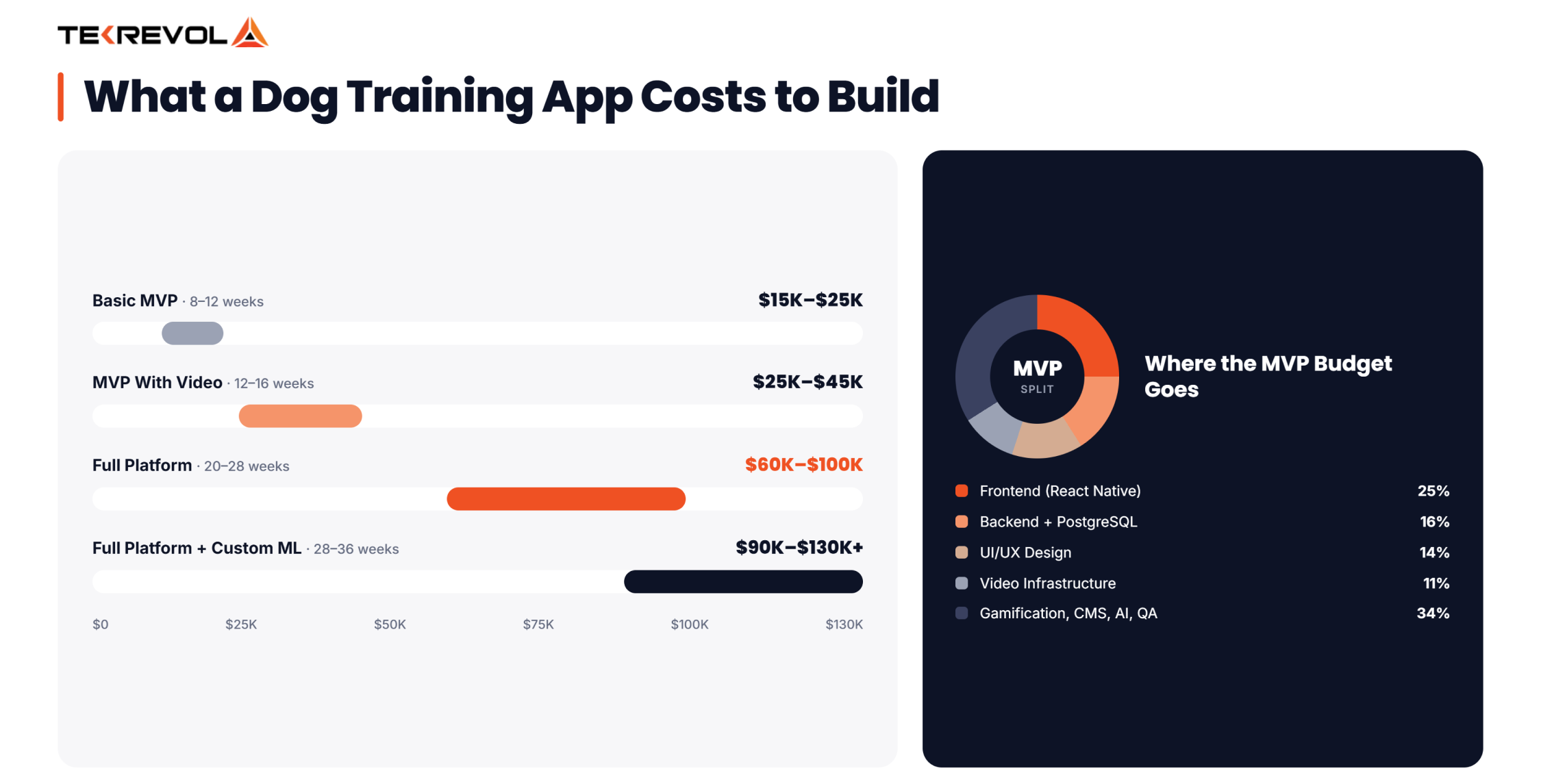
The mobile app development cost for a dog training app ranges from $25,000–$45,000 for an MVP with lessons, gamification, and progress tracking, and $60,000–$100,000 for a full platform with video streaming infrastructure, AI personalization, offline downloads, and a subscription model.
MVP vs. Full Platform Cost Breakdown
| Build Type | Features | Cost Range | Timeline |
| Basic MVP | Lesson library (text-based), progress tracker, basic gamification (streak + badges) | $15,000–$25,000 | 8–12 weeks |
| MVP with Video | Above + Mux/Cloudflare Stream video integration, adaptive HLS | $25,000–$45,000 | 12–16 weeks |
| Full Platform | All core features + AI personalization + offline downloads + trainer CMS + subscription | $60,000–$100,000 | 20–28 weeks |
| Full Platform + Custom ML | Above + ML recommendation model + camera behavior detection research | $90,000–$130,000+ | 28–36 weeks |
Cost by Component
| Component | MVP Cost | Full Platform Cost |
| UI/UX Design | $5,000–$10,000 | $12,000–$20,000 |
| Frontend (React Native) | $10,000–$18,000 | $20,000–$35,000 |
| Backend (Node.js + PostgreSQL) | $6,000–$12,000 | $15,000–$25,000 |
| Gamification System | $3,000–$6,000 | $6,000–$10,000 |
| Video Infrastructure (Mux/Stream) | $4,000–$8,000 | $8,000–$18,000 |
| Trainer CMS | $3,000–$5,000 | $6,000–$12,000 |
| AI Personalization (rule engine) | $2,000–$4,000 | $5,000–$10,000 |
| Subscription (RevenueCat) | $2,000–$3,000 | $3,000–$5,000 |
| QA + App Store Launch | $3,000–$6,000 | $6,000–$12,000 |
Ongoing Operational Costs to Budget
- Mux video hosting: ~$0.0026/min stored + $0.0052/min delivered. At 500 hours of video content with 10,000 monthly active users, approximately $200–$600/month.
- Server hosting (AWS/GCP): $200–$800/month at early scale
- Firebase (notifications, auth): Free tier covers most early-stage usage
- Annual maintenance: 15–20% of build cost per year for OS updates, security patches, and content platform updates
Monetization Strategies for Dog Training Apps
Dog training apps most commonly monetize through freemium plus premium subscription, with basic lessons free and premium curriculum, video content, and trainer access behind a paywall, supplemented by one-time course purchases and trainer marketplace commission.
Freemium + Premium Subscription (Primary Model)
Give enough free time to demonstrate value. Gate what users most want behind a paywall.
Typical free tier: introductory lessons for 3–5 basic commands, limited gamification features, no video demonstrations, text-only guides.
Premium tier ($7.99–$12.99/month or $49.99–$79.99/year): full curriculum, all video lessons, AI-personalized plan, offline downloads, trainer messaging access, premium gamification features (streak freeze, advanced badges).
Annual plans at a 40–50% discount improve LTV significantly. Push annual in your upgrade flow; a user who pays $69.99 upfront is retained for 12 months. A monthly subscriber at $9.99 can churn after 30 days.
One-Time Course Purchases
Specific problem-behavior courses — “Stop Leash Pulling in 7 Days,” “Crate Training Mastery” — sold as standalone one-time purchases ($9.99–$24.99) reach users who resist subscriptions. These are also strong acquisition tools — a focused, affordable course converts new users who are not ready to subscribe, then warms them toward the full subscription.
Trainer Marketplace Commission
When you have scale (10,000+ users), open the platform to independent certified trainers. Trainers create their own courses, set their own prices, and access your user base. You take 20–30% commission on all trainer course sales.
This model scales your content library without your content budget scaling with it. It also creates a community flywheel, trainers promote their courses on social media, driving new users to your platform.
How TekRevol Can Help You Build a Dog Training App
TekRevol builds engagement-driven mobile apps with gamification mechanics, video streaming infrastructure, and AI personalization, the three technical capabilities that determine whether a dog training app retains users or gets uninstalled after a week.
Here is exactly what TekRevol brings to a dog training app build:
- Gamification engineering: Streak systems, XP models, achievement badge libraries, leaderboard infrastructure. TekRevol has implemented these mechanics in consumer-facing apps and understands the behavioral design principles behind them, not just the code.
- Video infrastructure: Mux and Cloudflare Stream integration, adaptive HLS delivery, react-native-video implementation, offline download with DRM, and trainer-facing CMS. TekRevol handles the full video stack that most dev teams underestimate.
- AI personalization: Rule-based recommendation engines for MVP, with a clear roadmap toward ML-based personalization as your user dataset grows. TekRevol has shipped TruthGPT, an AI-powered app with complex inference pipelines, demonstrating the production ML capability behind this claim.
- Subscription architecture: RevenueCat integration, App Store subscription compliance, freemium gating logic, and annual plan optimization. TekRevol has built subscription models across lifestyle and utility apps.
- Full-cycle delivery: Discovery → UX design → development → QA → App Store submission. One team, one roadmap. You meet your developer, designer, and PM before signing anything.
Have a Pet Tech or EdTech App Concept?
TekRevol builds dog training apps with gamification, video streaming, and AI personalization that drive long-term engagement.
Start My Dog Training App


