



If advertising were high school, performance marketing would be that A-star student who also leads the debate team, places first in every science fair, and still finds time to run a side business worth six figures.
It’s the golden child of advertising: data-driven, metrics-obsessed, and utterly allergic to vague “brand awareness” measures that have zero guesswork, no fluff, just plain, ROI-centered success!
Fast forward to 2026, digital performance marketing is changing at lightning speed. AI-driven automation, first-party data approaches, and new ad platforms are revolutionizing the way businesses target, engage, and convert their audiences. If you’re not keeping up, you’re surely going to be left behind.
Whether you’re a seasoned marketer, a business owner looking to scale, or just someone who accidentally clicked on this article while searching for cat memes (hey, no judgment), this guide is your ultimate crash course on performance-based marketing.
From what it is and how it works to why it’s taking over the digital advertising world, your every question is answered here!
Performance Marketing vs. Traditional Marketing: What’s the Real Difference?
Before diving into components and trends, let’s settle the basics. Here’s how performance marketing stacks up against the old-school approach:
| Factor | Traditional Marketing | Performance Marketing |
|---|---|---|
| Payment Model | Pay upfront for placement (TV, print, billboards) | Pay only when a result happens (click, lead, sale) |
| Measurability | Hard to track direct ROI | Every dollar tied to a trackable action |
| Risk | Budget spent regardless of outcome | Budget tied to actual performance |
| Optimization | Set once, run for the full flight | Continuously tested and adjusted in real time |
| Primary Goal | Brand awareness and reach | Conversions, leads, and revenue |
| Data Use | Broad demographic targeting | Behavioral, first-party, and AI-driven targeting |
Bottom line: Traditional marketing bets on reach. Performance marketing bets on receipts.
Key Components of Performance Marketing
-
Affiliate Marketing
Consider Affiliate marketing to be the wingman of digital marketing. Brands team up with publishers, bloggers, and influencers who promote goods in return for a sales commission. In 2026, the affiliate marketing market will reach $15.7 billion worldwide.
With AI-powered tracking, brands are now able to pinpoint high-performing affiliates with laser accuracy. The biggest disruptor? Micro-influencers: Brands are moving away from mega-celebs to niche influencers with super-engaged audiences, demonstrating that authenticity beats vanity metrics.
-
Sponsored Content
The days of ads yelling “BUY NOW!” at individuals are behind us. In 2026, sponsored content is so integrated that you may not even notice it’s an ad.
Recent research discovered that native ads have 53% more engagement compared to display ads. Brands are focusing on storytelling, partnering with media houses and influencers to create compelling stories that do not come across as forced.
-
Influencer Collaborations: Authentic Engagement with Target Audiences
Influencer marketing is not just about shelling out money for a celebrity to hold your product. It’s creating authentic partnerships. Performance-based influencer marketing equates to influencers getting paid for actual conversions, not comments or likes.
In 2026, AI will be examining influencer audiences to determine brand fit, preventing companies from “fake engagement.” With TikTok and Instagram still leading the way, anticipate more brands investing in shoppable influencer content that enables direct purchases.
-
Programmatic Advertising: Automated Ad Buying for Efficiency
If you have ever wondered how brands appear to “follow” you online, check out programmatic advertising. Ad placement powered by AI sees that ads reach the right people at the right moment, maximizing every dollar spent.
Programmatic ad expenditure is expected to reach $725 billion by 2026. Look for even more automation, real-time bidding, and AI-driven ad creatives in 2026.
How Do You Actually Pay in Performance Marketing?
Here’s the part that makes performance marketing, well, performance marketing: you don’t pay for exposure, you pay for outcomes. Here are the pricing models driving budgets in 2026:
-
Cost Per Click (CPC)
You pay every time someone clicks your ad. Great for driving traffic, but a click doesn’t guarantee a conversion — so pair it with strong landing pages.
-
Cost Per Acquisition (CPA)
You pay only when a specific action is completed — a sale, a signup, a download. This is the gold standard for ROI-focused campaigns since you’re paying for the outcome, not the attempt.
-
Cost Per Mille (CPM)
You pay per 1,000 impressions. Less common in pure performance marketing since it’s exposure-based, but still used for awareness layers within a broader performance strategy.
-
Cost Per Lead (CPL)
You pay when a user submits their info — a form fill, an email signup, a demo request. Common in B2B and high-consideration purchases where the sale happens later in the funnel.
-
Revenue Share / Affiliate Commission
Common in affiliate marketing: publishers and influencers earn a percentage of the sale they generate, rather than a flat fee. Aligns incentives perfectly — they only get paid when you get paid.
Which one should you use? It depends on your funnel stage. Top-of-funnel awareness plays lean CPC/CPM; bottom-of-funnel, conversion-focused campaigns lean CPA and revenue share.
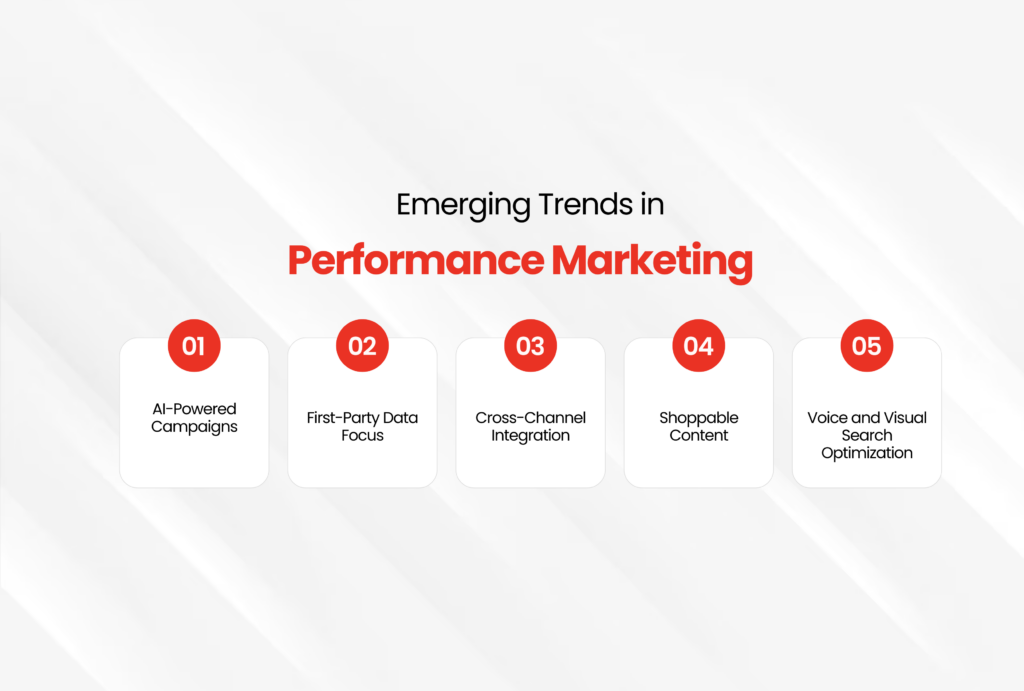
Emerging Trends in Performance Marketing
-
AI-Powered Campaigns
AI is no longer just a buzzword—it’s calling the shots. 84% of marketers indicate that AI enhances campaign performance. From chatbots to predictive analytics, AI is transforming marketing into something smarter, faster, and more efficient.
With AI personalization, look forward to personalized ads that seem like they read your mind (but don’t panic, they don’t—yet). Brands are leveraging AI to forecast customer behavior, optimize ad creatives, and personalize email marketing.
-
First-Party Data Focus
With Google eliminating third-party cookies, marketers are in a tizzy to find new sources of data. First-party data (data directly gathered from customers) is the new gold.
Firms are spending money on email lists, loyalty programs, and zero-party data (where consumers voluntarily share data). The transition to first-party data guarantees more precise targeting and compliance with privacy regulations such as GDPR and CCPA.
-
Cross-Channel Integration
Customers don’t live on only one platform. They scroll through Instagram, Google search, view YouTube, and read blogs—all within a single day. Cross-channel marketing provides an unbroken brand experience across multiple touchpoints.
The secret? It is to do everything that lies in omnichannel attribution models, which includes measuring customer journeys across different platforms to ensure marketing wallets are invested where real outcomes are being witnessed.
-
Shoppable Content
By 2026, customers will not want to click ten times just to buy something. Shoppable content allows users to buy products directly from ads, videos, and social posts.
With social commerce sales projected to reach $1.2 trillion worldwide by 2026, Instagram, TikTok, and Pinterest are going beyond social commerce, with brands seeing extraordinary conversion rates.
-
Voice and Visual Search Optimization
“Hello, Google. What is performance marketing?”
The voice and visual search have emerged, with 71% of customers expressing a preference for voice search over typing. Brands are optimizing content for conversational searches and ensuring their images are searchable through Google Lens and Pinterest.
- Stop Guessing Start Winning!
- Tired of throwing your ad budget into the void and hoping for the best?
Strategies for Successful Performance Marketing
To reap the maximum benefits from performance marketing, you require more than dumping ads in the digital void and crossing fingers. Here are some proven strategies to optimize your performance advertising strategies in 2026.
-
Define Clear Goals and KPIs
Before starting a performance-based marketing campaign, ask yourself: What do I want to accomplish? More leads? Increased sales? Website traffic? Set clear, quantifiable goals.
Common KPIs in performance marketing are:
- Cost Per Acquisition (CPA): What it costs you, in ad spend, to get one paying customer. Lower is better — but only if quality holds up.
- Return on Ad Spend (ROAS): Revenue generated for every dollar spent. A ROAS of 3x means $3 back for every $1 spent — your north star profitability metric.
- Click-Through Rate (CTR): The percentage of people who saw your ad and clicked it. A low CTR usually means your creative or targeting needs work.
- Customer Lifetime Value (CLV): The total revenue a customer generates over their entire relationship with your brand. A high CLV justifies spending more to acquire that customer upfront.
Understanding these will allow you to measure success and optimize your campaigns accordingly.
-
Harness AI and Automation
AI will be the superhero of digital performance marketing in 2026. Utilize machine learning tools to:
- Optimize ad placements in real-time
- Personalize content for various audience segments
- Predict consumer behavior for improved targeting
AI-powered platforms, such as Google Performance Max and Meta’s Advantage+ Shopping campaigns, are removing the guesswork from performance media.
-
Focus on First-Party Data Collection
With privacy laws tightening, relying on third-party cookies is a sinking ship. Instead, build your first-party data strategies using:
- Email subscriptions
- Loyalty programs
- Interactive content like quizzes and surveys
This data helps craft hyper-targeted ads while staying compliant with regulations.
-
Optimize Landing Pages for Conversions
You can drive all the traffic in the world, but if your landing page is slow or confusing, you’re burning money.
- Use compelling CTAs (not just “Click Here” – be creative!)
- Keep forms short – no one likes filling out a 20-field questionnaire
- A/B test different designs, headlines, and CTA buttons
-
Diversify Your Ad Channels
Don’t put all your marketing eggs into one basket. Try:
- Search ads (Google, Bing) – Good for high-intent users
- Social media ads (Facebook, Instagram, TikTok, LinkedIn) – Excellent for brand awareness and engagement
- Native advertising – Non-intrusive integration with content
- Affiliate marketing – Partnership based on performance
By adopting an omnichannel strategy, you engage with your audience wherever they spend time online.
How to Launch a Performance Marketing Campaign, Step by Step
Ready to actually get started? Here’s the simple sequence to follow:
- Set one clear goal. Pick a single primary objective — leads, sales, app installs, sign-ups. Trying to optimize for everything at once optimizes for nothing.
- Choose the right channel for that goal. High-intent buyers? Go search. Building awareness with a specific audience? Go social or native.
- Pick your pricing model. Match CPC, CPA, CPL, or revenue share to your funnel stage (see the payment models above).
- Set up tracking before you launch. Install pixels, configure conversion events, and connect GA4 — you can’t optimize what you can’t measure.
- Launch with multiple ad variations. Never launch a single creative. Run 3-5 variations to see what resonates before scaling spend.
- Monitor daily, optimize weekly. Check CPC, CPA, and ROAS daily to catch problems early, but make bigger budget or targeting decisions weekly — don’t overreact to daily noise.
Rule of thumb: Performance marketing isn’t “set it and forget it.” It’s “set it, watch it, and adjust it.”
Performance Marketing Challenges
Despite performance marketing revolutionizing the way brands promote, it’s not all a walk in the garden. Below are some of the challenges marketers need to address in 2026.
-
Increasing Ad Costs
The price of advertising has gone through the roof. Meta’s CPM (Cost Per Thousand Impressions) rose by 20% YoY in 2026. With more companies putting money into performance advertising, competition is stiff.
Solution: Maximize ad spend with AI-driven bidding tactics and retarget previous customers instead of pursuing cold leads.
-
Privacy and Data Regulations
With legislation such as GDPR, CCPA, and Apple’s App Tracking Transparency (ATT), marketers are granted less access to user information. This makes targeted digital performance marketing more difficult.
Solution: Shift to zero-party and first-party data collection. Encourage users to willingly share their info via engaging content, newsletters, and reward programs.
-
Attribution Challenges
With users switching between devices and platforms, tracking conversions accurately is like trying to follow a squirrel on caffeine.
Solution: Use multi-touch attribution models to improve understanding of the customer journey and leverage tools such as Google Analytics 4 (GA4) for more comprehensive tracking.
-
Ad Fatigue
People are exposed to tens of thousands of ads every day, and ad blindness sets in. If your performance media campaigns lack engagement, they will be dismissed.
Solution: Implement dynamic creative optimization (DCO) to deliver targeted ads, test interactive content, and update ad creatives on a regular basis.
-
Performance Marketing Fraud
Click fraud, bot traffic, and spoofed conversions bleed ad budgets. Advertisers lose more than $40 billion a year to fraudulent clicks ([source].
Solution: Invest in fraud detection technology, such as ClickCeas,e and employ AI-powered ad verification to guarantee that real people interact with your ads.
Common Mistakes That Quietly Drain Your Ad Budget
Even solid strategies fail when these mistakes creep in. Watch out for:
-
Overspending on the Wrong Channel
Just because a platform is trending doesn’t mean it’s right for your product. A B2B SaaS company blowing budget on TikTok because “everyone’s doing video” is a classic misfire.
-
Ignoring AI-Powered Automation
Manual bid adjustments can’t keep pace with real-time auction dynamics. Marketers who skip AI-assisted bidding are leaving optimization on the table.
- Casting Too Wide a Net
Broad targeting feels safe but wastes spend on people who were never going to convert. Precision beats reach in performance marketing.
The fix for all five? Constant testing, constant measuring, never “set and forget.”
Why It’s the Best Time to Get into Performance Marketing?
You’re not in performance marketing yet? What are you doing?. The industry is thriving, and AI has campaigns wiser than ever before, making this the best time to jump in.
Companies are transferring their advertising budgets to performance-based marketing models that promise quantifiable ROI. As a marketer, entrepreneur, or freelancer, there’s tremendous earning potential waiting for you in learning digital performance marketing tactics.
How Tekrevol Helps
Tekrevol is leading the charge for the performance marketing revolution. Whether you require AI-driven campaign management, influencer marketing options, or data-driven advertising plans, we’ve got you covered.
Our specialist team excels at campaign optimization for maximum conversions, smart ad spend, and measurable growth. As a startup or enterprise, Tekrevol makes your marketing dollars work harder and smarter.
Ready to own 2026 with leading-edge performance advertising? Contact us and let’s create magic.”.
- Your Competitors Are Already Doing This—Why Aren’t You?
- They’re out there optimizing, automating, and scaling their ads - Don’t miss out anymore!


