

Mobile app development changed more between 2024 and 2026 than it did in the five years before. Now, AI is no longer an add-on but a core architectural layer. Security requirements tightened across every major industry. Cross-platform frameworks closed the performance gap with native builds.
The mobile app development trends shaping 2026 have moved from innovation labs to production. On-device AI, hyper-personalization, edge computing, and privacy-first architecture change how you scope, build, and ship. Whether you are scoping your first app or scaling an existing product, understanding the latest trends in mobile app development gives you a real advantage.
This guide breaks down the 10 trends defining the future of app development. And if you want help connecting any of these trends to a live build, our mobile app development services match that pace without unnecessary technical debt.
Let’s get into the trends changing the future of mobile apps.
Mobile App Development Trends At a Glance
The biggest mobile app development trends in 2026 focus on smarter, faster, and more reliable applications. AI-powered architecture, cross-platform development, stronger security, and connected ecosystems have become practical business investments instead of emerging ideas.
Here’s a quick overview of the trends shaping the future of app development before we explore each one in detail.
| Trend | Business Benefit | Best For | Adoption Stage |
| On-Device AI | Faster responses, better privacy | Enterprise, SaaS | Mainstream |
| 5G + Edge Computing | Real-time experiences | Healthcare, Logistics, Gaming | Mainstream |
| Cross-Platform Development | Lower costs, faster launch | Startups, SMBs, Enterprise | Standard |
| AR & Spatial Computing | Higher engagement | Retail, Healthcare | Growing |
| Hyper-Personalization | Better retention | Consumer Apps | Mainstream |
| Voice & Touchless UI | Better accessibility | Enterprise, Healthcare | Growing |
| Super Apps | Unified customer experience | Enterprise | Growing |
| Privacy-First Security | Compliance and trust | All industries | Standard |
| IoT & Wearables | Connected experiences | Healthcare, Logistics | Growing |
| Green App Development | Lower energy use | Enterprise | Emerging |
Many businesses now treat mobile development as part of a broader digital transformation strategy. As an expert, TeRevol suggests that instead of adopting every trend, focus on technologies that improve user experience, development speed, and long-term growth.
Need Help Choosing The Right Trends?
Our consultants evaluate your goals and recommend the mobile app development trends that best fit your product, business objectives, and budget.
Book Your Consultation SessionThe 2026 Mobile Market in Numbers
The mobile app market is growing fast. According to EIN Presswire, the global mobile applications market is valued at $206.6 billion in 2026. It is projected to reach $616.4 billion by 2033, at a CAGR of 16.9%. Worldwide app downloads are on track to surpass 181 billion this year.
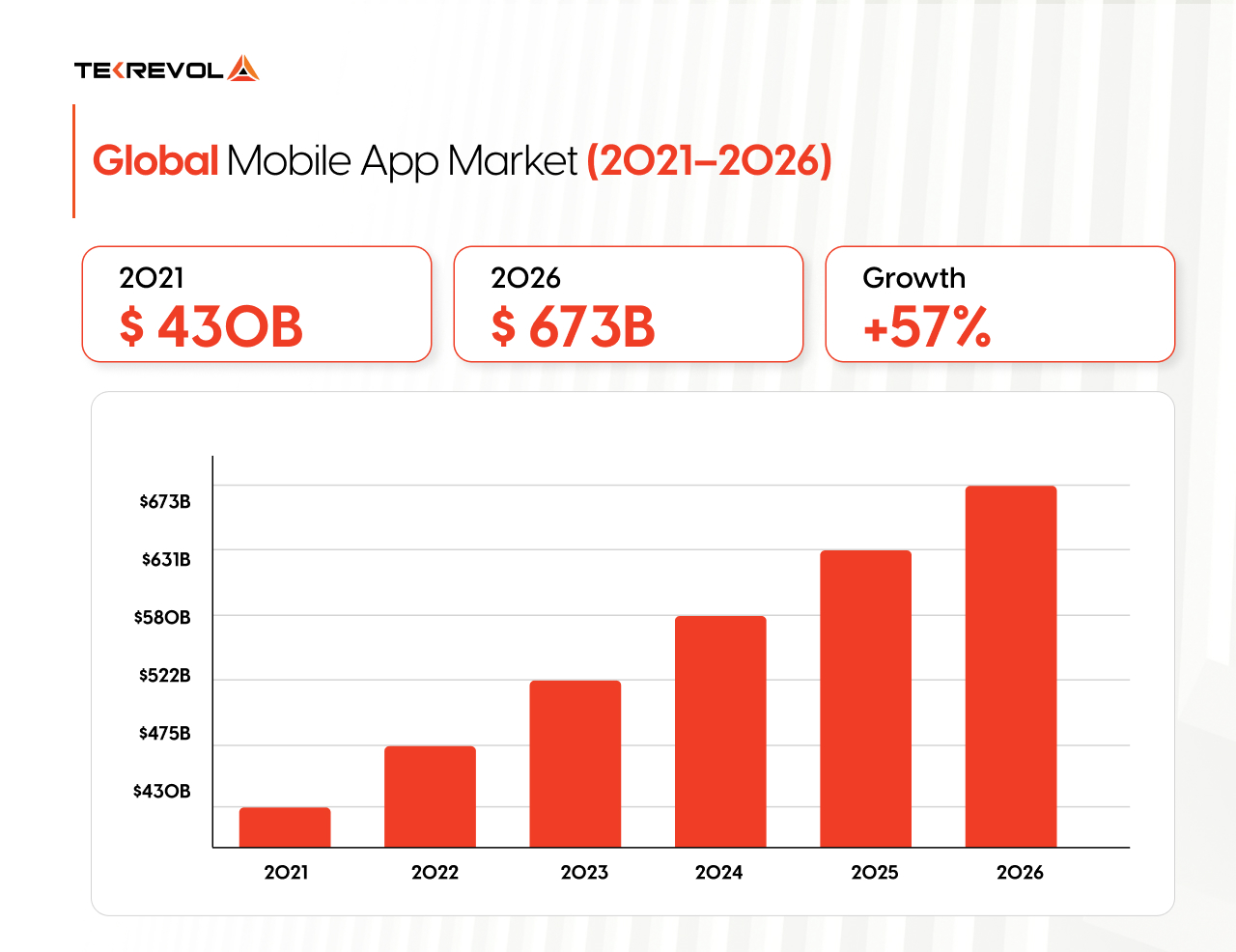
Three signals define the direction:
- AI is becoming standard. Gartner projects 40% of enterprise apps will include task-specific AI agents by the end of 2026, up from less than 5% in 2025.
- Cross-platform is now the default. Building separate iOS and Android codebases takes 30–40% longer to ship and offers no performance advantage in 90% of use cases.
- Teams building for scale are building leaner. McKinsey data shows AI tooling delivers 20–45% productivity gains for engineering teams, compressing development timelines across the board.
These signals frame the 10 mobile app development trends below, each one tied to what teams are building and shipping right now. For the full data picture, our mobile app download statistics report breaks this down by category and region.
Trend #1: On-Device AI Is an Architecture Decision
On-device AI means the model runs directly on the phone’s chip. Your data stays on the device, processing happens locally, and the feature works with no internet connection.
On-device AI is one of the biggest mobile app development trends that delivers faster responses, stronger privacy, and offline capabilities. It also shows how AI revolutionizes app development by moving intelligence closer to users instead of relying on cloud infrastructure. Until recently, most AI features depended on cloud servers. Every request traveled across the internet before returning a result, creating delays and increasing infrastructure costs.
What On-Device AI Looks Like
Modern mobile devices now support AI features that previously required cloud processing. Common examples include:
- Offline voice assistants
- Live language translation
- Smart photo enhancement
- Predictive text and layouts
- Personalized recommendations
- Accessibility improvements
- Camera scene recognition
These experiences feel immediate because the device performs much of the work locally. They also influence your storage strategy, synchronization model, and compliance requirements.
On-Device AI vs Cloud AI
Most teams in 2026 use both. The choice depends on latency requirements and data sensitivity.
| Factor | On-Device | Cloud |
| Latency | Sub-20ms | 200-500ms+ |
| Privacy | Data stays on the device | Data leaves the device |
| Offline capability | Full | None |
| Model size | Up to ~7B params | Unlimited |
| Cost at scale | Near-zero per inference | Per-request billing |
| Best for | Real-time features, sensitive data | Complex reasoning, generation |
Trend #2: 5G and Edge Computing Solves What Cloud Architecture Cannot
5G paired with edge computing processes data close to the user instead of sending it far away to a central server. Together, they make certain app experiences possible for the first time.
Many people associate 5G with faster downloads. The real advantage comes from lower latency. When you combine 5G with edge computing, apps process data closer to users instead of relying on distant cloud servers.
Which Industries Benefit Most From Edge Computing
- Field service: Real-time AR overlays of equipment diagrams without connectivity dependency
- Telemedicine: High-definition video and diagnostic data without compression artifacts
- Logistics: Asset tracking with sub-second refresh rates across large facilities
- Manufacturing: Edge vision models flag defects before products leave the line
Edge computing adds engineering complexity. That complexity is worth it in latency-critical workflows. If your app does not require real-time compute at the edge, cloud architecture remains the right call.
Trend #3: Cross-Platform Development Is the Default Starting Point
Cross-platform frameworks use a single codebase to build an app that runs on iOS and Android, reducing app development cost and shipping time without a meaningful performance penalty.
The answer to “should we build cross-platform or native?” in 2026 is almost always cross-platform app development, and the data supports it.
Flutter is used in 46% of cross-platform projects. React Native is used in 35%. Together, they cover over 80% of the market (Statista, 2025). Most users cannot tell the difference between a Flutter app and a native app anymore.
2026 Decision Framework
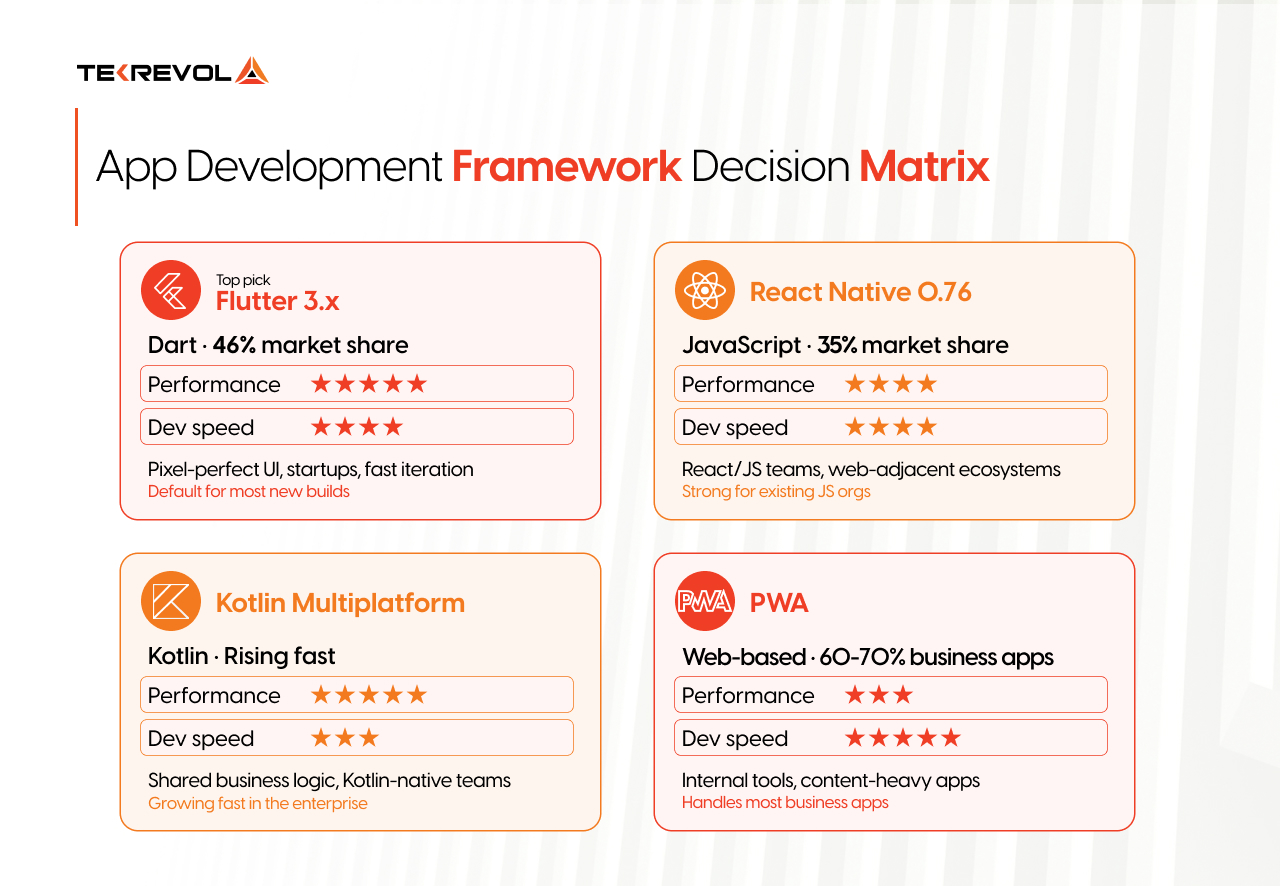
| Framework | Performance | Dev Speed | Best For | 2026 Position |
| Flutter 3.x | ★★★★★ | ★★★★ | Pixel-perfect UI, startups, fast iteration | Default for most new builds |
| React Native 0.76 | ★★★★ | ★★★★ | React/JS teams, web-adjacent ecosystems | Strong for existing JS orgs |
| Kotlin Multiplatform | ★★★★★ | ★★★ | Shared business logic, Kotlin-native teams | Growing fast in the enterprise |
| PWA | ★★★ | ★★★★★ | Internal tools, content-heavy apps | Handles 60–70% of business apps |
Flutter wins for performance and UI consistency across iOS and Android. React Native wins for teams already working in JavaScript. Kotlin Multiplatform wins for shared business logic in Kotlin-heavy environments. PWAs handle internal tools and content apps without requiring App Store submission.
Trend #4: AR and Spatial Computing Move From Novelty to Business Value
Augmented reality overlays digital information onto the physical world through your phone’s camera.
AR and spatial computing continue to shape mobile app development trends, helping businesses simplify complex tasks and improve customer decisions. In 2026, ARKit on iPhone and ARCore on Android will solve practical problems instead of adding visual effects.
Enterprise buyers have seen Apple Vision Pro and Meta Quest 3 in action. Many are now asking vendors whether their apps include an AR layer.
Where AR Is Paying Off in 2026
- Retail: Virtual try-on cuts return rates by 25-40%. IKEA, Warby Parker, and Sephora have all seen measurable results.
- Healthcare: Physio apps coach patients through exercises with real-time feedback on their movements.
- Field service: A technician points their phone at a machine and sees repair steps overlaid on the screen.
- Training: New workers practice a procedure in AR before touching real equipment. Mistakes on the actual job go down.
The AR/VR development work across these three verticals has one thing in common: AR solved a specific friction point; it did not create a new feature for its own sake.
Question to Ask Before Adding AR
Trend #5: Hyper-personalization Keeps Users Coming Back
Hyper-personalization means the app learns what each user likes and adjusts the content, layout, and notifications for them automatically.
Users want relevant recommendations, timely notifications, and content that reflects how they use the product. Personalization is one of the strongest ways to deliver that. Measuring user behavior through data analytics helps you understand which recommendations, messages, and journeys deliver the strongest results. Those insights also shape future product updates and customer retention strategies.
The Three Layers That Make Personalization Work
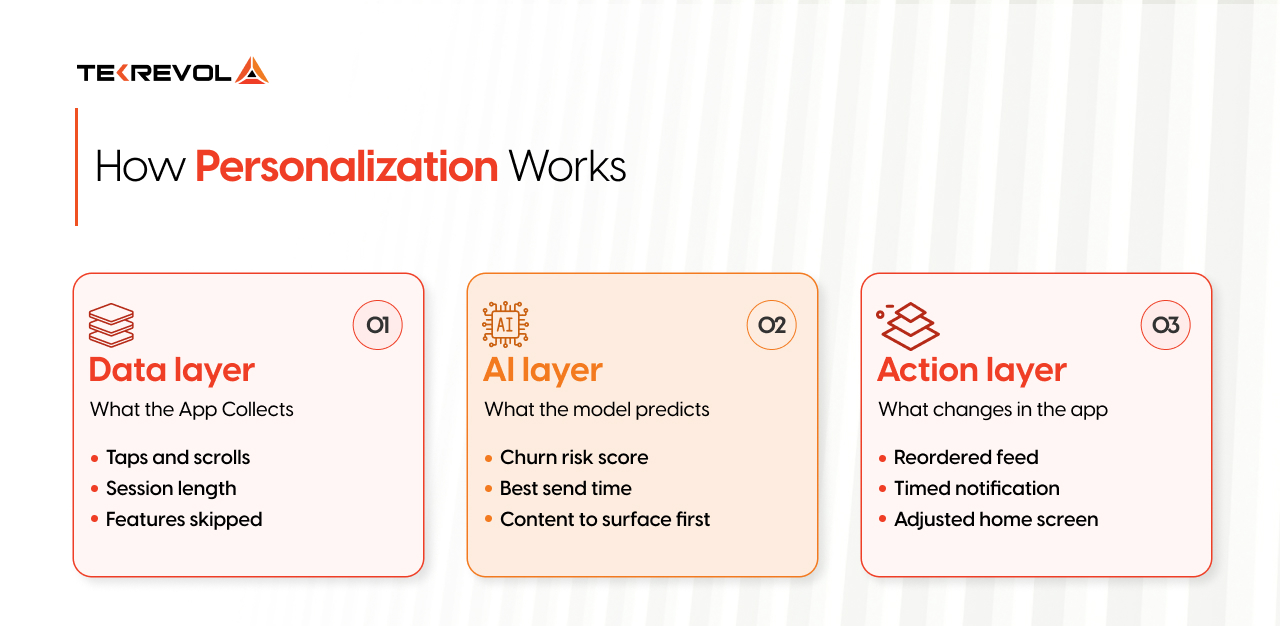
- Data layer: Collects user behavior like taps, scrolls, and session length. Third-party tracking tools are gone on iOS and Android, so you need to collect your own data directly.
- AI layer: Turns that data into predictions: who might stop using the app, what content someone wants next, and when to send a notification. Lightweight models handle this on-device for speed.
- Action layer: Takes those predictions and actually changes the app. Reorders content and adjusts the home screen. Times a push notification.
The same data can strengthen your growth strategy. Understanding emerging mobile app marketing trends helps you deliver personalized campaigns instead of treating marketing and product as separate efforts.
Trend #6: Security and Privacy-First Architecture Is a Procurement Requirement
Privacy-first architecture means sensitive data is processed and stored on the device, with security built into the product from sprint one rather than addressed post-launch.
Security is no longer a final testing step. It influences architecture, authentication, APIs, and data storage from the beginning of a project. Waiting until launch to address security often leads to expensive fixes and delayed releases.
The Privacy-First Architecture Checklist
- Data minimization: Collect only what you need. Each data field is a liability surface.
- On-device processing: Handle health data, biometrics, and financial inputs locally where possible. This eliminates transmission risk and simplifies compliance.
- Consent architecture: give users granular control over what the app collects and clear visibility into how it is used. Blanket consent dialogs do not meet 2026 regulatory standards.
- Zero-knowledge design: Build systems so that even the app developer cannot access certain user data. Use end-to-end encryption for messages and store keys on the device.
- Security testing: Automated scanning in CI/CD, penetration testing before major releases, and dependency audits to catch vulnerable third-party packages.
| Industry | Regulation | What Your App Needs |
| Healthcare | HIPAA | On-device data processing, encrypted storage, and audit logs |
| Fintech | PCI DSS | Tokenized payment data, MFA, penetration testing |
| Enterprise SaaS | SOC 2 | Access controls, encryption at rest and in transit |
| Consumer apps (EU) | GDPR | Consent management, data deletion workflow, DPA |
| Consumer apps (CA) | CCPA | Data disclosure, opt-out mechanisms, no sale of data |
Strong security also requires continuous monitoring after launch. Regular audits, dependency updates, and penetration testing help identify vulnerabilities before they become business risks. Following established mobile app security best practices keeps your application resilient as new threats emerge.
Trend #7: Voice and Touchless Interfaces Improve Accessibility and Convenience
Voice UI lets users control your app by speaking. Gesture and touchless interfaces extend that to hand movements and facial triggers, removing the requirement to tap through every interaction.
Users no longer rely only on taps and gestures. They use voice commands while driving, cooking, exercising, or multitasking. Voice technology has become more accurate thanks to AI. Modern apps can understand natural language, recognize different accents, and complete tasks with fewer commands.
The business case most teams miss is accessibility. Voice and touchless UI bring differently-abled users into your addressable market and support hands-free use.
The Multimodal App Stack
Gesture controls, facial recognition triggers, and voice commands together create multimodal interfaces.
The multimodal stack combines voice through the device microphone, gesture recognition via camera, and traditional touch inputs. Most 2026 implementations use voice as the primary modality and gesture as a secondary trigger.
Expert Tip:
Trend #8: Modular App Ecosystems Are the Practical Alternative to Super Apps
A modular app ecosystem means one shared backend powering multiple focused micro-experiences. Each experience does one thing well, and they share data, identity, and infrastructure.
Super apps are among the latest mobile app development trends because they bring multiple services into one experience. Instead of switching between apps, users can complete more tasks in one place.
The idea isn’t to copy platforms like WeChat or Grab. Most businesses benefit more from a modular approach. They start with one core service and add new features as customer needs grow. This keeps the app focused while creating expansion opportunities.
The business case is operational: lower maintenance cost, unified user data, consistent identity across touchpoints, and an AI layer that works across the whole ecosystem. An AI agent operating across a modular ecosystem can complete multi-step tasks without requiring the user to switch context.
Trend #9: IoT and Wearable Integration Are Expanding the App Surface Area
IoT integration means your app communicates with connected devices, sensors, wearables, machinery, and smart hardware in real time.
They remain important trends in mobile app development because apps no longer work in isolation. They connect with smartwatches, fitness trackers, medical devices, home automation systems, and industrial sensors. This allows users to access information and control devices from a single interface.
Verticals With the Highest Adoption
Healthcare is one of the fastest-growing areas for IoT adoption. Wearables track heart rate, sleep patterns, and activity levels, then share that data with companion apps. Logistics companies use connected sensors to monitor vehicle location and shipment conditions.
For operators, IoT integrations turn a mobile app into operational infrastructure. Remote equipment monitoring, predictive maintenance alerts, and field service automation all become possible when the app communicates with connected devices in real time.
According to IoT Analytics, the number of connected IoT devices is expected to exceed 21 billion worldwide by 2025. That growth continues to create opportunities for businesses that depend on connected products and real-time decision-making.
As connected ecosystems become more advanced, they also generate large amounts of data. Our machine learning engineering helps businesses identify patterns, predict outcomes, and automate routine decisions without overwhelming users with raw information.
Trend #10: Green App Development Is Becoming a Business Requirement
Green app development means writing code that uses less battery and processing power. It produces apps that run longer on a charge and help companies meet their sustainability targets.
Sustainability now extends beyond data centers. Mobile apps also affect battery life, network usage, and server resources. Optimizing them for a better user experience and lower operating costs. In fact, Gartner listed privacy-enhancing computation, including energy-efficient on-device AI, among the top 10 enterprise security priorities in 2026.
What sustainable engineering looks like
- Background tasks: Only run them when needed, not constantly. Always-on background processes are a main cause of battery drain.
- Animations: If an animation does not improve user navigation, remove it. It uses GPU power with no benefit.
- Data sync: Send only what has changed, not the full dataset. Sync when the phone is on Wi-Fi and plugged in, where possible.
- Dark mode: On OLED screens, dark pixels use almost no power. A proper dark mode can cut screen energy use by up to 47% at full brightness (Google, 2021).
- Cloud region selection: Some server regions consume more renewable energy. Routing jobs there reduces your carbon footprint without affecting the user experience.
Which Trends Belong in Your Build?
Following new trends in mobile app development won’t make your app successful. The best results come from choosing technologies that solve real business and user problems.
Define what your app needs to achieve. Then evaluate each trend on this 3-filter model before adding anything to the project scope.
1. Revenue Impact
Does this trend directly affect a metric that matters to the business? Conversion, retention, or monetization? If you cannot name the metric it moves, it belongs on the roadmap, not the current sprint.
2. Architecture Cost
Can this be integrated into your planned stack from day one? If it requires rebuilding something in year two, the cost multiplies significantly. That is the Architecture Tax. Pay it at the start, or pay far more later.
3. Audience Readiness
Are your users already engaging with this kind of experience? AR in a field operations app used by workers in their 50s has a different adoption timeline than AR in a retail app targeting a 25-year-old audience. Timing matters as much as the technology itself.
Conclusion
Mobile applications do not compete for simple download numbers anymore; they compete for permanent presence in a user’s daily workflow. The future of mobile apps belongs to those that eliminate structural technical debt and prioritize lean, secure, data-efficient codebases.
The ten latest mobile app development trends covered across this guide do not form a rigid checklist. Instead, they function as an architectural filter for your product strategy. Most teams that pick two or three and execute them well do better than teams that try to adopt all ten at once.
TekRevol works with founders, product teams, and enterprise buyers to figure out which trends fit their product and how to build for them.
Ready to Turn Trends Into a Real Product?
Talk to TekRevol's app development experts to validate your idea, define the right roadmap, and build a solution tailored to your business goals.
Book Your Consultation Session