Autonomous agents can now refund an order or update a customer record with no one clicking approve. That raises a question every leader ends up asking: what is an autonomous agent allowed to do alone, and who answers when the agent gets something wrong? This article gives you a four-level model for deciding how much autonomy a given task can safely take.
The short answer is that safe autonomy depends on what an agent can undo, not on how capable the model is. That is a judgment, not a measured fact, and the sections below show how to apply it.
Autonomous agents: how much autonomy is safe?
An autonomous agent is software that pursues a goal by choosing its own steps and acting in business systems with little or no human input. The software decides what to do next, where a chatbot only decides what to say next.
A copilot suggests and waits for a person to act, while a rule-based workflow follows a fixed path someone drew in advance. A chat assistant that only replies becomes an agent once it gets tools and permission to act.
People often use “AI agent” and “autonomous agent” as if they were the same thing. This article treats autonomous as a measure of freedom, meaning how much the agent may do without asking. Under that view, any AI agent sits somewhere on a scale that runs between tightly supervised and largely independent.
How an autonomous agent decides and acts
An autonomous agent works in a loop: it reads its situation, plans a step, acts through a tool and checks the result. A tool here means any system the agent can use, such as a customer relationship management system or a payment service. For the full mechanics, see TekRevol’s guide to how AI agents work.
On each pass, the agent makes a small decision, and any decision can be wrong. Because the loop repeats, one bad read in step one can compound through every later step before a person looks, which makes autonomy a risk question before it is a capability question.
The tekrevol autonomy ladder: four levels of agent control
The TekRevol Autonomy Ladder sorts agent work into four levels, and each level hands a little more control to the agent. Each level answers one question: who acts, and who checks?
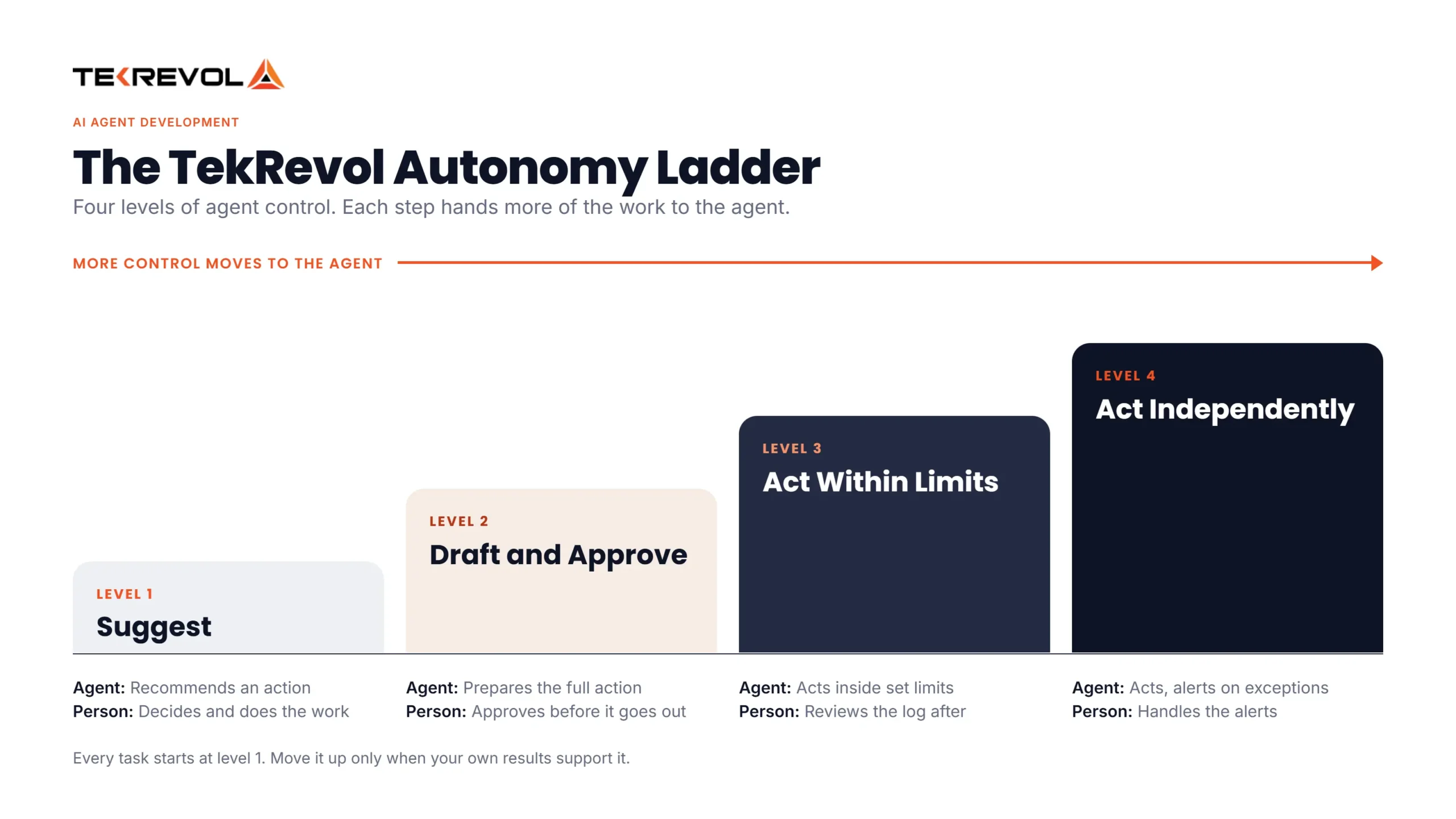
The ladder is TekRevol’s own simplification. We built it as a working tool for leaders, not as an industry standard. Teams that need finer control can read the Cloud Security Alliance’s six-level autonomy framework.
| Level | What the agent does | What the person does | Fits tasks that are |
| 1. Suggest | Recommends an action | Decides and does the work | New or high stakes |
| 2. Draft and approve | Prepares the full action | Reviews and approves before anything goes out | Customer-facing or costly to fix |
| 3. Act within limits | Acts inside set rules, such as a spending cap | Reviews a log after the fact | Reversible and governed by clear rules |
| 4. Act independently | Acts and raises an alert only on exceptions | Handles the alerts | Low risk and easy to undo |
Our rule of thumb is that a first agent belongs at level 1 or 2. Level 4 suits only the tasks where a mistake costs little and a person can reverse it in seconds.
How to decide which level a task can take
A task can move up the TekRevol Autonomy Ladder only when the agent’s mistakes are cheap to undo and easy to see. Four yes/no questions put that idea to work, and every “no” means hold the task at a lower level:
- Can the action be undone? Moving a draft to a folder is reversible, while a payment or a deleted record often is not.
- Is the result seen only inside the company? An internal note carries less risk than a message to a customer or a regulator.
- Has the agent done well on a sample of your own real tasks, with the misses recorded? A vendor demo shows best cases.
- Is the task free of any rule or contract that requires a person to sign off? If the answer is no, the task stays at level 2, where the agent drafts and a person approves, or below, whatever the test results say.
Score the task, not the agent in general, and answer each question for the level you want the task to move up to. A task nobody has assessed yet counts as running at level 1, where the agent only suggests and a person does the work. Four “yes” answers allow the task to move up one level.
One “no” holds the task at its current level, which is the level it runs at today, or level 1 if it has never been assessed. The task cannot move up until that answer becomes a “yes.” A “no” on the sign-off question is stricter: it keeps the task at level 2 or below, so a task running higher moves down to level 2.
In TekRevol’s judgment, two or more “no” answers put the task at level 1 or 2. Choose level 1 when the third question is one of the “no” answers, and level 2 when it is not.
Refund requests illustrate the rule, though this is an example and not a client result. The agent starts at level 1 recommending decisions. A good result on a sample of real requests lets it draft refunds at level 2, where a person approves each one.
Level 3, where the agent acts within set limits and a person reviews a log afterward, fails the first two questions. A sent refund is often hard to undo and the customer sees it, so those two “no” answers keep the task at level 2.
Some tasks need no agent at all. If the steps never change, a rule-based workflow does the job with less risk, because it cannot choose a step nobody planned.
Where autonomous AI agents go wrong
Agents fail in predictable ways: wrong inputs, too much access, silent errors and no record of what happened. Each failure has a matching guardrail:
- Wrong inputs. An agent that reads stale or incorrect data acts on it with full confidence. Check the data source before you raise the level.
- Too much access. An agent with broad permissions can reach systems the task never needed. Give each agent only the access its job requires.
- Silent errors. A wrong action that raises no alert goes unseen. Add exception alerts and a sample review, even at level 4 of the TekRevol Autonomy Ladder, where the agent acts independently and a person handles only the alerts.
- No record. Without a log, nobody can explain a decision to a customer or an auditor. Record every action and the reason the agent gave.
Agents can also drift upward in autonomy by habit. Reviewers may approve every draft for weeks and then stop reading closely, which quietly turns level 2, where a person approves each draft, into level 3, where a person only reviews a log afterward, even though no one keeps a log. Treat a rubber-stamp review as a signal to promote the agent on purpose or to fix the review.
These problems show up wherever an agent acts on live data. TekRevol covers the wider ethics and reliability issues in its guide to deploying AI agents responsibly, and the NIST AI Risk Management Framework offers a voluntary structure for managing the risk.
How to start low and promote an agent with evidence
Start every agent one level lower on the TekRevol Autonomy Ladder than you expect to need, then promote it only when the evidence supports it. Under this approach, no agent starts with full freedom: a new agent begins at level 1, where it only suggests, or at level 2, where it drafts and a person approves. Begin with a plain question: what is this agent expected to own in this process, and what stays with a person?
Evidence means numbers from your own work. Track how often reviewers correct the agent and how often the agent hands a case to a person. Set the promotion threshold with the person who owns the risk, because no universal number exists.
Name one owner for each agent. That owner approves every promotion and every demotion, and can pull the agent back a level the day results slip. If you are scoping a first agent, TekRevol’s AI agent development service is the closest next step.
Autonomy is something an agent earns, one level at a time. Give it only what it has proved it can hold.