



- AI agent development costs $8,000 to $400,000+, depending on complexity, integrations, and autonomy.
- Integrations, data preparation, and architecture drive costs far more than model choice, accounting for 30% to 50% of the total budget.
- Simple task automation runs from $5,000 to $25,000, while enterprise multi-agent systems reach $150,000 to $500,000 and beyond.
- No-code tools can keep MVP costs around $5K–$20K, while custom AI development can reach $60K–$250K+ for more complex and scalable solutions.
- Ongoing costs are often underestimated, AI agents require $500 to $20,000+/month for token usage, infrastructure, monitoring, and optimization.
- Compliance and security requirements can add $15,000 to $60,000+ to costs in regulated industries like healthcare and finance.
Every business wants the same thing right now. Automation that works faster and thinks smarter. That’s why AI agents went from buzzword to boardroom priority. They don’t just run tasks. They handle whole workflows, from sorting leads to closing support tickets.
Yet one question still stops tech leaders cold. What does an AI agent really cost, and where does that money go?
AI agent development costs $8,000 to $400,000+ in 2026. Running one costs another $500 to $20,000+ a month. Where you land depends less on the model you pick than on how many systems the agent touches, how much room it has to be wrong, and which US regulations apply to your industry.
These map to four cost drivers: project scope, integration complexity, model architecture, and the expertise of the AI agent development company you partner with.
The absence of a clear framework can even leave experienced technology leaders in a situation where they are comparing drastically different quotes without having a solid foundation.
That’s the groundwork we’ve done for you. This guide provides a clear, information-based analysis of what AI agent development really costs in 2026 in each of the major project categories.
Average AI Agent Development Cost in 2026
AI agent development costs $5,000 to $500,000+ in 2026. Scripted bots sit at the bottom. True agents start near $12,000. Workflow agents run $25,000 to $80,000. Multi-agent systems push past $200,000.
Those numbers cover the build only. Every tier also has a monthly run rate. We’ve paired the two below, since quoting one without the other is how budgets blow up in month four.
Before diving into the numbers, here’s what actually drives the cost of building an AI agent.
| Project Type | Estimated Cost Range | Typical Timeline | Monthly run rate |
| Scripted automation (not a true agent) | $5,000–$12,000 | 2 – 4 weeks | $200–$800 |
| Simple single-task agent | $12,000 – $25,000 | 3–6 weeks | $500–$1,500 |
| Customer support agent | $20,000–$80,000 | 4– 10 weeks | $1,500–$5,000 |
| RAG-based knowledge agent | $30,000–$90,000 | 6 – 12 weeks | $2,000–$6,000 |
| Multi-agent workflow system | $50,000–$150,000 | 3–6 months | $4,000–$12,000 |
| Autonomous enterprise agent | $100,000–$300,000+ | 6–12 months | $8,000–$20,000 |
| Custom fine-tuned domain agent | $80,000–$250,000+ | 4–9 months | $6,000–$18,000 |
Stop guessing your AI agent cost?
Share your project details with our team and get an honest estimate with no fluff and no generic quotes.
Talk to Our AI Team!Factors That Determine Your AI Agent Development Cost
AI agent development cost comes down to ten factors, and autonomy is the biggest. Two projects with the same goals can carry very different price tags. What changes them is how much the agent decides alone, which systems it touches, and where your team sits.
These are the variables that top AI agent development companies evaluate before scoping any project budget.
1. Agent Complexity & Type of Autonomy
The largest single cost driver is the extent to which your agent has to make independent decisions. An AI agent with a fixed set of rules is much cheaper than an autonomous agent that makes plans, thinks, and makes corrections in multi-step processes.
| Type / Autonomy Level | Core Functionality | Use Case Example | Estimated Cost Range |
| Rule-based / Scripted | Predefined logic, no memory or planning | Simple automation, scripted flows | $5,000 – $12,000 |
| LLM-Powered Assistant | Natural language understanding, contextual responses | Customer queries, content generation | $12,000 – $50,000 |
| RAG / knowledge agent | Retrieves from your documents and reasons over them before answering | Internal knowledge base, policy lookup, research support | $30,000–$90,000 |
| Voice Agent | Speech-to-text and text-to-speech with interruption and latency handling | Inbound call handling, appointment booking, phone support | $35,000–$110,000 |
| Contextual / Model-Based Agent | Holds an internal picture of the conversation, so it handles multi-turn and partial information | Onboarding bots, knowledge assistants | $40,000 – $70,000+ |
| Goal-based / tool-using agent | Plans its own steps, uses tools to complete tasks, and handles failures with fallback logic. | Lead qualification, ticket handling, order processing, and CRM/ERP automation. | $50,000–$150,000 |
| Utility-based agent | Evaluates multiple actions and chooses the best one. | Pricing decisions, routing optimization, resource allocation | $70,000–$160,000 |
| Learning / self-improving agent | Adjusts behavior from outcomes and feedback over time | Personalization engines, adaptive recommendations, fraud detection | $100,000–$300,000+ |
| Domain-Specific Agent | Built for regulated or vertical industries | Legal assistants, medical diagnosis support | $100,000 – $200,000+ |
| Multi-Agent System | Multiple agents collaborating across complex workflows | Enterprise automation, cross-department ops | $150,000 – $500,000+ |
The cost jumps when an AI agent moves from simply answering questions to taking action. That’s because action-based agents need guardrails, testing, monitoring, and safety controls. See how reactive and proactive agents differ in our guide
2. Cost by Development Approach
Your build approach shapes your pricing, your ownership, and your long-term freedom. Three routes deliver the same result at very different costs.
| Approach | Cost Range | Advantages | Best For |
| No-Code Platforms | $5k – $20k | Fast deployment, lower upfront cost | MVPs, internal tools, simple automation |
| Low-Code Frameworks | $20k – $50k | Balanced speed and customization | Startups, growing teams |
| Custom Development | $60k – $250k+ | Full architectural control, deep integrations, and enterprise security | Enterprises, complex workflows |
3. LLM and Model Selection
Your model choice hits both build cost and the monthly bill. Frontier models do more out of the box, but their per-token fees stack up fast at scale. Open models cost more to set up and less to run.
According to McKinsey, data preparation alone can consume 60–80% of the effort in AI projects, making integration and data readiness some of the largest contributors to overall AI agent development costs.
- GPT-5 / Claude Opus & Sonnet / Gemini 3: High capability, faster deployment, recurring API costs.
- Mistral / LLaMA / Falcon: Open-source, self-hosted, higher upfront infrastructure investment
- Personalized fine-tuned models: Pinnacle control and performance with conditioned datasets, but they need to be run on GPUs with trained ML engineers.
Training a model on proprietary data only may increase a project budget by $30,000 to $100,000, depending on the size of its dataset and how often it needs to be trained.
4. Number and Complexity of Integrations
Every system your agent connects to adds build time, testing, and upkeep forever. Integration is the line teams get most wrong. It often eats 30% to 50% of the budget before a single line of agent logic is written.
| Integration Type | Estimated Cost Per Integration |
| Well-documented REST API | $2,000 – $5,000 |
| CRM (Salesforce, HubSpot) | $5,000 – $12,000 |
| ERP (SAP, Oracle, Workday) | $10,000 – $25,000 |
| Legacy or Undocumented System | $15,000 – $40,000 |
| Real-time data pipelines | $8,000 – $20,000 |
Most enterprise projects involve four to eight integrations, which means integration costs alone can represent 30–50% of the total project budget.
5. Memory Architecture and Knowledge Management
Agents that handle context, company knowledge, or large document sets often need a more advanced and costly memory layer.
- Short-term / session memory: Included in most base builds
- RAG pipelines: Retrieval-Augmented Generation connects agents to internal documents, FAQs, and knowledge bases. Adds $8,000 – $30,000
- Vector databases (Pinecone, Weaviate, pgvector): Required for semantic search and long-term knowledge retrieval. Adds $5,000 – $15,000 in setup
- Long-term persistent memory: Agents that remember past interactions across sessions. Adds $10,000 – $40,000, depending on architecture
One thing to know before you scope this. Re-embedding is a repeat cost, not a one-off. Every new document costs tokens, and any change to your chunking means redoing the whole set.
6. Compliance, Security, and Governance Requirements
Compliance work can add $15,000–$60,000+ and extend timelines by four to eight weeks. In regulated industries like Healthcare, Finance, legal, and government, these requirements are mandatory and affect the entire system, not just one module.
- HIPAA-compliant data handling and audit trails
- GDPR-aligned data residency and user consent flows
- SOC 2 Type II infrastructure requirements
- Role-based access control (RBAC) and permission layering
- Prompt injection protection and adversarial input handling
We have broken down the biggest compliance cost changes in 2026 below.
7. Team Location and Engagement Model
Where your development team is based has one of the most direct effects on cost, without necessarily affecting quality proportionally.
| Team Location | Avg. Hourly Rate | 100-Hour Project Cost |
| United States / Canada | $150 – $300/hr | $15,000 – $30,000 |
| Western Europe | $100 – $180/hr | $10,000 – $18,000 |
| Eastern Europe | $50 – $100/hr | $5,000 – $10,000 |
| South / Southeast Asia | $25 – $60/hr | $2,500 – $6,000 |
8. In-House vs Outsourcing
The delivery model you choose affects not just cost but speed, risk exposure, and long-term control. Each option comes with a different set of trade-offs worth understanding before committing.
| Model | Cost | Risk level | Control |
| In-House Team | $400,000–$700,000 first-year compensation | High hiring, retention, and ramp-up time | Full ownership |
| Outsourcing Partner | $25k – $300k/project | Medium, vendor dependency | Shared governance |
| Self-Build Tools | $5k – $40k | Skill-dependent | Limited flexibility |
A 1,500-hour AI agent project costs about $225,000 at $150/hour in the US, compared with $105,000 at $70/hour with a senior Eastern European team. That’s a $120,000 difference for similar senior-level work. Location can significantly affect the budget, especially for larger projects.
Building in-house also adds major costs. You typically need AI, data, and MLOps engineers, plus 6–12 months of ramp-up time. For a first agent, outsourcing is often more practical; an in-house team makes more sense when you plan to run multiple agents.
9. Ongoing Maintenance and Model Upkeep
Development cost is a one-time investment. Maintenance is not. AI agents require continuous attention as models are updated, APIs change, and user behavior evolves.
- Prompt maintenance: Keeping instructions optimized as model behavior shifts
- Model version upgrades: Migrating to newer LLM releases without breaking existing workflows.
- Performance monitoring: Tracking accuracy, hallucination rates, and latency
- Retraining cycles: For fine-tuned models, periodic retraining on new data
Industry standard for ongoing maintenance sits at 15–25% of the original build cost annually. A $100,000 agent should be budgeted at $15,000 – $25,000 per year to maintain reliability.
US Compliance Rules That Changed Your AI Agent Budget in 2026
Four US states now impose AI disclosure duties, and Colorado repealed and replaced its AI Act in May 2026. Any plan built before then targets a dead statute. Here’s the current picture as of August 2026.
| Jurisdiction | Law | Status | Requires |
| Colorado | SB 26-189 (replaced SB 24-205) | Signed May 14, 2026; compliant by Jan 1, 2027 | Includes AI disclosure, human review, data correction, and 3-year record retention. |
| Texas | TRAIGA (HB 149) | In force since Jan 1, 2026 | Intent-based prohibitions; clear AI disclosure for government/healthcare, no dark patterns |
| California | AB 2013 | In force since Jan 1, 2026 | Public summary of training data, retroactive to systems released since Jan 1, 2022 |
| California | SB 243 | In force since Jan 1, 2026 | Companion chatbot disclosure, minor protections, self-harm protocols; $1,000/violation private right of action |
| California | SB 942 (amended by AB 853) | Operative Aug 2, 2026 | Applies above 1M monthly users; latent AI-output disclosure + free public detection tool; $5,000/violation/day |
| Illinois | HB 3773 | In force since Jan 1, 2026 | Employer notice whenever AI influences an employment decision; 4-year records |
| Illinois | BIPA | In force | Voiceprints are biometric identifiers; written notice + release required for voice agents |
| EU | AI Act Article 50 | Applied Aug 2, 2026 | Disclose AI interaction, mark synthetic content (if serving EU users); high-risk duties postponed to Dec 2027 |
| Federal | Executive Order 14365 | Signed Dec 11, 2025 | AI Litigation Task Force + FTC guidance; no preemptive force — state law still binds |
State and federal AI regulation is moving quickly. The details reflect the best available information as of August 2026, confirm current status for any jurisdiction relevant to your business before finalizing a compliance budget.
For regulated AI projects, budget compliance should be addressed from the start rather than treated as a final-stage add-on. Our team covers the governance side in Deploy AI Agents: Ethics, Bias, and Reliability Challenges and can help scope your AI development requirements.
Custom AI Agents vs. Off-The-Shelf: Cost Comparison
Custom AI agents cost more upfront and less per unit at volume. Off-the-shelf tools charge $0.50 to $2.00 per ticket solved. So they win below about 3,000 a month. Above 8,000, a custom build pays for itself within a year.
Build versus buy comes up in nearly every AI project. Both routes work. Picking the wrong one is costly in different ways.
| Cost factor | Off-The-Shelf | Custom AI Agent |
| Upfront cost | $3,000 – $20,000 for setup and configuration | $30,000 – $250,000 depending on scope and complexity |
| Ongoing costs | Subscription plus usage fees, predictable early, unpredictable at scale | Token fees, API calls, and maintenance, no recurring license fees |
| Scaling risk | Teams commonly go from $8,000 to $50,000/month as volumes grow | Costs scale with engineering hours, not vendor pricing decisions |
| Additional workflows | Often unsupported or requiring expensive vendor SOW engagements | 8 to 100 engineering hours per workflow, depending on complexity |
| Customization | Limited to settings and prompt tweaks | Full control over prompts, tools, policies, context windows, and audit trails |
| Compliance | General controls, regulated data may be restricted | Built to meet GDPR, HIPAA, SOC 2, PCI, and other requirements |
| Vendor lock-in | Medium to high, vendor controls model, pricing, and roadmap | None, you own the IP, the data, and the roadmap |
| ROI timeline | Faster early returns for standard workflows | Stronger long-term ROI — custom typically becomes cheaper than subscription within 18 to 24 months |
Note: If your workflows are standard and speed matters, start with off-the-shelf. If your data is sensitive, your processes are specialized, or you are building for the long term, custom is the smarter investment.
Not sure whether to build or buy?
Share your workflow and expected usage. We’ll compare the real costs, effort, and long-term trade-offs so you can make the right call.
Get a Free AI ConsultationAI Agent Development Cost by Project Type: A Full Breakdown
AI agent development cost by project type varies from $10,000 for a proof of concept to $500,000+ for a multi-agent enterprise system. Each category carries its own risk profile and ROI cycle, so matching your scope to the right category is the first budgeting decision.
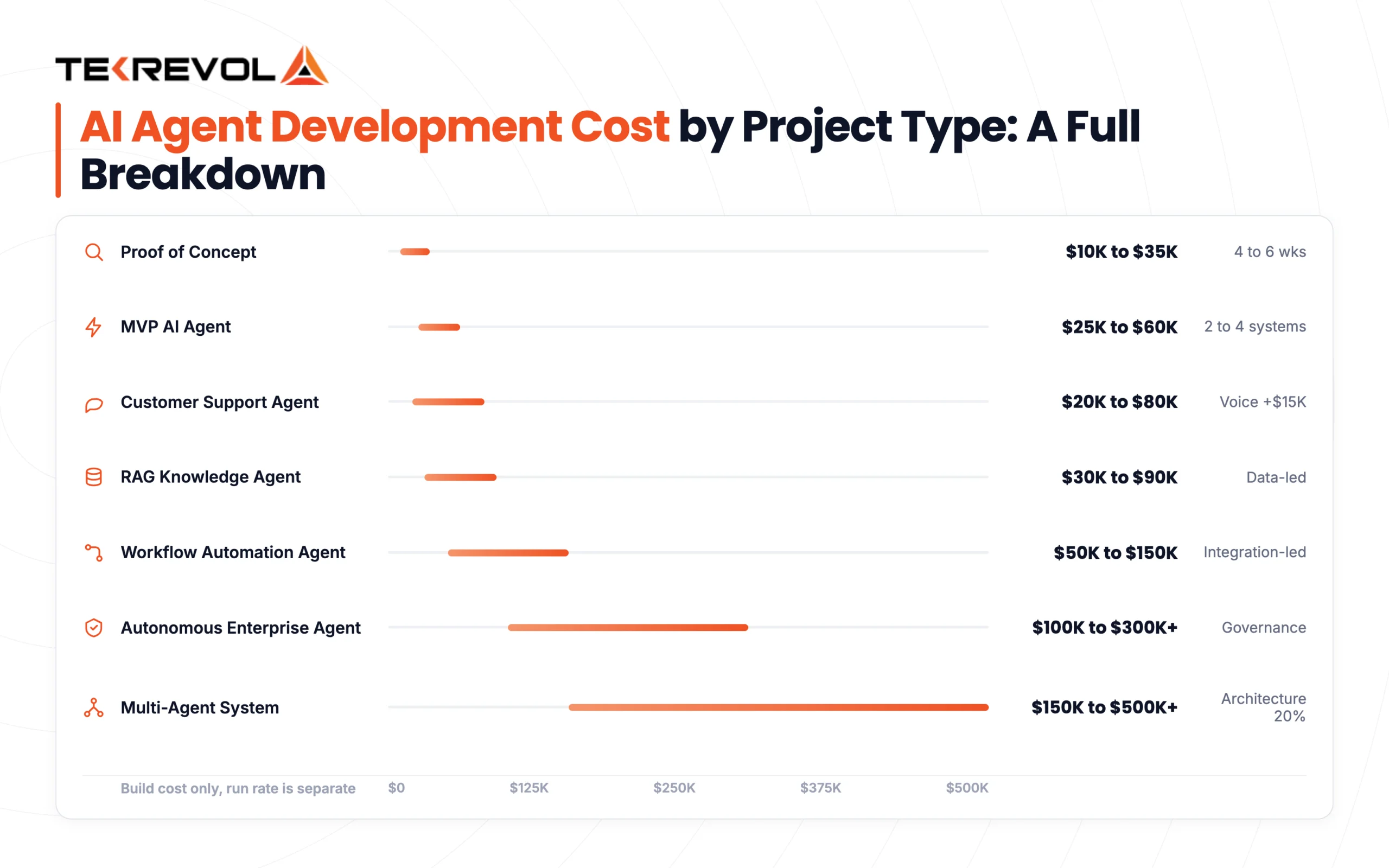
Here is a detailed breakdown by category.
Proof of Concept and Prototype: $10,000 – $35,000
The PoC is the appropriate place to start when organizations desire to prove the business case before investing in an all-in-one build. It is not aimed at a finished product but at a specific demonstration that the agent is capable of a specific task with acceptable accuracy. The lack of this step and going directly to full development often creates expensive gaps in requirements during the project.
- Single-use case with no fine-tuning
- Minimal integrations (one or two)
- Runs on shared cloud infrastructure
- Delivered in four to six weeks
- Includes requirements discovery, architecture planning, and evaluation framework
MVP AI Agent: $25,000 – $60,000
The MVP development moves beyond validation and into early production with real users, real integrations, and real performance expectations. It is deliberately scoped to one primary workflow to keep timelines and costs predictable.
- Core agent capabilities for a defined use case
- Two to four system integrations
- Basic RAG layer if knowledge retrieval is needed
- Testing, QA, cloud deployment, and monitoring dashboard
- Strict scope discipline to avoid cost overruns
Customer Support and Service Agent: $20,000 – $80,000
Customer-facing agents are the most commonly deployed and the most variable in cost because the range is enormous. A basic FAQ bot and a full support agent with CRM access, sentiment detection, and escalation logic are completely different builds.
- Lower end: single-channel, static knowledge base, basic intent recognition
- Upper end: multi-channel, live CRM integration, tone detection, compliance logging
- Voice support adds $15,000 – $30,000 for speech processing and telephony integration
RAG-Based Knowledge and Research Agent: $30,000 – $90,000
These agents are built for organizations that need to retrieve, synthesize, and reason over large repositories of proprietary documents.
RAG AI development cost is almost entirely determined by data preparation quality, not the LLM itself. Underinvesting in the document pipeline is the leading cause of RAG agent failure in production.
Workflow Automation Agent: $50,000 – $150,000
Workflow agents automate multi-step processes that previously required human coordination across systems. Integration depth drives the cost here, not model scope.
Every state, exception, handoff, and failure mode needs mapping before production development starts, which is why discovery matters more on these projects than on any other type.
For a closer look at AI agents and workflow automation, read AI Agents and Workflow Automation Explained.
Autonomous Enterprise AI Agent: $100,000 – $300,000+
Such systems are built with low human oversight, advanced decision-making, and infrastructure. The main difference between an enterprise deployment and a high-tech MVP is governance. It ensures the agent behaves predictably, remains auditable, and operates safely at scale.
Multi-Agent System: $150,000 – $500,000+
McKinsey Global Institute estimates that generative AI solutions and autonomous agents could add $2.6 trillion to $4.4 trillion annually across industries, a figure that contextualizes why enterprise investment in multi-agent systems, despite the higher upfront cost, carries a compelling long-term ROI case.
These systems require senior AI architects, and the discovery and architecture phase alone can represent 20–30% of the total project cost. We unpack the architecture tradeoffs in Multi-Agent Systems: How Collaborative AI is Solving Complex Problems.
AI Agent Development Cost Breakdown by Stage
AI agent development cost breaks down across six build stages, each with its own hour range and drivers. Understanding what each stage involves is what separates a realistic budget from one that falls apart halfway through the project.
Model Selection and Tuning
Choosing the right model is not a single decision; it is a process that consumes real engineering time before a single line of product code is written.
- Candidate evaluation: Candidate evaluation consists of running representative prompts, comparing accuracy and latency, and calculating token costs between tasks. This is usually done in 15 to 30 hours and with a cost of $900 to $1800.
- Task-specific tuning: There is a task-specific model training that includes data preparation, training, and evaluation harness construction, 40 to 70 hours at $2,600 to $4,400.
- Prompt architecture: Model tuning encompasses timely design, adapter layers, organized testing, and a monitoring system, usually 40 to 90 hours with a cost between 2,800 and 5300 dollars.
- Larger context windows and advanced reasoning drive higher ongoing token fees.
- Vendor lock-in and migration risk should be evaluated at this stage, not after deployment.
User Experience and Interface Design
The interface layer has a wider cost range than most teams expect because the gap between a simple chat window and a fully embedded enterprise UI is significant.
- Text-only chat interface covers UI build, error handling, and session storage, typically 25 to 60 hours at $1,500 to $3,500.
- Voice support requires integrating speech-to-text and text-to-speech, managing latency, and handling interruptions, typically 40 to 110 hours at $2,600 to $6,900
- Vision and document understanding add OCR, image embeddings, and layout parsing, typically 60 to 140 hours at $3,500 to $8,600
- Embedding the agent inside existing enterprise software requires role-specific views, accessibility features, and design system integration, typically 40 to 100 hours at $2,600 to $6,100.
- Embedded enterprise UI: role-specific views, accessibility, design system integration. Usually 40 to 100 hours at $2,600 to $6,100.
Data Preprocessing and Labeling
The quality of an AI agent’s output is almost entirely determined by the quality of its training data. This stage is consistently underestimated and is consistently the root cause of performance problems in production.
- Basic ingestion and cleaning covers file collection, duplicate removal, and format normalization, typically 30 to 70 hours at $1,800 to $4,300.
- Full preparation with labeling adds PII redaction, metadata tagging, human labeling, and quality assurance, typically 70 to 130 hours at $4,300 to $7,800.
- Errors introduced at this stage compound through every subsequent layer, making shortcuts here among the most expensive decisions in the entire project
API and Middleware Integration
Integration cost scales directly with the number of systems being connected and the age of those systems.
- Standard API connections covering one to two modern systems with good documentation, typically 30 to 70 hours at $1,800 to $4,300
- Complex or legacy integrations across three or more systems require middleware setup, schema transformation, and extensive error handling, typically 70 to 140 hours at $4,300 to $8,600
- Legacy systems with poor documentation frequently require refactoring before integration is even possible.
- Every additional system added mid-project resets a portion of the integration work already completed.
Business Logic and Decision-Making
The logic layer is where agent behavior is enforced, and its cost scales with how consequential those decisions are.
- Simple decision routing with linear planning and fallback messages, typically 30 to 60 hours at $1,800 to $3,500.
- Moderate branching with tool sequencing, error recovery, and conditional checks, typically 60 to 110 hours at $3,500 to $6,500.
- High-risk audited logic for actions like payment processing requires policy engines, rollback mechanisms, escalation flows, and signed audit logs, typically 110 to 170 hours at $6,500 to $10,400.
The more consequential your agent’s actions, the more engineering time goes into guardrails rather than powers. That ratio surprises people, and it’s the honest answer to why a payments agent costs more than a support agent doing similar reasoning.
Security and Compliance
Security is not something that is introduced into the project after the project is finished. It is a base layer that has contact with all other elements of the system, and in controlled industries, it is frequently the largest single element of cost.
- Basic hardening of security includes role-based access controls, threat modeling, timely filtering, sandboxing, and penetration testing. An average of 80 to 130 hours will cost between $4800 and $7800.
- Privacy controls are anonymization, PII redaction, synthetic data generation, and consent flows, generally 40 to 100 hours at $2600 to $6100.
- Regulated industries’ full compliance preparedness includes signed logs, audit trails, RBAC policy mapping, and regulator evidence packages, usually 100-170 hours at $6100-$10400, and external audit expenses.
Compliance requirements cannot be retrofitted after launch without significant rework; they must be scoped and budgeted from day one.
AI Agent Development Cost Estimates by Business Size and Industry
AI agent costs vary by business size and industry mainly because of workflow scope and regulatory overhead. Enterprise builds cost more than SMB builds for the same result. Regulated industries run two to three times higher than retail on the same tech scope.
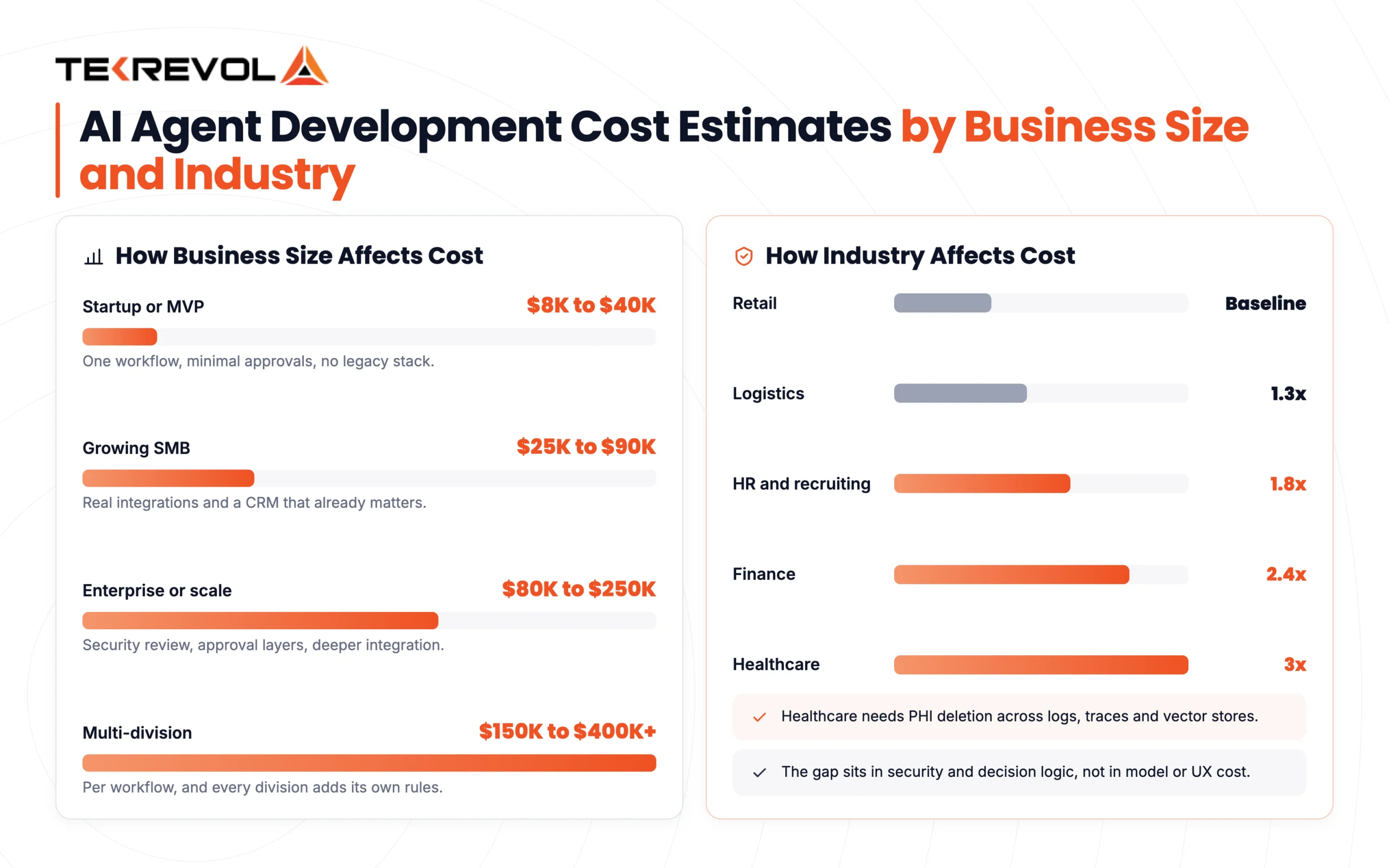
How Business Size Affects Development Cost
Company size shapes integration depth, approval layers, and security rules more than most teams expect. The figures below are per workflow.
| Cost Per Workflow | Startup | SMBs | Enterprise |
| Model development and selection | $4,500 – $8,300 | $5,600 – $10,400 | $8,400 – $15,600 |
| UX and multimodality | $1,920 – $5,120 | $2,400 – $6,400 | $3,600 – $9,600 |
| Data preprocessing and labeling | $3,200 – $5,800 | $4,000 – $7,200 | $6,000 – $10,800 |
| API and middleware integration | $1,900 – $4,480 | $2,400 – $5,600 | $3,600 – $8,400 |
| Decision-making logic | $2,600 – $4,800 | $3,200 – $6,000 | $4,800 – $9,000 |
| Security and compliance checks | $1,900 – $4,480 | $2,400 – $5,600 | $3,600 – $8,400 |
| Ongoing maintenance (monthly) | $400 – $1300 | $500 – $1,600 | $700 – $2,400 |
How Industry Affects Development Cost
Not all industries build AI agents under the same conditions. Some sectors carry compliance overhead that touches every layer of the build, turning what looks like a standard project into a significantly more complex and expensive one.
| Cost Per Workflow | Retail & E-Commerce | Healthcare | Insurance & Finance | Logistics & Supply Chain | Public Sector & Government |
| Model development and selection | $8,400 – $15,600 | $8,400 – $19,800 | $8,400 – $15,600 | $8,400 – $15,600 | $8,400–$17,200 |
| UX and multimodality | $3,600 – $9,600 | $3,600 – $10,500 | $3,600–$10,100 | $3,600 – $9,600 | $4,200–$11,500 |
| Data preprocessing and labeling | $6,000 – $10,800 | $7,200–$13,000 | $7,200–$12,400 | $6,000–$10,800 | $6,600–$11,900 |
| API and middleware integration | $3,600 – $8,400 | $3,600 – $10,500 | $4,200–$11,200 | $4,200–$10,100 | $4,800–$12,600 |
| Decision-making logic | $4,800 – $9,000 | $4,800 – $11,000 | $4,800 – $9,000 | $4,800 – $9,000 | $5,300–$11,800 |
| Security and compliance checks | $3,600 – $8,400 | $6,200–$14,800 | $6,800–$16,200 | $3,600–$8,400 | $7,400–$18,000 |
| Ongoing maintenance (monthly) | $720 – $2,400 | $900–$3,300 | $900–$3,500 | $700–$2,400 | $1,000–$3,800 |
The cost gap appears mainly in security, compliance, and decision logic. Model and UX costs stay fairly similar, but regulated industries need more controls and auditability.
Two examples: healthcare needs PHI deletion across logs, traces, and vector stores. HR and recruiting may require AI disclosures that name the product and developer. These requirements should be planned from the start.
For a closer look at how agents get deployed across regulated sectors, see AI Agents in Healthcare, Finance, and Retail: Use Cases by Industry.
Hidden Costs of AI Agent Development Nobody Talks About
Hidden AI agent costs almost all appear after launch, which is exactly when nobody budgeted for them. Model drift, bias control, usage that scales faster than expected, unclear ownership, and production integration failures are the five that hurt most.
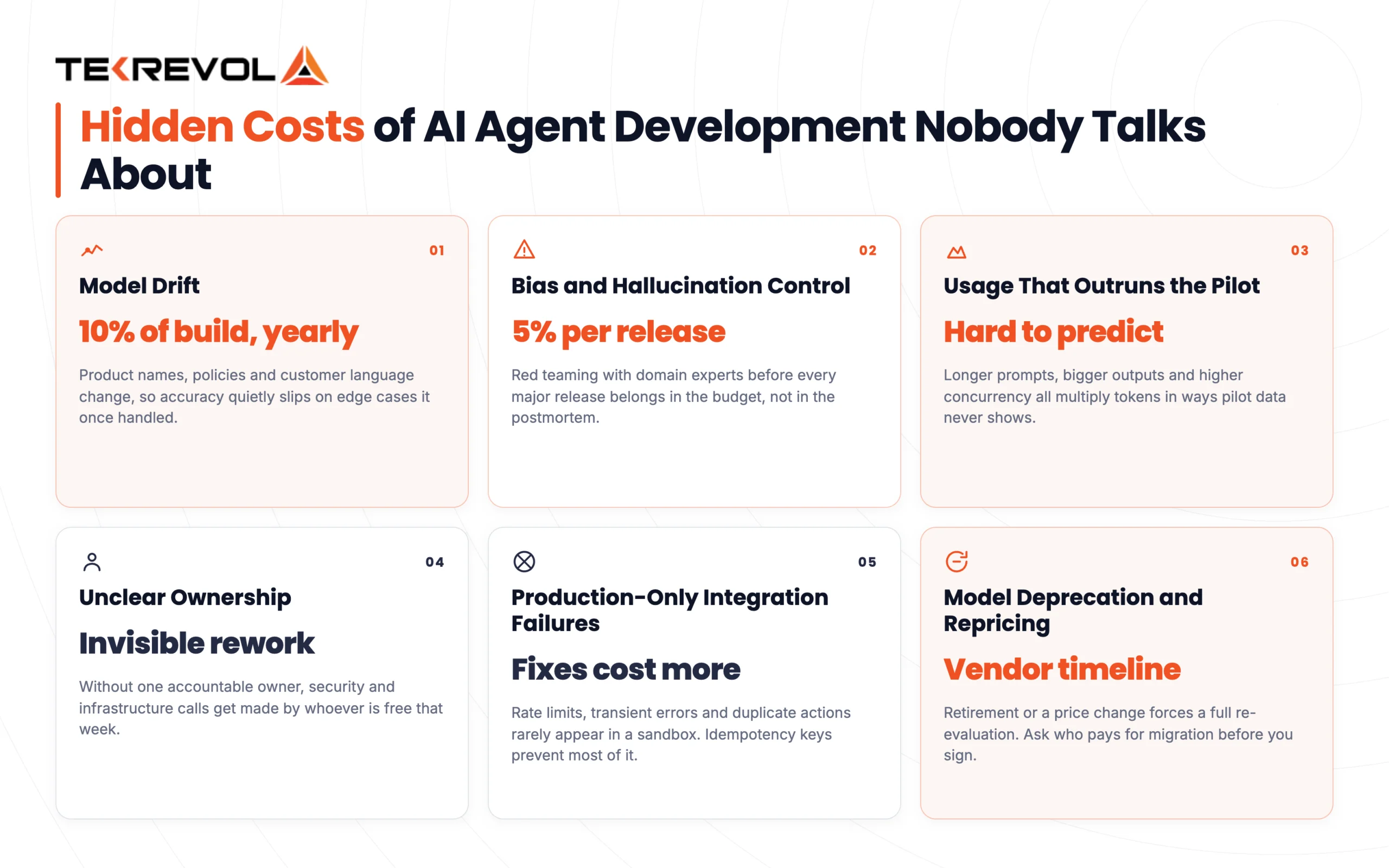
A 2026 survey of 396 enterprises found that 62% faced unexpected AI costs that affected business decisions. Of those, 40% took the issue to the board, and 25% cancelled an initiative. Only 11% could forecast AI costs within 10% accuracy, down from 15% the year before.
So forecasting is getting harder, not easier. Here’s what’s driving it.
Model Drift and Ongoing Optimization
An AI agent is not something you ship and forget. As your business evolves, the agent slowly loses accuracy and starts missing edge cases it once handled confidently.
- Product names, policies, and customer language change over time, causing response quality to drift.
- Prompts need periodic refreshing to stay aligned with the current business context.
- Test sets must be expanded and rebalanced as new edge cases emerge
- Guardrails require adjustment as the agent encounters real-world usage patterns
Budget at least 10% of your initial build cost annually to cover this ongoing work
Bias and Hallucination Control
Two failure modes that are easy to dismiss during planning and expensive to fix in production are bias and hallucinations.
- Bias emerges when training data overrepresents certain groups or viewpoints, producing inconsistent or unfair outputs.
- Hallucinations occur when the agent reasons over incomplete data or lacks a trusted source to ground its response.
- Data preparation, cleansing, and governance are the foundation for preventing both.
- Before every major release, red teaming with domain experts should already be in the budget.
Factor in roughly 5% of your initial build budget per release cycle for this work
Usage Costs That Scale Faster Than You Expect
What looks manageable in a controlled pilot can multiply several times over once real users are in the system.
- Longer prompts, larger outputs, and higher concurrency all drive up token consumption.
- Token consumption scales with usage in ways that are hard to predict from pilot data alone.
- Trim prompt context to reduce tokens processed per request.
- Set token and concurrency budgets per workflow to keep costs predictable.
- Enable response caching for repeated queries and track cost per computation.
The Cost of Unclear Ownership
Without a clearly accountable senior owner, AI agent projects accumulate invisible costs that nobody sees coming.
- Security, compliance, and infrastructure decisions get made by whoever is available rather than whoever is responsible.
- Duplicated work and late-stage rework inflate budgets without producing anything visible.
- Establish a single owner of the model policy and risk management before development starts.
- Engage an external AI adviser in the early months if an internal owner is not yet in place.
- Transition responsibility to a full-time internal owner once standards and processes are established.
Integration Failures That Only Appear in Production
APIs that worked perfectly in testing will surface edge cases the moment real users hit them.
- Rate limits, transient errors, and duplicate actions are rarely caught in sandbox testing.
- Rework required to fix integration failures in production is almost always more expensive than preventing them upfront.
- Retry logic for transient errors and backoff handling for rate limits should be built in from the start, not added later.
- Use idempotency keys to prevent duplicate actions across connected systems.
- Preload sandbox environments with realistic data so test runs reflect actual production usage.
Multilingual and Accessibility Support
Both are cheap to build from the start and expensive to retrofit once the product is live.
- Every additional language requires localized prompts, translated knowledge bases, and adapted UI elements.
- Translation APIs alone are not sufficient; quality trade-offs make human localization review necessary.
- Accessibility requirements around color contrast, screen reader support, and input methods compound rework if left to post-launch
- Define language and accessibility scope before development starts, not after the first audit.
- Teams that treat these as core requirements rather than polish consistently spend less overall
Model Deprecation and Repricing
This one wasn’t on anyone’s radar two years ago. Now it’s a standing risk on every build. You ship on a model, the vendor retires it or reprices it, and you’re re-testing work you already signed off on.
- Vendors deprecate models on their own schedule, not yours, and notice periods are shorter than most teams assume.
- Migration means re-running your whole evaluation suite, since a new model breaks prompts that worked fine before.
- Price changes hit just as hard as retirements, and they arrive with no code change to blame.
- Ask any prospective vendor who pays for that migration before you sign, because it’s rarely written into a fixed-price contract.
- Model routing reduces the blast radius, since an agent that already switches between models is far cheaper to migrate.
How to Stop Your AI Agent From Burning Through Its Token Budget
AI agent costs need technical limits, not just better prompts. Agents can get stuck in loops, repeat tool calls, or trigger retries that quickly increase your bill. Monthly alerts often come too late.
Build these controls from day one:
- Per-task token budgets: Set a hard limit for each task and stop or escalate when it is reached.
- Loop detection: Detect repeated tool calls and stop the agent before costs grow.
- Circuit breakers: Pause agents when spending crosses a set threshold.
- Per-step tracing: Track token use and costs at each step to find expensive workflows.
- Model routing: Use cheaper models for simple tasks and stronger models only when needed.
- Caching: Cache repeated prompts and stable data to reduce input-token costs.
These controls are easier and cheaper to add during development than after a runaway bill. They help keep AI spending predictable as usage grows.
Worried your AI agent costs will keep growing?
We’ll estimate your expected usage and run rate before you commit to an architecture, so you know what to budget for.
Plan Your AI Agent CostsHow to Reduce AI Agent Development Costs Without Compromising Quality?
Building a custom AI agent does not have to mean an uncapped budget. The teams that spend efficiently are not the ones that compromise on quality; they are the ones that make smarter decisions about where to invest and where to save.
Start Small and Validate Early
Test the concept on a real workflow before committing to a full build.
- Before scaling, use a PoC or MVP to test performance on real business processes.
- Create a workflow, verify its functionality in production, and scale.
- Identifying issues in the prototype phase would cost a fraction of the cost of fixing them in the middle of the development cycle.
Use Open-Source Models for Early Stages
Paid APIs are not always necessary, especially when you are still experimenting.
- Models like Llama 3 and Mistral are free to run and more than capable for prototyping.
- Avoid token fees during the exploration phase when requirements are still being defined.
- Switch to commercial models only once the use case is validated and performance demands are clear.
Leverage What Already Exists
Not all the capabilities have to be developed.
- Apply the ready-to-use models to perform traditional tasks such as speech recognition or sentiment analysis.
- Use transfer learning methods such as LoRA or QLoRA to incorporate domain information without retraining.
- Utilize SDKs and available connectors made by the vendor rather than creating their own connections.
Be Smart About Computing
How and when you run computations has a direct impact on AI agent development cost.
- Run lightweight checks locally and reserve cloud-based LLMs for complex reasoning only.
- Batch smaller tasks together to reduce idle computation and unnecessary token spend.
- Set token and concurrency budgets per workflow so costs stay predictable as usage grows.
Know When to Bring in Outside Help
Hiring for every skill in-house is rarely the most cost-effective approach.
- Outsource specialized areas like security architecture or compliance infrastructure to experienced partners.
- Engaging external expertise for high-risk components is almost always cheaper than learning through expensive mistakes.
- Once standards are established, transition ownership back to an internal team
What It Actually Costs to Run an AI Agent Every Month
Running an AI agent costs $500 to $20,000+ a month, based on volume and scope. Launch isn’t the finish line. It’s where the real spending starts. Most teams budget hard for the build and leave run costs for later.
LLM Token Spend
Every conversation, every reasoning step, every retry costs tokens, and those tokens add up faster than most teams anticipate.
- A mid-sized deployment serving around 1,000 users per day can consume 5 to 10 million tokens per month, putting LLM costs between $1,000 and $5,000 monthly.
- Multi-turn conversations, tool-calling, chained reasoning, and long context windows all multiply token consumption beyond a simple estimate.
- Failed API calls still count; cold-start retries alone can add 1 to 3% to your monthly token bill.
- Prompt compression alone can yield 6 to 10% savings for teams running GPT-4o at scale.
- Enabling prompt caching for repeated inputs can reduce costs significantly; cache hits are typically charged at around 10% of standard input token rates.
- Batch processing runs 50% cheaper across all three major vendors for anything asynchronous
Infrastructure and Retrieval Layer
Agents that use retrieval to pull from knowledge bases require a dedicated infrastructure that runs continuously, not just when queries arrive.
- Vector databases like Pinecone or Weaviate carry monthly costs of $20 to $500 or more, depending on index size and query volume.
- Workflow orchestration tools and supporting infrastructure add another $100 to $1,000 per month in operational costs.
- Embedding generation adds token costs on top of the retrieval infrastructure; OpenAI’s text-embedding-3-small runs around $0.0001 per 1,000 tokens.
- Infrastructure costs scale with usage in ways that are difficult to predict from pilot data alone.
Monitoring and Observability
An agent making decisions in production without proper visibility is a liability, not an asset.
- Logging tools, trace systems, and alerting infrastructure typically run $200 to $1,000 per month, including internal QA time.
- Without observability tooling, diagnosing why the agent gave a wrong answer requires manual investigation, which costs engineering hours every time it happens.
- Tools like LangSmith, Helicone, or OpenPipe provide structured visibility into agent decisions, token usage, and failure patterns.
- Monitoring is not optional in regulated industries, where every agent’s decision may need to be auditable.
Prompt Tuning and Behavior Maintenance
Agent behavior does not stay stable on its own; it requires continuous attention to remain accurate and aligned with business requirements.
- Plan for 10 to 20 hours of prompt tuning and testing per month, typically running $1,000 to $2,500, depending on shipping frequency.
- Policy changes, new product information, and evolving user behavior all require corresponding updates to prompts and guardrails.
- Unoptimized prompts and unlimited conversational depth are among the most common causes of runaway token spend in production.
- Teams that treat prompt maintenance as reactive rather than scheduled consistently spend more over time
Security and Access Control
Running an AI agent against real business data without proper access controls is not a cost optimization, it is a risk that is far more expensive when it materializes.
- Role-based access controls, API gating, audit logging, and encrypted data storage typically add $500 to $2,000 per month, depending on complexity.
- Compliance requirements like PCI DSS can add $15,000 to $25,000 in annual audit fees for organizations where card data touches the agent’s prompts.
- Security infrastructure costs scale with the sensitivity of the data the agent accesses and the regulatory environment the organization operates in
- Building security in from the start is consistently cheaper than retrofitting it after a compliance review flags gaps.
Questions to Ask Before You Sign an AI Agent Development Contract
Before signing an AI agent development contract, ask about failure, ownership, and the token bill. Most disputes trace back to three things nobody wrote down. Who pays for API usage during the build? Who owns the test data? And what “done” actually means.
Take this into your next vendor call:
- Who pays for API usage during development? Testing an agent burns real spend. Get it in writing.
- What are the acceptance criteria? “Works well” isn’t a standard. Ask for a target resolution rate on a defined test set.
- What happens when the agent is wrong? You want a documented escalation path, not an apology.
- Do we own the prompts, evaluation data, and fine-tuned artifacts? If not, you’re renting your own product.
- What happens when the model gets deprecated? Establish who pays for migration and re-testing.
- Is the evaluation suite a deliverable? If it isn’t, you can’t verify anything after they leave.
- How is scope change priced? Fixed-price contracts with vague scope produce change orders. Know the rate up front.
- What are the handover terms? Documentation, runbooks, and knowledge transfer should be contractual, not a favor.
- Which compliance duties are yours versus ours? Given the state laws above, name this explicitly.
- Can we see a failure case from a past project? Any vendor with production experience has one.
That last question tells you the most. Anyone who has genuinely run agents in production has watched one do something surprising, and they’ll describe it honestly.
Wrapping Up
Most AI agent projects do not fail because the technology is wrong. They fail because the scoping was rushed, the architecture was an afterthought, and nobody asked the hard questions before development started.
TekRevol is a leading mobile app development company with deep expertise in AI, automation, and intelligent agent development. We have a proven track record of building top AI productivity tools that help businesses streamline workflows, improve efficiency, and scale operations.
Our AI team has delivered 200+ AI agents with 75+ certified AI and ML engineers. We build production-ready solutions for support, knowledge retrieval, content automation, and enterprise workflows, with expertise in agentic AI, RAG, LLM integration, and system architecture.
We can help you cut through the noise with a real cost estimate, a grounded architecture plan, and a team that has shipped this before.
Get a Realistic AI Agent Budget
Share your requirements with our AI engineers. We’ll break down the build cost, timeline, and expected run rate before development starts.
Estimate Your AI Agent Cost


