Teams often start by picking a tool, then find out later that their data was not ready or that nobody had defined how to test the result. The fundamentals of AI development come down to five decisions made in order: fit, data, build route, testing and governance.
The order of the five decisions is TekRevol’s judgment, and McKinsey’s 2026 survey gives context but does not test it: nearly nine in ten respondents use AI in at least one business function, yet only 37% report any EBIT impact from it.
This article walks through each decision with the evidence behind it. It ends with a table you can fill in for one use case.
We checked every figure in this article against its source on October 22, 2026.
What is AI development, and what does it include?
AI development is the work of designing, building, testing, deploying and operating systems that learn from data to produce predictions and generated content. A model is the learned program at the center.
Training fits the model to data, and inference is the model producing an answer for new input. Artificial intelligence development also covers the data pipeline before training and the monitoring after launch, so building the model is only one step.
| Algorithm family | What it does | Typical use |
| Supervised learning | Learns from labeled examples | Classifying documents, scoring risk |
| Unsupervised learning | Finds structure in unlabeled data | Grouping customers, spotting outliers |
| Reinforcement learning | Learns by trial and reward | Routing, robot control |
| Neural networks | Layers of connected units learn complex patterns | Image and speech recognition |
| Transformers | Neural networks that process sequences using attention, the basis of large language models | Text and image generation |
These are plain-language summaries.
The choice of AI development algorithm matters less than the data and testing behind it, which is our judgment. For types of AI and common tools, see our guide to how to build an AI app.
Why do AI development projects stall?
Most organizations use AI, but fewer report EBIT impact: in McKinsey’s 2026 survey, nearly nine in ten respondents use AI regularly, while 37% attribute at least some EBIT impact to it and 6% are high performers who also report significant value. The survey covered 1,719 respondents in 97 nations in May and June 2026.
About 44% say AI is scaling across their enterprise, up from 38% a year earlier. Only about 6% qualify as high performers, meaning they attribute at least 5% of EBIT to AI.
Gartner adds a data warning. It predicts that through 2026 organizations will abandon 60% of AI projects that lack AI-ready data. The five decisions below target these gaps in the development of artificial intelligence.
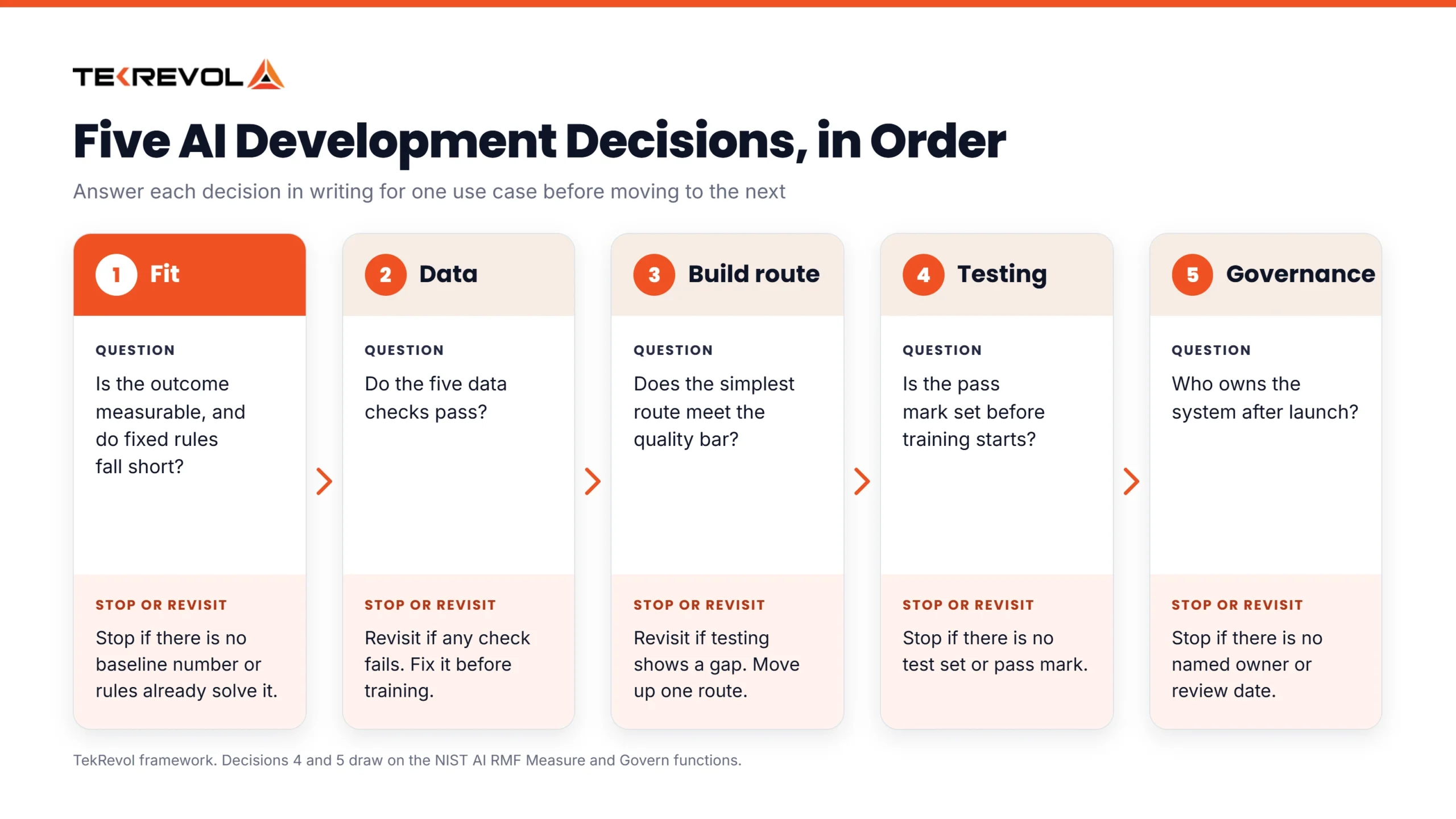
Decision 1: is this a job for AI development?
Choose AI development only when the outcome is measurable and fixed rules cannot produce it, and stop if a simpler tool does the job. NIST’s Map function describes setting the context for a system so that you can make an initial go or no-go decision. Three questions make that decision concrete:
- Can you name one number that improves, such as handling time or error rate?
- Do fixed rules or a standard software feature fail on this task?
- Error cost. What happens when the system is wrong, and who catches it?
If you cannot name a measurable outcome, or fixed rules already solve the task, ordinary software is usually the better build. Reporting dashboards and fixed approval flows are common examples. That is our judgment.
Decision 2: is your data ready for AI development?
Check your data before you pick a model, because Gartner found that 63% of organizations either lack the data management practices AI needs or are unsure whether they have them. Gartner’s survey ran in 2024 and was published in February 2025. The table lists five checks to run first.
| Check | Question to ask |
| Availability | Does enough relevant data exist, and can the team reach it? |
| Quality | Is it accurate, complete and consistently labeled? |
| Rights | Do you have permission to use it, including personal data? |
| Representativeness | Does it cover the cases the system will meet in real use? |
| Freshness | How often does it change, and who updates it? |
The five checks are TekRevol’s judgment. Fix a failed check before training, because a model trained on poor data inherits its flaws.
Decision 3: should you use an API, RAG, fine-tuning or your own model?
Start with the simplest route that meets your quality bar, and move up only when testing shows a gap. AI technology development moves quickly, so favor the route you can swap later. The table compares four routes.
| Route | When it fits | Main limit |
| Model API with good prompts | A general task where a hosted model already performs well | Vendor dependence, and data leaves your systems. Our judgment |
| RAG (retrieval-augmented generation) | Answers must rest on your own content | Query understanding, multi-source access, token limits, response time and security, per Microsoft Learn |
| Fine-tuning | Consistent style, structured output or tool-use accuracy, with a small, high-quality dataset | Needs good data, adds cost, and may need repeating when a new base model arrives, per Microsoft Learn |
| Training your own model | Rare cases with unique data where no existing model fits. Our judgment | Highest data, talent and compute needs. Our judgment |
Microsoft Learn defines RAG as a pattern that grounds responses in your proprietary content, and it describes retrieval as a complement to fine-tuning, so the routes can be combined. Microsoft puts a useful fine-tuning dataset at between hundreds and a few thousand prompt and response pairs. In our reading, retrieval supplies knowledge and fine-tuning shapes behavior.
For how generative models differ, see our guide to types of generative AI models and tools. For what each route costs, see how much AI development costs.
Decision 4: how will you test an AI system before release?
Set the pass mark and the test set before training starts. This order is TekRevol’s judgment. McKinsey found that high performers are twice as likely to have defined processes to measure the impact of AI initiatives.
NIST’s Measure function calls for testing and monitoring risks before and during deployment. The table lists what to measure.
| What to measure | How |
| Quality | Score outputs on a held-out test set you did not train on, using precision and recall for classifiers and graded review for generated text |
| Safety and bias | Test the cases where an error hurts most, and compare results across user groups |
| Cost | Track the cost per task, since about 20% of McKinsey respondents said AI operating costs, including token costs, constrained their AI use |
| Speed | Time the full response, model call included |
These are practical defaults and our judgment. Release only when the system meets the pass mark on the test set and on a sample that a person has reviewed.
Decision 5: who governs the system after launch?
Name an owner and a review cycle before launch, and use NIST’s four functions as the checklist. The NIST AI Risk Management Framework 1.0 is voluntary, and NIST says a revised version is in progress.
| NIST function | What it means for your build team |
| Govern | Assign accountability, policies and oversight, including for third-party components |
| Map | Set the context and risks, and make the go or no-go call |
| Measure | Test and monitor risks before and during deployment |
| Manage | Direct resources to the risks you mapped and measured, and plan for incidents |
Artificial intelligence technology development is also moving under new EU rules. The AI Omnibus was published in the Official Journal on July 24, 2026 and took effect on July 27, according to the National Law Review. It delays rules for stand-alone high-risk systems to December 2, 2027, and for AI embedded in regulated products to August 2, 2028.
Reports on the Omnibus say transparency obligations still apply from August 2, 2026. Have legal counsel confirm which rules cover your system. For risks to plan for after launch, see our guide to AI adoption challenges.
How should you start?
Answer the five decisions in writing for one use case before you spend on a build. The table shows what each answer needs as evidence.
| Decision | Question | Evidence you need |
| Fit | Is the outcome measurable, and do fixed rules fall short? | One baseline number |
| Data | Do all five checks pass? | A short data audit |
| Build route | Does the simplest route meet the quality bar? | A pilot result on your test set |
| Testing | Is the pass mark set before training? | A test set and a pass mark |
| Governance | Who owns the system after launch? | A named owner and a review date |
A blank row is where the project will stall. TekRevol’s AI development team can help you work through AI development for your first use case. Start with a Free Consultation.
Decide in order, write each answer down, and build only when every row has evidence.