



- A travel MVP starts near $25,000, while a full OTA marketplace can pass $250,000 in 2026.
- Regional developer rates swing the same build by three to five times, before any feature changes.
- Booking engines, real-time availability, and GDS integrations absorb the largest share of any travel budget.
- Travel apps carry running costs that grow with bookings, because APIs, maps, and payments are all metered.
- Budget 15% to 25% of your build cost every year for maintenance, compliance, and platform updates.
- A tightly scoped MVP with cross-platform code cuts first-year spend without removing a single core feature.
Two travel apps can look almost identical on a phone screen. Same clean search bar, same map, same tidy booking flow. One costs $38,000 to build. The other costs $210,000. Nothing about the screenshots tells you why, and that’s exactly the problem every founder runs into when the first quotes land in their inbox.
Most travel apps in 2026 land somewhere between $25,000 and $250,000. A simple itinerary or city-guide app sits at the low end. A booking app with live inventory and payments sits in the middle. A full online travel agency with supplier integrations and multiple user roles sits at the top. Where you land depends on how much real-time data your app has to move, and who’s writing the code.
This guide walks through travel app development cost by complexity, by region, and by individual feature. Then it covers the part of what the app costs to run after launch, month after month.
If you’re trying to work out what a travel app development company should reasonably charge you, the numbers below will give you something firm to negotiate with. Travel apps behave a lot like the marketplaces and booking platforms we build as an on-demand app development company, which means the cost patterns are predictable once you know where to look.
How Much Does Travel App Development Cost in 2026?
Travel app development costs between $25,000 and $250,000 in 2026, depending on complexity. Simple guide apps run $25,000 to $50,000. Booking apps with live inventory run $50,000 to $120,000. Full OTA marketplaces with supplier integrations and multi-role dashboards start around $120,000 and climb past $250,000.
Those are the ranges we quote. The spread looks huge until you realize the three tiers aren’t the same product. They’re three different businesses that happen to share an app icon.
| Complexity level | What’s included | Cost range | Timeline |
| Simple / MVP | Search, listings, itinerary builder, maps, profiles, basic CMS | $25,000 – $50,000 | 3 – 4 months |
| Mid-complexity booking app | Everything above plus live availability, payments, reviews, notifications, admin panel | $50,000 – $120,000 | 4 – 6 months |
| Advanced / OTA marketplace | Everything above plus GDS or supplier APIs, dynamic pricing, multi-vendor roles, AI planning, offline mode | $120,000 – $250,000+ | 6 – 12 months |
The jump from tier one to tier two isn’t about adding screens. It’s the moment your app stops showing stored content and starts talking to live inventory. Tier three adds a second problem: you’re serving several types of users. Hotels, tour operators, admins, and travelers each need their own interface and permissions, and every extra role is another product to design, build, and test. It’s the same scoping logic behind mobile app development services budget, amplified because travel data never sits still.
Still Guessing What Your Travel App Should Cost?
Send us your feature list, and we'll break it into a line-by-line estimate with timelines, so you can see exactly what drives the number.
Get Your Free Travel App Cost Estimate →How Does Travel App Development Cost Change by Region?
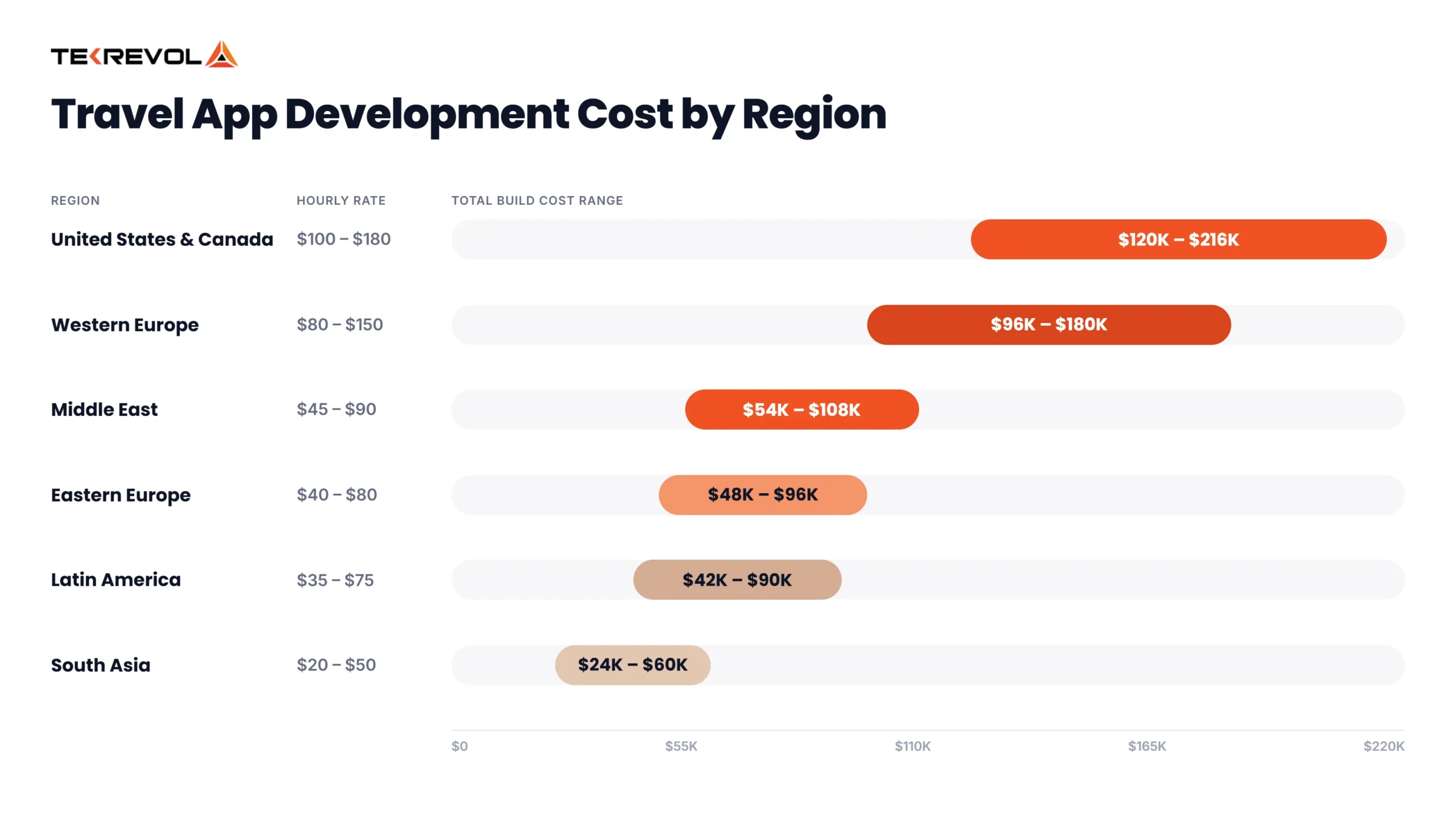
Travel app development cost changes by region mainly through hourly rates. The same 1,200-hour build costs roughly $150,000 in the United States, $66,000 in Eastern Europe, and $42,000 in South Asia. Rate differences, not scope differences, create most of the gap you’ll see across quotes.
| Region | Typical hourly rate | Same 1,200-hour build |
| United States & Canada | $100 – $180 | $120,000 – $216,000 |
| Western Europe | $80 – $150 | $96,000 – $180,000 |
| Eastern Europe | $40 – $80 | $48,000 – $96,000 |
| Latin America | $35 – $75 | $42,000 – $90,000 |
| South Asia | $20 – $50 | $24,000 – $60,000 |
| Middle East (UAE, KSA, Qatar) | $45 – $90 | $54,000 – $108,000 |
A cheaper rate only saves money if the hour count stays the same, and it often doesn’t. Travel projects involve constant back-and-forth about supplier rules, refund logic, and partial cancellations.
Run that conversation across a ten-hour time gap in a second language and the hours multiply quietly.
What Factors Influence Travel App Development Cost?
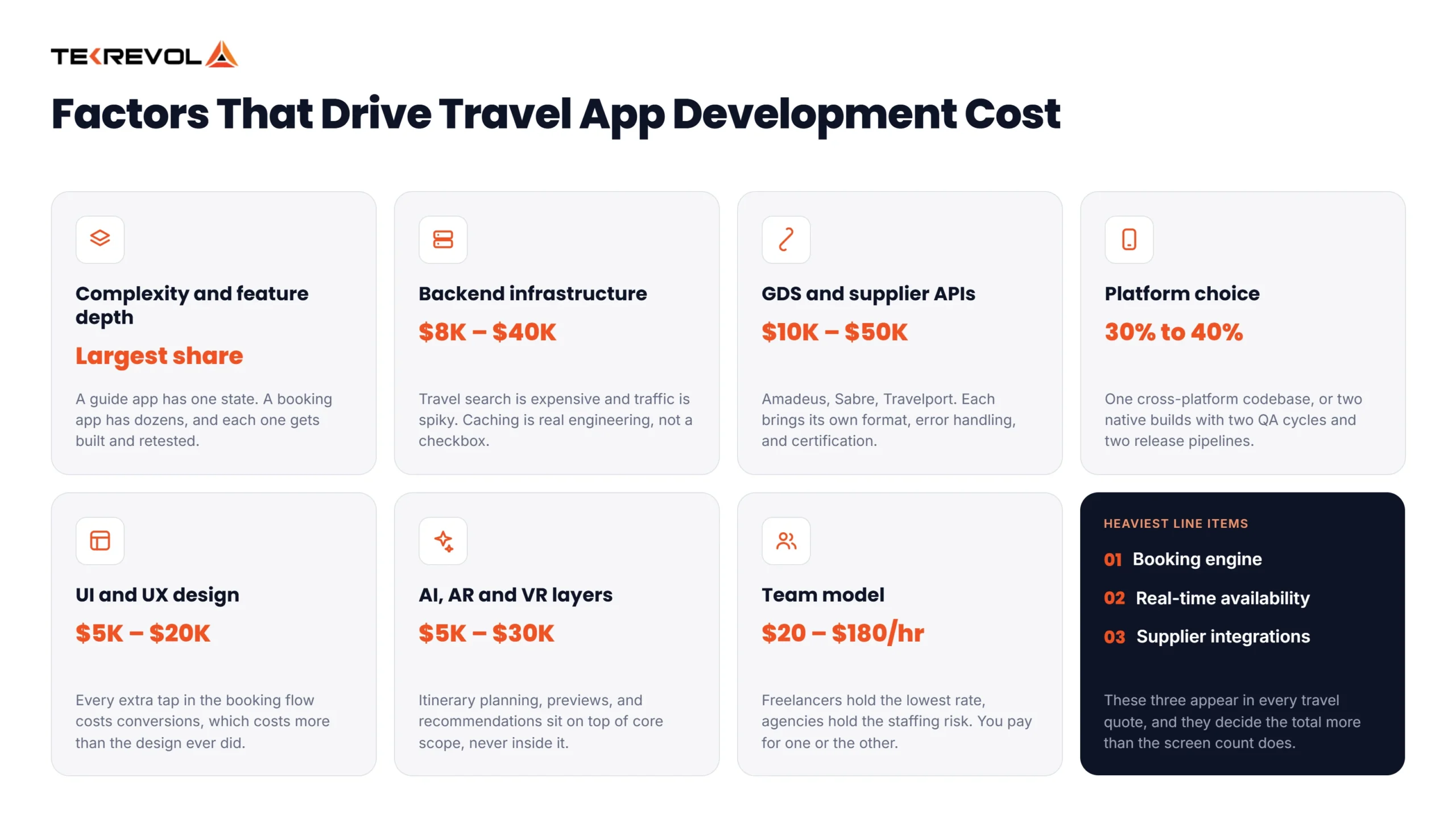
Factors influencing travel app development cost fall into seven buckets: app complexity, feature depth, platform choice, UI/UX design, backend infrastructure, third-party technology integration, and your development team model. Feature depth and backend architecture usually account for the largest share of the final invoice.
App’s Complexity and Feature Depth
App complexity drives cost more than any other single factor, because it determines how many states your app has to handle. A guide app has one state: show the content. A booking app has dozens, including “seat available,” “seat held,” “payment pending,” “payment failed,” and “supplier timed out.”
Every one of those states gets designed, built, tested, then tested again against a supplier’s sandbox. That’s why two apps with the same screen count can differ by $60,000. Our guide on developing a next-level travel app walks through what the modern feature set actually involves.
Features and Functionalities
Feature costs are the most useful numbers to have in a negotiation, because they let you trade items in and out without reopening the whole estimate. Here’s what individual travel features typically add.
| Feature | Complexity | Cost to build |
| Registration, profiles, social login | Low | $2,000 – $5,000 |
| Search with filters and sorting | Medium | $4,000 – $10,000 |
| Maps, geolocation, nearby discovery | Medium | $5,000 – $12,000 |
| Booking engine | High | $12,000 – $30,000+ |
| Real-time availability and dynamic pricing | High | $12,000 – $25,000+ |
| Payment gateway integration | Medium-High | $3,000 – $10,000 |
| Reviews and ratings | Low-Medium | $2,000 – $5,000 |
| Push notifications and trip alerts | Low-Medium | $1,500 – $4,000 |
| Multi-language and multi-currency | Medium | $3,000 – $8,000 |
| Offline access to tickets and maps | Medium-High | $5,000 – $12,000 |
| AI itinerary planner | Medium-High | $6,000 – $18,000 |
| Recommendation engine | High | $10,000 – $25,000+ |
| Admin and vendor dashboard | Medium-High | $6,000 – $18,000 |
Notice the pattern. Anything that reads stored data is cheap. Anything that writes money or holds inventory is expensive. That’s the whole rule.
Platform Choice: Native vs Cross-Platform
Platform choice typically moves the budget by 30% to 40%. Two native apps mean two codebases, two QA cycles, and two release pipelines. One cross-platform codebase covers both stores from a single build, which is why most travel MVPs start there.
| Approach | Cost impact | Best fit |
| Native iOS + Android (separate) | Highest, roughly 1.6× to 1.8× a single build | Heavy AR, complex offline maps, deep hardware use |
| Cross-platform (Flutter, React Native) | Baseline | Booking, search, itinerary, most travel MVPs |
| Single platform first | Lowest, roughly 55% to 65% of both | Testing one market before committing |
For most travel products, cross-platform app development service is the right call. You’re rendering lists, maps, forms, and payment flows. None of that needs native-only performance, and you ship to both stores at once.
UI/UX Design
UI/UX design typically runs $5,000 to $20,000 for a travel app. A clean design system with reusable components sits at the low end. Custom illustration, animated transitions, and full brand identity work push toward the top.
Travel design has one non-negotiable: the booking flow. People book on phones, on bad hotel Wi-Fi, while distracted. Every extra tap between “I want this” and “confirmed” costs conversions, which quietly costs far more than the design ever did.
Backend Infrastructure
Backend infrastructure runs $8,000 to $40,000 depending on load. It covers your database, APIs, caching layer, authentication, and hosting. Travel hits this harder than most categories because search is expensive and traffic is spiky.
Think about a long weekend. Searches spike, everyone hits the same routes, and your database gets hammered by near-identical queries. A caching layer fixes that, but it’s real engineering work a lightweight quote won’t include. Our custom software development service team scopes it separately so clients see what they’re paying for.
Technology Integration
Technology integration is the line item that surprises people most. Connecting to a global distribution system like Amadeus, Sabre, or Travelport is not a plug-in; it’s a project.
Expect $10,000 to $50,000 for GDS or supplier API work, depending on how many suppliers you connect and how messy their data is. Each has its own format, error handling, and certification process. Add AI features, AR previews, or VR integration in travel apps, and you layer on another $5,000 to $30,000.
Development Team Model
Your team model changes cost and risk together. Freelancers are cheapest per hour and most expensive when someone disappears mid-sprint. In-house teams give you control but carry salaries and hiring time. Agencies cost more per hour and absorb the staffing risk.
| Team model | Typical rate | Trade-off |
| Freelancers | $20 – $80/hr | Cheapest, but you’re the project manager and the risk holder |
| In-house team | $8,000 – $15,000/month per senior dev, fully loaded | Full control, slow to assemble, expensive to idle |
| Development agency | $25 – $180/hr | Full team on day one, higher rate, contractual accountability |
What Does a Travel App Actually Cost to Run After Launch?
Travel apps cost more to run than most app categories, because nearly every core function is metered. Maps, supplier APIs, and card payments all bill per use. That means your monthly bill grows as bookings grow, so running costs need to be modeled per booking, not as a flat annual figure.
- Google Maps Platform gives 10,000 free calls per month per SKU, then charges by tier. Dynamic Maps starts at $7.00 per 1,000 calls, Places Autocomplete at $2.83 per 1,000, and Routes at $5.00 per 1,000, with volume discounts as you scale.
- Stripe charges 2.9% + 30¢ per successful US card transaction, plus 1.5% for international cards and another 1% if currency conversion is needed. For a travel app, cross-border is the normal case, not the exception.
- Apple’s Developer Program is $99 per year. Google Play is a $25 one-time registration fee.
- GDS and supplier APIs are commercially negotiated, usually with a monthly minimum plus per-transaction or per-search fees.
Now put it together. Here’s roughly what a mid-complexity travel booking app costs to operate each month at three different scales, assuming a $180 average booking value.
| Monthly cost driver | 500 bookings/mo | 2,500 bookings/mo | 10,000 bookings/mo |
| Cloud hosting and database | $150 – $400 | $500 – $1,200 | $1,500 – $4,000 |
| Maps and location APIs | $80 – $250 | $400 – $1,100 | $1,400 – $3,500 |
| Payment processing (2.9% + 30¢, cross-border weighted) | ~$3,500 | ~$17,500 | ~$70,000 |
| Supplier / GDS API fees | $500 – $2,000 | $1,500 – $5,000 | $4,000 – $15,000 |
| Monitoring, analytics, push, email | $100 – $300 | $300 – $800 | $800 – $2,000 |
| Maintenance and bug fixes (amortized) | $1,000 – $2,000 | $2,000 – $4,000 | $4,000 – $8,000 |
| Approximate monthly run rate | $5,300 – $8,450 | $22,200 – $29,600 | $81,700 – $102,500 |
Figures are TekRevol modeling based on published vendor rates from Google Maps Platform, Stripe, Apple, and Google, plus typical cloud and supplier contracts. Actual costs vary with booking mix and negotiated supplier terms.
The takeaway is simple. Your build budget is a one-time number; your run rate is permanent. Model both before you sign anything, and negotiate supplier and payment terms early, because those two lines will outweigh your development cost within two years at any real volume.
What Are the Hidden Costs of Building a Travel App?
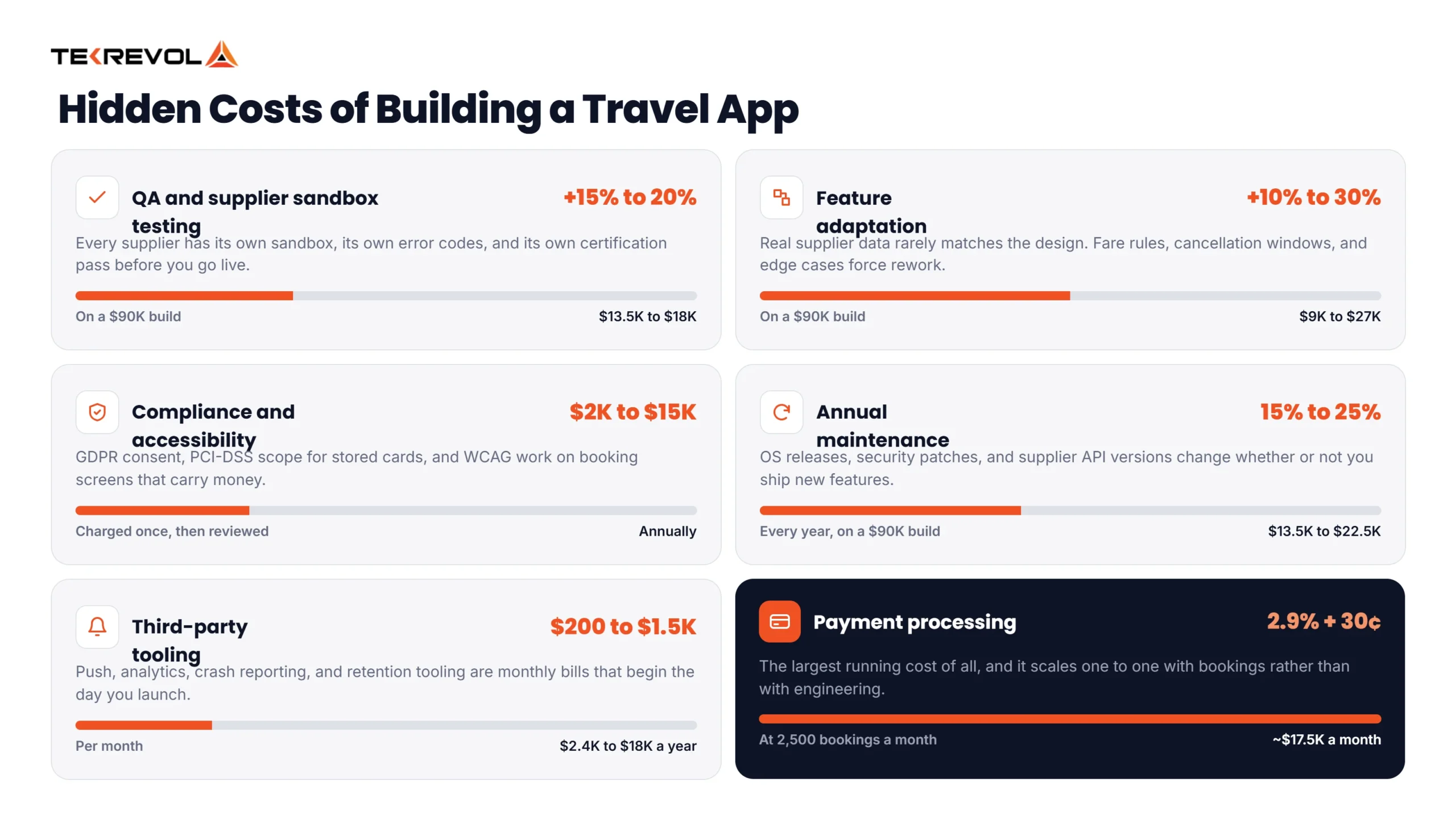
Hidden costs of building a travel app typically add 30% to 50% on top of the development quote. The five that catch teams off guard are quality assurance, feature adaptation, legal and data privacy compliance, post-launch maintenance, and marketing automation tools that keep users coming back.
Quality Assurance, Testing and Validation
QA adds 15% to 20% to a travel build, and it’s the worst place to economize. A broken checkout on a normal app loses a sale. A broken checkout on a travel app can strand someone in an airport.
Testing here also means testing against supplier sandboxes, which behave differently from production and break without notice. Budget for that cycle instead of assuming a two-week QA sprint covers it.
Feature Adaptation
Feature adaptation adds 10% to 30%, and it isn’t scope creep. It’s the cost of discovering that a supplier’s cancellation rules don’t match your design, or that a new market needs a different payment method entirely.
Every travel project we’ve delivered has hit at least one of these. The teams that handle it well are the ones that left room for it.
Legal and Data Privacy Cost
Legal and data privacy costs run $2,000 to $15,000 depending on your markets. Travel apps collect passport data, payment details, and location history, which puts you inside GDPR, PCI-DSS, and increasingly the European Accessibility Act.
If you serve EU travelers, none of that is optional, and retrofitting it costs several times more than building it in from the start.
Post-Launch Support and Maintenance
Maintenance runs 15% to 25% of your build cost every year. On a $90,000 app, that’s $13,500 to $22,500 annually for OS updates, security patches, supplier API changes, and the steady stream of small fixes every live product needs.
Skip a year of this, and you don’t save money; you accumulate a rebuild. Gartner forecasts worldwide IT spending will hit US$6.37 trillion in 2026, up 14.2%, with software alone growing 15.5%. The tools your app depends on move fast.
Marketing Automation and Retention Tools
Retention tooling costs $200 to $1,500 per month for a growing travel app. That covers push automation, email, in-app messaging, and the analytics stack that tells you which trip types convert.
Travel has brutal seasonality and long gaps between purchases. Someone books in June and forgets you until the following spring. Retention tooling is how you stay in that gap, and it’s a running cost, not a launch expense.
How Do You Monetize a Travel App and Recover Your Development Cost?
Monetizing a travel app usually comes down to four models: merchant, commission, advertising, and subscription. Most profitable travel apps run two or three at once, because commission alone rarely covers payment processing, supplier fees, and acquisition costs at early volume.
Merchant Model
The merchant model means buying inventory in bulk at a negotiated rate and reselling at your own price. Your margin is the spread, and it’s usually the fattest of the four. It also ties up capital and puts unsold inventory risk on you, so it fits operators with real buying power or a niche where suppliers want guaranteed volume.
Commission Fees
Commission is the default for most travel apps. You take a cut of each booking, typically 5% to 20% depending on category and supplier relationship. Hotels pay more than flights. Tours and activities often pay the most.
Here’s the math to watch. Your commission has to clear payment processing plus supplier API costs before it becomes margin. At a 4.4% cross-border payment cost, a 6% commission leaves you 1.6%. That’s not a business; it’s a hobby.
Advertisement Model
Advertising works through sponsored listings, featured placements, and banner inventory. Travel is one of the highest-CPM ad categories, because intent is unusually clear when someone searches for a Lisbon hotel for next month. The catch is volume, so treat ads as a layer you add later rather than a launch strategy.
Subscription and Fintech Add-Ons
Subscriptions and fintech features are where the strongest 2026 travel apps make real money. Price-freeze options, travel insurance, currency wallets, and premium tiers all generate revenue that doesn’t depend on booking volume alone.
These add $15,000 to $40,000 to a build and usually pay back faster than any other feature category, because they lift revenue per user instead of chasing more users.
How Can You Reduce Travel App Development Cost Without Cutting Core Features?
Reducing travel app development cost without cutting core features comes down to sequencing, not sacrificing. Ship a tight MVP, use one shared codebase, keep the design system simple, integrate one supplier before many, and work with a team that gives you itemized estimates rather than a single number.
Tip 1: Start With an MVP and Protect the Core Loop
Start with the smallest version that completes one full journey: search, select, book, confirm. Everything else waits. This alone routinely cuts a first release from $120,000 to somewhere near $45,000.
The discipline is deciding what “core” means before development starts, not during it. Our breakdown of what you’re actually paying for in app development helps when you’re pushing back on a bloated scope.
Tip 2: Choose Cross-Platform Development
One codebase for iOS and Android saves 30% to 40% on the build and roughly the same on every update forever. For an app built around lists, maps, and forms, there’s almost no user-visible downside. Flutter app development company handles travel UI patterns well and keeps your maintenance line predictable in years two and three.
Tip 3: Keep the Design System Simple
Custom animation and bespoke illustration are lovely and rarely convert anyone. A clean component library, built once and reused everywhere, costs less to build, less to test, and far less to change later. Spend the design budget on the booking flow and the search experience instead, because those two screens decide whether the app makes money.
Tip 4: Integrate One Supplier First, Then Expand
Each supplier or GDS connection is its own project, with its own data quirks and certification process. Launching with one supplier proves the model and defers a large chunk of cost.
Suppliers two through five also cost less per connection, because your integration layer already exists. Our blog on API integration cost and use cases breaks down how those numbers behave as you scale.
Tip 5: Insist on Itemized Estimates
A quote that says “$85,000, four months” tells you nothing and gives you nothing to negotiate. A quote broken into features, hours, and rates lets you move items between phase one and phase two. If a team can’t itemize, it usually means they haven’t scoped it, and that gap becomes a change request later at your expense.
Why Choose TekRevol for Travel App Development?
Choose TekRevol for travel app development when you want the cost conversation handled honestly before the build starts. We estimate travel apps line by line, model the running costs alongside the build cost, and scope suppliers and payments early, because those decide your margin.
We’ve delivered 500+ applications, hold a 4.8 rating across 83+ verified Clutch reviews, and our average MVP reaches launch in 14 to 20 weeks. More relevant to travel: the products we’ve shipped here, including Into Go, Equitrip, and Yeppy, cover discovery, two-sided marketplaces, and multi-service booking. Those are the three shapes almost every travel app takes.
What we won’t do is quote a single number and discover the scope later. Travel is full of edge cases, from partial refunds to supplier timeouts, and pretending otherwise just moves the cost into a change request. Browse the full range on our projects portfolio, including the travel and transport work above.
Got a Travel App Idea and No Idea What It Should Cost?
Bring us your feature list and target markets. We'll come back with an itemized estimate, a realistic timeline, and a first-year running cost model, free of charge.
Schedule Your Free Travel App Consultation →


