



- Your real SXSW 2027 deadline is November 13, 2026, the date SXSW Pitch applications finally close.
- Most Austin startup MVPs cost $40,000 to $100,000 in 2026, though scope swings that range wildly.
- Texas now enforces app store age verification, adding real disclosure duties for developers shipping consumer apps.
- Only 6% of Austin venture capital over four quarters landed in rounds under $15 million.
- Austin startups raised $5.0 billion in early 2026, tracking toward roughly $9.9 billion this year.
- Pick demo-ready, pilot-ready, or launch-ready before you scope, because all three cost dramatically different amounts.
Here’s what most founders in Austin get wrong about SXSW.
They circle March on the calendar and count backward from March 15, 2027, which feels like plenty of runway.
It isn’t. If you want to pitch at SXSW 2027, your application is due November 13, 2026, roughly sixteen weeks out, and an application with nothing behind it won’t get you onto a stage.
So the real question isn’t “can we build by March?” It’s “can we have something credible by November?”
Based here in Austin, TekRevol has watched good ideas miss that window by a few weeks. So let’s walk through it properly. What “SXSW-ready” actually means, what an MVP costs in this market, how long it takes, and the dates you need on your calendar.
Let’s dig in.
What Does “SXSW-ready” Actually Mean?
SXSW-ready means having a polished story, a demonstrable offering, a preplanned networking strategy, and a follow-up process that converts event attention into measurable business opportunities.
Three different levels count as ready, and picking the cheapest one that still hits your goal is the best money decision you’ll make all year.
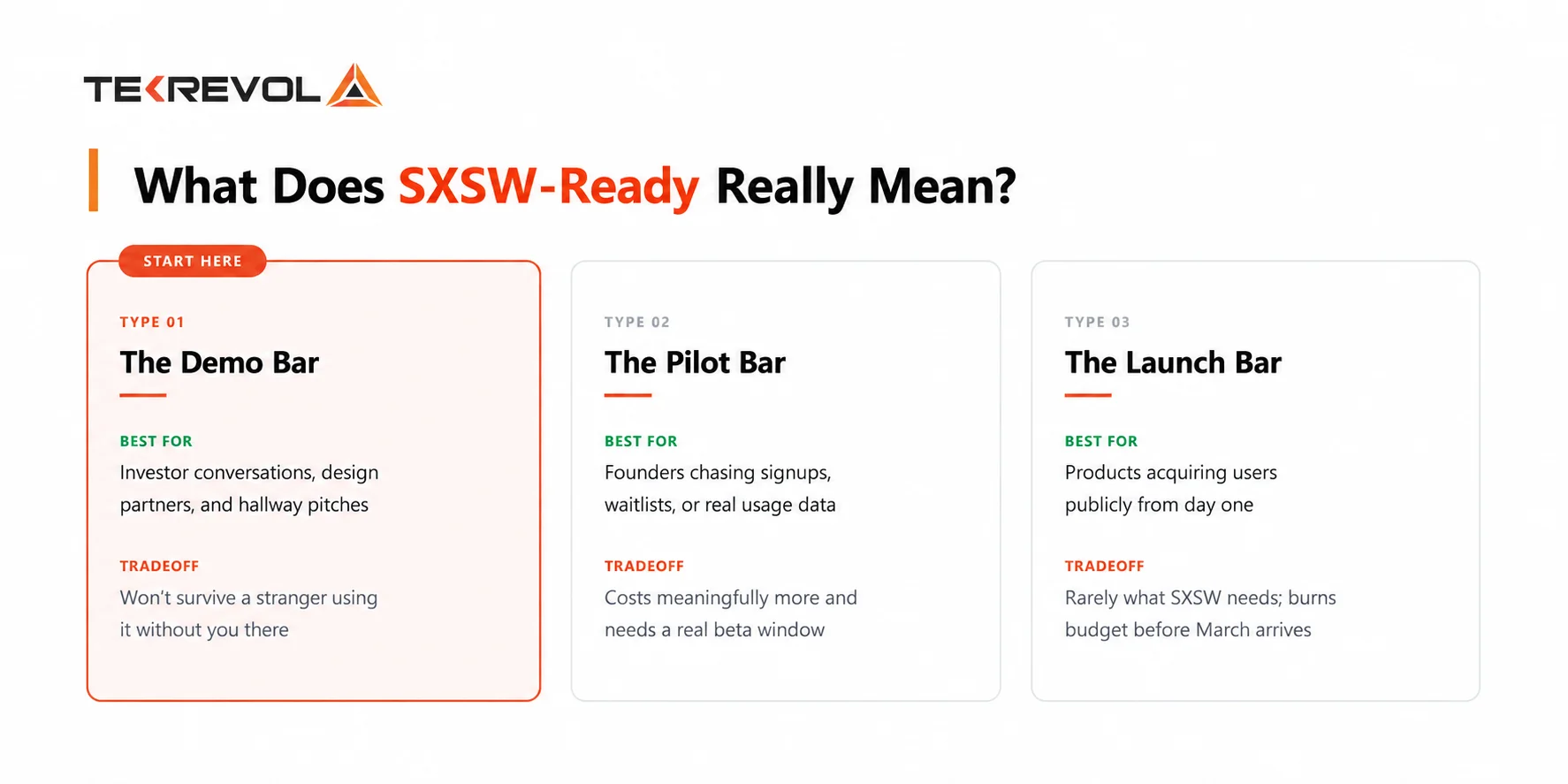
Here’s what each level actually looks like.
- Demo-ready is your product working reliably on your device, with your data, in your hands. It doesn’t need to survive a stranger or sit in an app store. If your goal in March is conversations, press, and investor interest, this is genuinely enough, and plenty of founders have raised considerably less.
- Pilot-ready means someone you’ve never met can finish the core task without you narrating. It handles real data. It recovers when someone taps the wrong thing. This is your bar if you’re chasing signups, a waitlist, or design partners.
- Launch-ready is the whole thing. Public, in the store, supported, with analytics running. Honestly? That’s rarely the right bar for SXSW. Chasing it is the fastest way we’ve seen a budget disappear before anyone gets to March.
Here’s the trap: nobody picks Bar 3. You start at Bar 1 in September, and by December someone’s said “well, if people are going to see it…” and now you’re funding Bar 3 on a Bar 1 budget.
So write your bar down, put a date on it, and defend it in every meeting that follows.
Not Sure Which Bar Your SXSW Goal Actually Needs?
Talk to our Austin team, and we'll scope your MVP around your real objective, not a generic feature list.
Get a Free MVP ConsultationWhen is the Deadline for an SXSW 2027 MVP?
November 13, 2026, if you’re applying to SXSW Pitch.
SXSW runs March 15–21, 2027, but the pitch competition closes four months earlier. Early Bird entry ends September 13, 2026, at $105, then the fee climbs to $225. SXSW EDU’s Launch competition shuts even sooner, on November 1. Those dates come straight from SXSW’s own Pitch page, and they reshape the whole plan.
Here’s how we’d actually work the calendar:
| Date | What happens | What you need ready |
| Aug 18, 2026 | SXSW 2027 badges go on sale | Buy one. It makes the deadline real |
| Sept 13, 2026 | Pitch Early Bird closes ($105) | Working prototype, clear category fit |
| Nov 1, 2026 | SXSW EDU Launch final deadline | Education startups only |
| Nov 13, 2026 | Pitch final deadline ($225) | A demo you’d show an investor |
| Jan 2027 | Finalists notified | Beta feedback in hand |
| Feb 2027 | Feature freeze, rehearse | Stop building. Seriously |
| Mar 15–21, 2027 | SXSW 2027, downtown Austin | You’re demoing, not debugging |
A few eligibility details worth knowing before you spend the fee.
- SXSW Pitch is in its 19th year and runs across eight categories for 2027.
- Your company can’t have raised more than $10 million. Founders have to still own part of it.
- You can only be a finalist in one SXSW competition, so applying to all three doesn’t triple your odds.
How Much Does MVP Development Cost in Austin in 2026?
Between $15,000 and $250,000, driven almost entirely by scope. Most startup MVPs land in the $40,000 to $100,000 band. A no-code validation build can come in under $20,000. Being in Austin barely moves the number, but your scope moves it enormously.
That picture is consistent across 2026 pricing guides published by development agencies.
| Build type | Typical 2026 cost | Timeline | Right for you if… |
| No-code validation | $5,000–$20,000 | 3–8 weeks | You need to know if anyone wants it |
| Lean web MVP, one workflow | $15,000–$40,000 | 2–4 months | You’re building B2B or SaaS |
| Standard web MVP | $40,000–$80,000 | 3–5 months | You need real users and real data |
| Cross-platform mobile MVP | $60,000–$120,000 | 4–6 months | Mobile is core to the value |
| AI-enabled MVP | $75,000–$150,000+ | 5–8 months | A model is the product |
| Compliance-heavy build | $120,000–$250,000+ | 6–12 months | Health, financial, regulated data |
Not Sure Which Budget Band Your Idea Falls Into?
Send us your idea, and we'll provide an itemized MVP estimate within 48 hours.
Book a Free Strategy SessionWhat Factors Actually Move Your MVP Austin Budget
Four multipliers move these numbers reliably:
Platform Choice
Web-only is cheapest by a wide margin, and a web app is often all an MVP needs. Adding native iOS and Android typically tacks on $20,000 to $50,000. Going cross-platform instead usually lands 30–40% under building both natively. For most consumer MVPs headed to SXSW, that’s the call we’d make.
Integrations
One or two well-documented APIs are fine. Legacy systems and undocumented partner APIs are where budgets quietly detonate. Test every outside dependency in week two, not week twenty.
Data sensitivity
Health, money, or identity data brings obligations you can’t defer or fake. If you’re building fintech, our Austin fintech cost and compliance guide breaks that overhead down properly.
AI Features
Model work, training data, and evaluation add real cost and real time. Our AI development team scopes these separately for a reason an AI MVP is different.
The Hidden Cost Founders Forget
Maintenance runs 15–25% of your build cost every year. Hosting, third-party tools, bug fixes, small iterations. It’s not optional, and it starts the week you launch.
How Long Does MVP Development Take in Austin?
Roughly six to ten weeks for a simple MVP, ten to sixteen for mid-complexity, and sixteen to twenty-four for anything AI-driven or compliance-heavy. Those are 2026 benchmarks.
The build itself is rarely what runs long; discovery and validation are, and founders under-budget both.
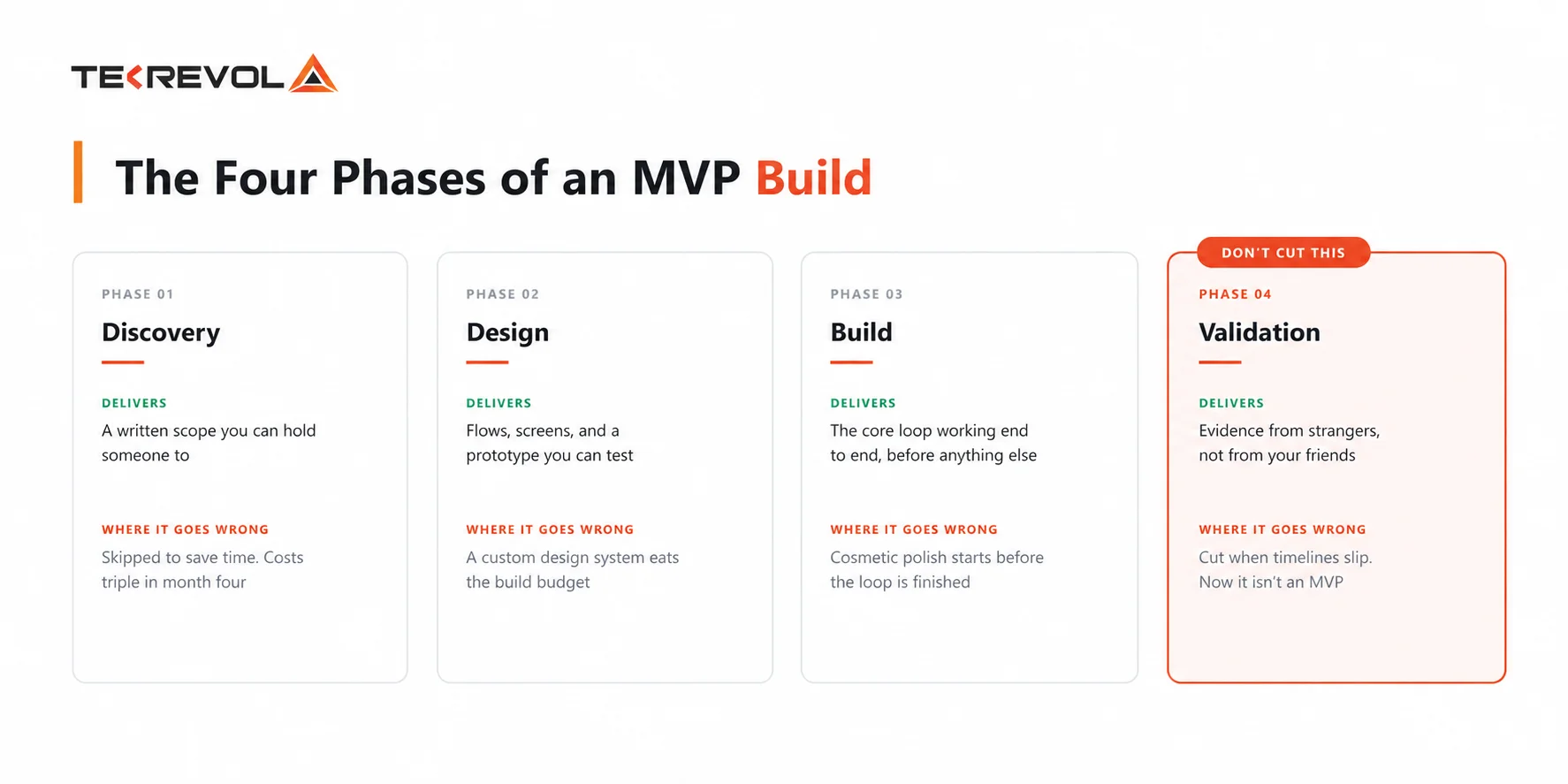
- Discovery is where you decide what you’re not building. Skipping it doesn’t save time. It just moves the same arguments into the build phase, where they cost three times more.
- Design covers flows, interface, and a prototype you can test before anyone writes production code. This phase compresses well if you use proven components.
- Build is the predictable part, precisely because the first two phases removed the guesswork.
- Validation is people using it. And this is the phase that gets deleted when things slip, which is a shame, because it’s the entire reason you built an MVP instead of a product.
Want the mechanics of each phase? We’ve written that up separately in our guide on how to build an MVP.
Why is Early-stage Money in Austin Tighter than the Headlines Suggest?
Because the capital is real but heavily concentrated. Austin startups raised $5.0 billion in the first half of 2026, tracking toward roughly $9.9 billion for the year, according to Dealroom’s Austin.
The catch: 79% went into rounds of $100 million or more, and only 6% landed in rounds under $15 million.
What that means: when early-stage capital is this concentrated, your MVP can’t just be a nice demo. It has to be evidence. Screenshots don’t move anyone. Twenty real users doing the core thing repeatedly does.
What Should You Cut From Your MVP before November?
Almost everything that isn’t the core loop. Admin dashboards, settings screens, onboarding tours, password recovery, and analytics can all wait. Cut anything a judge or investor won’t see in a four-minute demo. Every feature you keep costs time you don’t have and money better spent on validation.
The cuts we’d argue for first, roughly in order:
- Custom design systems. Use a component library. Rebuild the brand after March.
- A second platform. Pick web, iOS, or Android. One. Ship it well.
- Admin tooling. You can manage a hundred users in a spreadsheet. Genuinely.
- Edge cases. Get the happy path right first.
- Native features you don’t need. Camera, offline, push only if the product breaks without them.
What we’d never cut: authentication that actually works, your genuine differentiator, and enough error handling that the demo doesn’t crash on stage in front of everyone.
Scope creep dressed up as feedback. In our experience, four out of five missed deadlines trace back to scoping rather than engineering. That’s our observation across projects, not a published statistic.
Should You Hire in-house, Go freelance, or Work With an MVP Development Company in Austin?
Depends what you’re short on. In-house gives you control, but you’ll spend two months hiring before anyone writes code. Freelancers start fast and cost less, with real continuity risk. An MVP app development company gives you a full team immediately at a higher hourly rate.
| In-house team | Freelancers | Development company | No-code | |
| Time to start | 6–10 weeks | Days | 1–2 weeks | Same day |
| Relative cost | Highest total | Lowest hourly | Mid-to-high | Lowest |
| Continuity risk | Low | High | Low | N/A |
| Product judgment included | Depends on hires | Rarely | Usually | No |
| Handles compliance | If you hire for it | Rarely | Usually | No |
| Realistic ceiling | Anything | Well-scoped features | Anything | Simple logic only |
| Best when… | You’re funded, building a company | Scope is small and settled | You need it by November | You’re testing demand |
A few honest notes on that table.
You don’t have to pick a corner. Plenty of Austin founders bring in staff augmentation to add senior engineers to a small in-house team, which keeps control without the hiring cycle.
Others hand the whole first build to a startup app development team, then bring maintenance in-house after March once they know what they’ve got.
How Do You Pick an MVP Development Company in Austin?
Find out whether they’ll tell you no. The right MVP development companies for startups cut your scope, flag the integration that’ll wreck your timeline, and push back when you add features in month three.
The wrong one builds everything you ask for and invoices you. Ask what they’d remove from your list.
Questions worth asking any partner, including us:
- What would you cut from this scope? “Nothing, we can do it all” is a sales answer. Walk.
- Who owns the code? You should, in writing, before work starts. Repo access day one.
- Have you shipped in my category? Not “we do apps.” A specific comparable project.
- What if we’re behind in January? A real answer isn’t “we’ll add people.”
- Can you show work in my budget range? Good reality check on whether your number is plausible.
Why Choose TekRevol for MVP Development in Austin?
Austin startups choose TekRevol because we’re actually here, we build to fixed dates, and we’ll tell you what to cut before we tell you what it costs. Our Austin app development team works alongside our other US offices, and MVP work is a core part of what we do.
Our Expertise
Company-wide, we’ve delivered 800+ projects for 800+ clients across 11+ industries with an app development team of 500+. We hold 4.8 on Clutch, 4.8 on RightFirms, and 5.0 on GoodFirms.
Those are company-wide numbers, not Austin-only ones. We’d rather say that plainly than dress up a local figure we haven’t measured.
How We Scope an MVP
We start with what to remove. Discovery produces a written scope you can hold us to. Design leans on proven components unless your brand genuinely needs more, and the build sequences the core loop first so the thing that matters works.
If March is your target, we’ll also tell you honestly when it doesn’t fit. That conversation is free, and it’s better to have it in July than in January.
Ready to Scope Your MVP Against an SXSW Deadline?
Talk to TekRevol's Austin team and get an itemized MVP estimate within 48 hours.
Book a Free Consultation


